


President Ma Ying-jeou (馬英九) yesterday made a stopover in Mumbai, India, en route to Africa, becoming the first Taiwanese president to make a transit stop in the South Asian giant.
The stop in Mumbai came as a surprise because the itinerary the Ministry of Foreign Affairs had released showed that Ma would make a stopover in Dubai.
Minister of Foreign Affairs Timothy Yang (楊進添), who is accompanying Ma on the 12-day trip to three of Taiwan’s African diplomatic allies, said the ministry did not announce the stopover until the last minute because of the sensitivity of the issue.
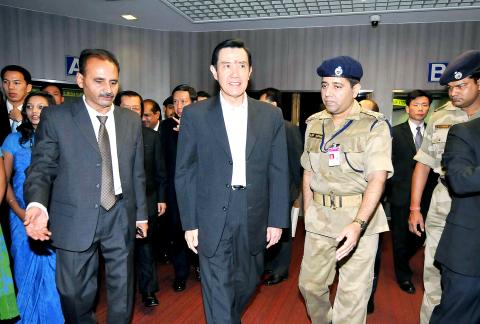
Photo: CNA
Ma’s plane landed yesterday morning at Chhatrapati Shivaji International Airport in Mumbai for refueling, and Ma was greeted at the airport by Taiwanese representative to India Philip Ong (翁文祺), officials of Taiwan’s representative office in India and local government officials.
During the 85-minute stopover, Ma stayed in the airport’s VIP lounge and did not meet any government officials from India, the ministry said.
Ma yesterday thanked both India and the United Arab Emirates for agreeing to the stopovers and said their purpose was for refueling.
“There were other countries that also agreed to let us make transit stops, and we cherish the diplomatic achievements,” he said.
Yang said India agreed to the stopover because of the Ma administration’s record of keeping its promises and as a result of Taiwan’s diplomatic efforts over the past three years.
He denied that pressure from China was behind the last-minute announcement of the stopover in Mumbai.
Yang said the ministry had contacted several other countries before choosing Mumbai as the refueling stop.
“All of them responded positively,” he said.
However, he declined to name which countries had agreed to stopovers, saying that anonymity was part of the agreement.
Ma and his delegation will visit Burkina Faso, the Gambia and Swaziland during his first trip to Africa since taking office in 2008.
A scheduled visit to Sao Tome and Principe was canceled because Ma’s visit coincided with Sao Tomean President Manuel Pinto da Costa’s visit to Cuba, raising concerns about the stability of diplomatic ties between the two countries.
The trip to Africa marked Ma’s sixth official trip overseas since 2008. He has made stopovers in the US during his previous five foreign trips.
He visited India in 2007 shortly after announcing his presidential bid.

The National Chungshan Institute of Science and Technology yesterday showcased its locally developed variants of the Vision 60 robotic patrol dog, which it plans to deploy on the nation’s outlying territories in the South China Sea. The variants were produced under the Joint Lab project — created by the institute and domestic companies — and assembled with domestically produced motors, lenses and artificial intelligence (AI) systems alongside licensed tech from the US, Missile and Rocket Systems Research Division deputy director Jen Kuo-kang (任國光) told the media event at a military base in Taipei’s Dazhi (大直) area. Taiwan has built up its strengths

RIGHT DIRECTION: Taiwan’s efforts to prevent forced labor include a proposal to ‘fully prohibit’ employers from withholding workers’ documents, an official said Taiwan is to establish a mechanism to restrict imports of goods linked to forced labor, the Executive Yuan said yesterday, after the US proposed imposing additional tariffs on Taiwanese goods over labor concerns. “The Ministry of Labor and the Ministry of Economic Affairs are to establish an interministerial review procedure,” Executive Yuan spokesperson Michelle Lee (李慧芝) said at a news briefing in Taipei. “The government is to use the Foreign Trade Act [貿易法] as the legal basis to restrict imports of goods produced with forced labor” and bring its supply chain governance more in line with international standards on human rights, resilience

NOT IMMEDIATE: Taiwan has a chance to appeal the proposed 10 percent tariff before it starts, while other countries face a 12.5 percent tariff from the trade office Taiwan is among 60 economies determined by the US to have failed to impose or enforce a ban on the importation of goods produced with forced labor, according to a notice released on Tuesday by the Office of the US Trade Representative (USTR), which proposed imposing an additional 10 percent or more tariff on them. The USTR in a statement said that following an investigation, it had determined under Section 301 of the Trade Act of 1974 that the failure of the 60 economies to impose and effectively enforce a prohibition on the importation of goods produced with forced labor is

TIT-FOR-TAT: The US allegedly revoked the visa of a Chinese national working at Xinhua News Agency in the US in response to Beijing’s expulsion of Vivian Wang The Presidential Office yesterday condemned China for expelling a New York Times correspondent from Beijing following the newspaper’s interview with President William Lai (賴清德), saying the move highlighted Beijing’s suppression of press freedom and its threat to international news media. Taiwan has noted a series of recent incidents in which Beijing used similar tactics to “threaten and pressure international media outlets and journalists,” Presidential Office spokeswoman Karen Kuo (郭雅慧) said in a statement. “This concerns not only press freedom and freedom of expression, but also the safety of journalists, and Taiwan and relevant partners are paying close attention to the situation,” she


 RSS
RSS