


President Ma Ying-jeou (馬英九) embarked on a 12-day trip to Africa last night, visiting three ally nations in the continent for the first time since taking office in 2008.
Ma will visit Burkina Faso, Gambia and Swaziland.
However, his scheduled visit to Sao Tome and Principe was canceled because the ally nation said Ma’s visit coincided with Sao Tomean President Manuel Pinto da Costa’s visit to Cuba, raising concerns about the stability of diplomatic ties between the two countries.
The African tour marks Ma’s sixth foreign trip since becoming president. The last time a Taiwanese head of state visited the continent was when former president Chen Shui-bian (陳水扁) visited the four African allies in 2002.
The delegation includes adviser to the president Steve Chan (詹啟賢), Minister of Foreign Affairs Timothy Yang (楊進添) and Council of Labor Affairs Minister Jennifer Wang (王如玄).
Ma’s trip comes amid domestic disputes over a series of controversial policies, from US beef imports and avian flu to the tax system and the removal of a freeze on fuel price increases.
Saying that Taiwan, under Ma’s governance, has become a subsidiary of China, opposition lawmakers called into question the timing of the overseas trip, characterizing it as Ma’s attempt to escape various controversies, such as the issue of the “one country, two areas (一國兩區)” proposal by former Chinese Nationalist Party (KMT) chairman Wu Poh-hsiung (吳伯雄), rising commodity prices and the planned relaxation of a ban on beef products containing ractopamine residue.
Presidential Office spokesman Fan Chiang Tai-chi (范姜泰基) -responded by saying the trip had been arranged some time ago, and that, as the nation’s leader, the president should take into consideration both domestic policy and diplomacy, adding that visiting African allies was part of efforts to deepen the nation’s diplomatic ties.
Consolidating diplomatic ties and expanding the nation’s international space did not conflict with handling national matters, he said.
The president trusts Premier Sean Chen (陳冲) to handle ongoing issues and to solve any -problems that arise, Fan Chiang added.
Ma visited Central and South America in 2009, and was originally scheduled to visit the four African allies in March last year, but the trip was postponed after the earthquake and tsunami in Japan and mass protests in North Africa.
During the 12-day trip, Ma will visit hospitals, schools and factories that Taiwan has helped build and inspect cooperative projects in agriculture, medicine and education. He will also meet with Taiwanese businesspeople in the area.
Additional reporting by Tseng Wei-chen

‘NO SECURITY RISK’: The Railway Bureau reassured the public that the technicians’ activities were limited to technical guidance and did not involve sensitive systems The Railway Bureau yesterday said it had invited eight Chinese technicians to assist with an airport MRT construction project. The bureau issued the confirmation after an Internet user said Chinese nationals had entered the construction zone of Taiwan Taoyuan International Airport’s Terminal 3 project. They asked why “individuals from an enemy state” were allowed access to such a major national infrastructure project, which raised serious concerns over Taiwan’s industrial safety, sensitive systems and information security. The bureau’s Northern Region Engineering Branch Office said subcontractor Taiwan Handle Industrial Co (台灣手把工業) of the Taoyuan airport MRT’s “Contract No. CU05 Project A14 Station Civil, MEP &

A US uncrewed surface vessel (USV) encountered multiple Chinese warships during an autonomous transit of the Taiwan Strait, US defense company Seasats said in a statement on Wednesday. Seasats announced that a Lightfish USV had completed the first autonomous transit of the Taiwan Strait. Over five days, the USV traversed the entire length of the Strait while constantly monitoring surface vessel traffic, the company said. The Lightfish encountered multiple Chinese warships, one of which was a Chinese People’s Liberation Army Navy (PLAN) Type 056 corvette, it said. The Chinese vessels were operating “well within Taiwan’s exclusive economic zone without transmitting their identity via the
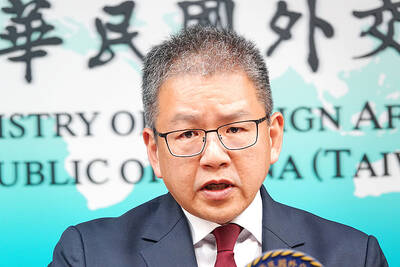
Taiwan is still in the process of assessing the possibility of recruiting workers from Eswatini, the Ministry of Foreign Affairs said yesterday, adding that its goal is to help Eswatini upgrade its vocational training centers. If there are plans to recruit workers from Eswatini, safeguarding national security, protecting public health and ensuring the employment rights of Taiwanese would be prerequisites, Department of West Asian and African Affairs Director-General Yen Chia-liang (顏嘉良) told a news conference. Key considerations would also include filling labor shortages in specific industries, and fostering bilateral professional and technical exchanges, he said. Yen was asked about the progress of labor
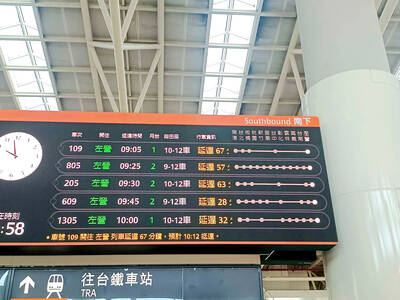
The nation’s usually punctual high-speed rail system yesterday was hit by major disruptions after all scheduled services were canceled and replaced with three hourly trains offering only non-reserved seating, affecting more than 200,000 passengers. Preliminary findings indicate the disruption was caused by a faulty power module in a track switch control cabinet, Taiwan High-Speed Rail Corp (THSRC) said, adding that as a full system inspection could only be conducted after operations end for the day, a decision on whether normal service would resume today would be announced before the first train departs. During a routine inspection early yesterday, a switch signal abnormality


 RSS
RSS