


Academics yesterday urged President Ma Ying-jeou (馬英九) to prioritize cooperation with opposition parties on foreign affairs in his second term, to better manage the challenge presented by China’s continued efforts to prevent the nation from participating in the international community, escalating calls from various parties in the US to abandon Taiwan and domestic opposition to trade liberalization.
Taipei Forum, a think tank led by former National Security Council secretary-general Su Chi (蘇起), which is touted as bipartisan, yesterday published its policy recommendations on diplomacy.
Presenting the recommendations at a symposium, National Taiwan University vice president Bau Tzong-ho (包宗和) said Taipei had to heed the increased calls for the US to abandon Taiwan in return for closer relations with Beijing.
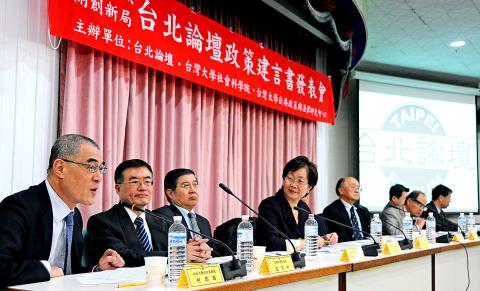
Photo: Liu Hsin-de, Taipei Times
It was a “warning sign” and Taiwan “has to remain vigilant” because cross-strait rapprochement could increase US worries over its cooperation with Taiwan in the military and intelligence fields and raise questions about the need for the US to continue to support Taiwan, he said.
Taiwan should ensure that the US understands that its moves to increase contacts with China “have nothing to do with unification” and its efforts to improve cross-strait relations should take place “with the understanding of the US” to ensure the idea of abandoning Taiwan gains no traction, Bao said.
“We have to enhance our friendship with the US based on Taiwan’s freedom, democratic achievements and common values, present more convincing arguments to persuade the US to sell us arms and make cross-strait interactions as transparent as possible to ensure mutual trust,” he said.
Joanne Chang (裘兆琳), a research fellow at the Institute of European and American Studies at Academia Sinica, said China had not reduced its efforts to suppress Taiwan’s efforts to expand its international participation, even though the Ma administration had adopted flexible diplomacy to adjust to its cross-strait policies.
On occasion, “the suppression has even intensified,” she said.
The academics said China has obstructed Taiwan’s cooperation with the international community, tried to downgrade its participation in some non-government organizations in terms of its name and status, and actively built up its economic and trade relations with Taiwan’s diplomatic allies.
“We have also learned that Taiwan still encounters obstacles erected by Beijing in its attempts to negotiate free-trade agreements with [other countries],” Bao said.
The academics made several suggestions to counter China’s efforts to contain Taiwan: Establish a mechanism to respond to any Chinese attempts to reduce Taiwan’s international space; dispel the misunderstanding that UN Resolution 2758 “states that China has sovereignty over Taiwan”; and negotiate with China and the US to expand Taiwan’s international participation.
Chang said these were challenges faced by the whole country and not just certain political parties.
“Ruling and opposition parties should refrain from recrimination and move toward cooperation in dealing with these challenges,” she said.
To forge a joint stance on matters of diplomacy, the Chinese Nationalist Party (KMT) must be receptive to suggestions and -criticism from opposition parties, instead of blaming the former administration for everything, Chang said.
National Chengchi University political science professor Ho Szu-yin (何思因) highlighted the importance of economic aspects of diplomatic activities in terms of foreign aid and engagements in bilateral and regional economic integration.
Instead of just providing aid, Taiwan could make good use of its achievements in technology and democracy to advance soft diplomacy in various areas, such as technology, disaster relief and human rights, thereby cultivating its reputation as “a responsible stakeholder,” they said.
The academics also said the government should develop ways to minimize political pressure from vested interests when negotiating free-trade agreements with other countries, an issue which is inseparable from the opening of the agricultural market.
One possibility would be for the government to consult more thoroughly with the legislature and obtain its consent before negotiations start. The legislature would then agree to not draft amendments to override clauses in negotiated deals, but instead only approve or reject such deals, Ho said.

‘NO SECURITY RISK’: The Railway Bureau reassured the public that the technicians’ activities were limited to technical guidance and did not involve sensitive systems The Railway Bureau yesterday said it had invited eight Chinese technicians to assist with an airport MRT construction project. The bureau issued the confirmation after an Internet user said Chinese nationals had entered the construction zone of Taiwan Taoyuan International Airport’s Terminal 3 project. They asked why “individuals from an enemy state” were allowed access to such a major national infrastructure project, which raised serious concerns over Taiwan’s industrial safety, sensitive systems and information security. The bureau’s Northern Region Engineering Branch Office said subcontractor Taiwan Handle Industrial Co (台灣手把工業) of the Taoyuan airport MRT’s “Contract No. CU05 Project A14 Station Civil, MEP &

A US uncrewed surface vessel (USV) encountered multiple Chinese warships during an autonomous transit of the Taiwan Strait, US defense company Seasats said in a statement on Wednesday. Seasats announced that a Lightfish USV had completed the first autonomous transit of the Taiwan Strait. Over five days, the USV traversed the entire length of the Strait while constantly monitoring surface vessel traffic, the company said. The Lightfish encountered multiple Chinese warships, one of which was a Chinese People’s Liberation Army Navy (PLAN) Type 056 corvette, it said. The Chinese vessels were operating “well within Taiwan’s exclusive economic zone without transmitting their identity via the
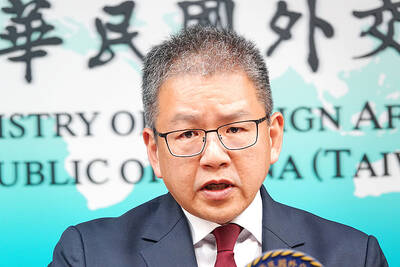
Taiwan is still in the process of assessing the possibility of recruiting workers from Eswatini, the Ministry of Foreign Affairs said yesterday, adding that its goal is to help Eswatini upgrade its vocational training centers. If there are plans to recruit workers from Eswatini, safeguarding national security, protecting public health and ensuring the employment rights of Taiwanese would be prerequisites, Department of West Asian and African Affairs Director-General Yen Chia-liang (顏嘉良) told a news conference. Key considerations would also include filling labor shortages in specific industries, and fostering bilateral professional and technical exchanges, he said. Yen was asked about the progress of labor
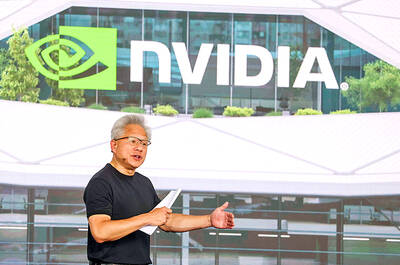
‘BOOMING’: ’ The number of partners we have here is incredible. You can see from their stock prices. They’re doing so well, they’re so happy,’ Jensen Huang said Nvidia Corp’s spending in Taiwan has ballooned to about US$150 billion a year, 10 times the US$10 billion to US$15 billion the company spent five years ago, Nvidia chief executive officer Jensen Huang (黃仁勳) said yesterday, suggesting Taiwan’s strategic importance in the global artificial intelligence (AI) supply chain. “Taiwan is the epicenter of the AI revolution. This is where the chips come, packaging comes. This is where the systems are made. This is where AI supercomputers were created,” Huang said at a meeting for the company’s employees in Beitou-Shilin Technology Park (北投士林科技園區) in Taipei, the planned site of Nvidia’s Taipei headquarters. “Taiwan


 RSS
RSS