


Chinese Premier Wen Jiabao (溫家寶) yesterday cut the Asian giant’s growth target to 7.5 percent for this year in a key annual speech focused on economic expansion, stability and military might ahead of a leadership change.
Wen, who will step down as prime minister next year, said China faced “many difficulties and challenges” as he delivered his opening address to the annual session of the National People’s Congress (NPC).
Wen also said China’s military needed to be better prepared to fight “local wars,” a day after the Asian powerhouse announced its defense spending would top US$100 billion this year — an 11.2 percent increase on last year.
He said China should enhance the ability of its military to “win local wars under information age conditions,” amid concern about Beijing’s growing assertiveness over its territorial claims.
China’s military budget has seen double-digit increases every year for much of the last decade, worrying other countries in the region as well as the US, which is expanding its own military power in Asia.
This year’s NPC session is the last before a handover of power that begins later this year, and leaders are anxious to ensure the world’s second-largest economy grows at a steady pace, while keeping a lid on social unrest.
The lower growth target, down from 8 percent last year, is an official acknowledgment that China’s export-driven economy is slowing as Europe’s debt crisis and the sluggish recovery in the US hurt demand for its goods.
China’s economy expanded by 9.2 percent last year, slowing from a blistering 10.4 percent in 2010, as global turbulence and efforts to tame high inflation put the brakes on growth.
“We are keenly aware that China still faces many difficulties and challenges in economic and social development,” Wen said in his annual speech at the opening of the 10-day gathering in Beijing’s Great Hall of the People. “There is downward pressure on economic growth. Prices remain high. Regulation of the real estate market is in a crucial stage.”
Expanding domestic demand was a key focus this year, Wen said, announcing increased investment in low-cost housing, social security, education and higher wages as Beijing seeks to reverse “the trend of a widening income gap.”
China typically exceeds the annual growth target unveiled every March and most economists are predicting GDP growth between 8 percent and 8.5 percent this year.
Wen vowed to maintain property restrictions introduced in the past two years to rein in surging real estate prices that had risen out of the reach of many ordinary Chinese.
The inflation target was set at 4 percent for this year, unchanged from last year, after consumer prices rose 5.4 percent last year, causing concern about the prospect of social unrest.
Wen also highlighted the sensitive issue of government land grabs, a major cause of public unrest in China, where almost 50 percent of the population still lives in the countryside.
Speaking a day after landmark elections in the southern village of Wukan, where a revolt last year put the growing public anger over land seizures in the spotlight, Wen said farmers’ rights to land “must not be violated.”
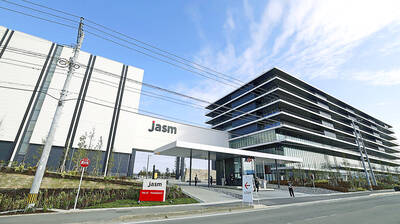
The subsidiary of Taiwan Semiconductor Manufacturing Co (TSMC, 台積電) in Kumamoto, Japan, turned a profit in the first quarter of this year, marking the first time the first fab of the unit has become profitable since mass production started at the end of 2024. According to the contract chipmaker’s financial statement released on Friday, Japan Advanced Semiconductor Manufacturing Inc (JASM), a joint venture running the fab in Kumamoto, posted NT$951 million (US$30.19 million) in profit in the January-to-March period, compared with a loss of NT$1.39 billion in the previous quarter, and a loss of NT$3.25 billion in the first quarter of
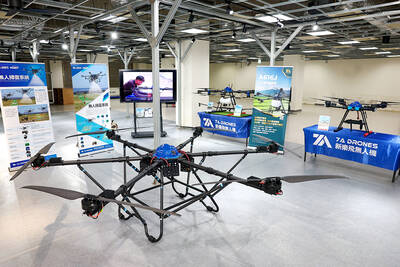
DRONE CENTRAL: Taiwan aims to become Asia’s democratic hub for drones, with most exports focused on high-quality military-grade models, an official said Taiwan’s drone industry is expected to expand significantly by 2030, producing 100,000 units per month and exporting half of them, the Ministry of Economic Affairs said yesterday. Current drone production capacity is about 15,000 units per month, but the industry can quickly scale up as demand increases, Industrial Development Administration Director-General Chiou Chyou-huey (邱求慧) told a news conference in Taipei. Taiwan’s drone output grew 2.5-fold last year to NT$12.9 billion (US$408.3 million) under a government program to develop the uncrewed vehicle sector, he said. The Executive Yuan in October last year approved plans to invest NT$44.2 billion into domestic production of uncrewed aerial
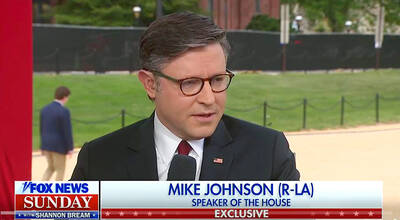
RESOLUTE BACKING: Two Republican senators are planning to introduce legislation that would impose immediate sanctions on China if it attempts to invade Taiwan US House of Representatives Speaker Mike Johnson on Sunday reaffirmed US congressional support for Taiwan, saying the US and “all freedom-loving people” have a stake in preventing China from seizing Taiwan by force. Johnson made the remarks in an interview with Fox News Sunday on US President Donald Trump’s summit with Chinese President Xi Jinping (習近平) last week. In an interview that aired on Friday on Fox News, just as Trump wrapped up a high-stakes visit to China, he said he has yet to green-light a new US$14 billion arms package to Taiwan and that it “depends on China.” “It’s a very good
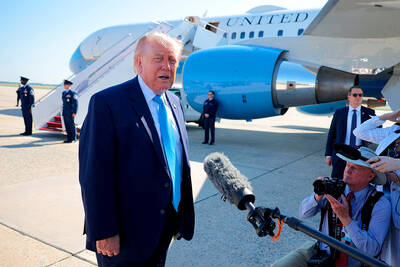
US President Donald Trump yesterday said he would speak to President William Lai (賴清德) as his administration considers whether to move ahead with a US$14 billion weapons sale to Taiwan — a potential arms deal that has drawn criticism from China. “Well, I’ll speak to him. I speak to everybody,” Trump told reporters yesterday when asked if he had any plans to call his counterpart, although he did not offer a time frame for when such a conversation could take place. Trump previously said he would speak to the person “that’s running Taiwan,” without specifying who he meant. “We have that situation very


 RSS
RSS