


Western and Arab nations were set to demand yesterday that Syria allow aid to be delivered to desperate civilians in the absence of any international resolve to intervene to end a crackdown on a near year-old revolt against Syrian President Bashar al-Assad.
Foreign ministers from more than 50 countries were in Tunis for the first meeting of the “Friends of Syria” group, against the backdrop of a surge in government attacks on the city of Homs and mounting world outrage over violence that has claimed thousands of lives during the uprising.
In Homs, Syrian government artillery fire killed five people in the city’s Baba Amro district, opposition activists said, as the bombardment of opposition-held neighborhoods entered its third week yesterday.
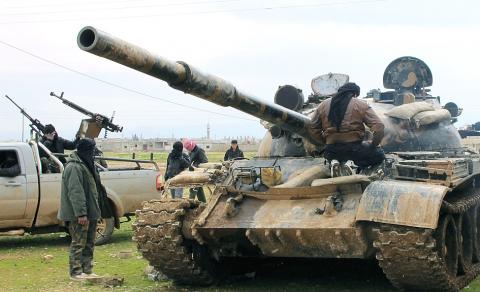
Photo: Reuters
“Baba Amro is being hit with 122mm artillery directed at it from surrounding villages. A father and his 14-year-old son were among those killed. They were trying to flee the shelling when shrapnel hit them in the street,” Mohammad al-Homsi said.
US Secretary of State Hillary Rodham Clinton has warned that Syria’s opposition would ultimately arm itself and go on the offensive if diplomacy failed, but with moves for tough action in the UN Security Council stymied by Russian and Chinese vetoes, and a lack of appetite for military action to end al-Assad’s crackdown, delegates in Tunis had limited options.
German Foreign Minister Guido Westerwelle said: “It is very important that the first contact group is taking place today, because it sends a message to the Syrian people that we support them in their struggle for freedom.”
An updated draft declaration from the meeting called on Syria to “immediately cease all violence” to allow the UN access to Homs and to let agencies deliver aid to civilians affected by the violence.
The “Friends of Syria” pledged, in the latest version of the draft, to deliver humanitarian supplies within 48 hours if Syria’s government “stopped its assault on civilian areas and permitted access.”
In a sign the international community is seeking ways around the Security Council deadlock, UN Secretary-General Ban Ki-moon said he would dispatch former UN chief Kofi Annan to Syria as a joint UN-Arab League envoy.
The draft communique did not mention any foreign military intervention along the lines of the NATO bombing campaign that helped force out former Libyan leader Muammar Qaddafi.
Instead, it called for further diplomatic pressure on al-Assad to step down and endorsed an Arab League plan that sees him handing power to a deputy as a prelude to elections.
Western diplomats said it had not yet been possible to recover the bodies of Marie Colvin, an American working for British newspaper the Sunday Times, and French photographer Remi Ochlik.
Two journalists wounded in the same attack were also awaiting evacuation from Homs, where activists say the army is blocking medical supplies and electricity is cut off for 15 hours a day.
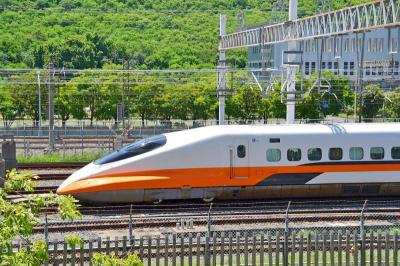
A signaling system malfunction disrupted high-speed rail (HSR) services beginning at 8am today, with trains temporarily reduced to three northbound and three southbound trains per hour as authorities conduct inspections. The malfunction occurred on a section of track in Miaoli County during pre-operation checks early this morning, forcing northbound and southbound trains to use a single track, the HSR operator said. The regular schedule has been replaced with three hourly trains offering only nonreserved seating in each direction, stopping at every station, it said, adding that business class cars would still have reserved seating. Departures from terminal stations are scheduled at the top

DRONE CENTRAL: Taiwan aims to become Asia’s democratic hub for drones, with most exports focused on high-quality military-grade models, an official said Taiwan’s drone industry is expected to expand significantly by 2030, producing 100,000 units per month and exporting half of them, the Ministry of Economic Affairs said yesterday. Current drone production capacity is about 15,000 units per month, but the industry can quickly scale up as demand increases, Industrial Development Administration Director-General Chiou Chyou-huey (邱求慧) told a news conference in Taipei. Taiwan’s drone output grew 2.5-fold last year to NT$12.9 billion (US$408.3 million) under a government program to develop the uncrewed vehicle sector, he said. The Executive Yuan in October last year approved plans to invest NT$44.2 billion into domestic production of uncrewed aerial
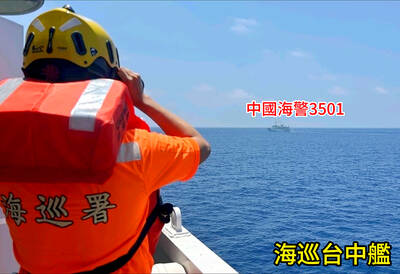
VERBOSE VESSELS: A CGA cutter and a China Coast Guard exchanged verbal barbs for more than a day in Taiwanese-controlled waters before the Chinese vessel left The Taiwanese and Chinese coast guards had a standoff near the strategically located Pratas Islands (Dongsha Islands, 東沙群島) in the north of the South China Sea, the Coast Guard Administration (CGA) said yesterday. The two sides engaged in intense radio exchanges over sovereignty claims during the 33-hour standoff. China Coast Guard vessel 3501 eventually left the restricted waters, 26.6 nautical miles (49.2km) west of the Pratas Islands, at 5pm yesterday, the CGA said. Lying approximately between southern Taiwan and Hong Kong, the Taiwan-controlled Pratas are seen by some security experts as vulnerable to Chinese attack due to their distance — more than
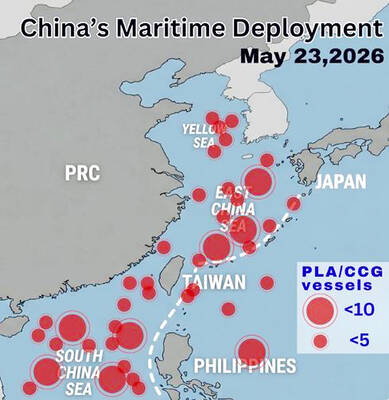
WARNING: China should stop engaging in actions that undermine regional peace and stability, as it would only build resentment among people across the Strait, the CGA said China has deployed more than 100 navy, coast guard and other vessels in waters from the Yellow Sea to the South China Sea and the western Pacific since US President Donald Trump and Chinese President Xi Jinping (習近平) met in Beijing, National Security Council Secretary-General Joseph Wu (吳釗燮) said yesterday. “In this part of the world, #China is the one & only PROBLEM wrecking the #StatusQuo & threatening regional peace & stability,” Wu wrote on X. In a separate post, he said Beijing was coercing Taiwan’s maritime domain, calling it illegal and provocative, after the Coast Guard Administration (CGA) expelled a


 RSS
RSS