


The government yesterday dismissed concerns over possible changes in the US’ policy on cross-strait relations after a Chinese press release said that US President Barack Obama “rejects” any call for Taiwan’s independence.
The press release, issued on Wednesday in Washington by the Chinese delegation led by Chinese Vice President Xi Jinping (習近平), China’s likely next leader, appeared to show that the US had changed its wording regarding its stance on Taiwan’s independence from “not support,” to “reject.”
The Ministry of Foreign Affairs was unable to verify whether Obama had changed his wording in response to calls from Xi that the US should “take concrete actions to oppose Taiwanese independence,” but it was confident that Washington had kept its policy stance consistent regarding cross-strait affairs.
Xi, held talks with Obama, US Vice President Joe Biden and US Secretary of State Hillary Rodham Clinton on Wednesday.
During the three meetings, the Taiwan issue was brought up by the Chinese side, said Bruce Ling-hu (令狐榮達), director-general of the Department of North American Affairs.
Linghu said that while Washington has not yet briefed Taipei on the content of discussions regarding the Taiwan issue, it was expected that the US had responded to China’s concerns in accordance with the overarching principles that apply to its cross-strait policies.
“We don’t think the US offered any responses that we did not expect,” he said, adding that Taipei received a thorough briefing from Washington prior to Xi’s visit, during which it provided reassurances that it would maintain a consistent Taiwan policy.
According to Xinhua news agency reports, during the Xi-Obama meeting, the US president reiterated his adherence to the “one China” policy based on the three joint communiques.
According to a Xinhua report on Wednesday, Obama told Xi that the US “rejects any calls for Taiwan independence” and added that his country “wants to see the peaceful development of cross-strait relations move forward.”
Xi said the Taiwan issue concerns China’s sovereignty and territorial integrity, and remains, as always, the most important and most sensitive issue in China-US relations, it reported.
The agency also quoted Xi as saying that Beijing appreciates Washington’s repeated declarations of its commitment to the “one China” policy.
However, the way top US officials responded to Xi on the Taiwan issue was not exactly the same as what was reported by Xinhua, Linghu said.
“We have checked with the US. In response to Xi during the three meetings, the US reiterated its commitments to Taiwan under the Taiwan Relations Act,” Linghu said.
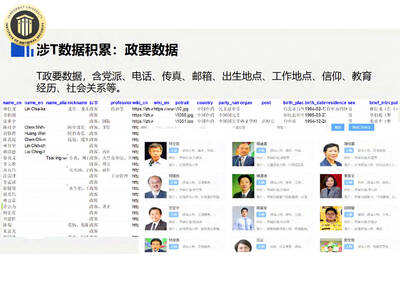
NETWORK-MAPPING PROJECT: The database contains 170 detailed files of Taiwanese politicians and about 23 million records of household registration data in Taiwan China has developed a network-mapping project targeting political figures and parties in Taiwan to monitor public opinion during elections and to craft tailored influence campaigns aimed at dividing Taiwanese society, according to documents leaked by Chinese technology firm GoLaxy (中科天璣). The documents, collected by Taipei-based Doublethink Lab, showed a database was specifically created to gather detailed information on Taiwanese political figures, including their political affiliations, job histories, birthplaces, residences, education, religion and a brief biography about them. Several notable Taiwanese politicians are in the database, including President William Lai (賴清德), former president Tsai Ing-wen (蔡英文), Minister of Foreign Affairs Lin Chia-lung (林佳龍),
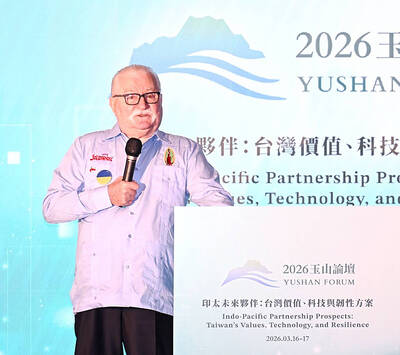
RECOGNITION: Former Fijian prime minister Mahendra Chaudhry said that Taiwan’s New Southbound Policy serves as a stabilizing force in the Indo-Pacific region Taiwan can lead the unification of the Chinese people, Nobel Peace Prize laureate and former Polish president Lech Walesa said in Taipei yesterday, adding that as the world order is changing, peaceful discussion would find good solutions, and that the use of force and coercion would always fail. Walesa made the remarks during his keynote address at a luncheon of the Yushan Forum in Taipei, titled “Indo-Pacific Partnership Prospects: Taiwan’s Values, Technology and Resilience,” organized by the Taiwan-Asia Exchange Foundation with the Ministry of Foreign Affairs. Walesa said that he had been at the forefront of a big peaceful revolution and “if
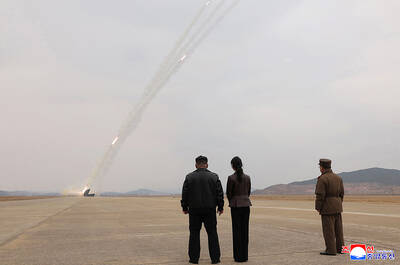
North Korea tested nuclear-capable rocket launchers, state media reported yesterday, a day after Seoul detected the launch of about 10 ballistic missiles. The test comes after South Korean and US forces launched their springtime military drills, due to run until Thursday. North Korean leader Kim Jong-un on Saturday oversaw the testing of the multiple rocket launcher system (MRLS), the Korean Central News Agency (KCNA) said. The test involved 12 600mm-caliber ultra-precision multiple rocket launchers and two artillery companies, it said. Kim said the drill gave Pyongyang’s enemies, within the 420km striking range, a sense of “uneasiness” and “a deep understanding

North Korea yesterday fired about 10 ballistic missiles to the sea toward Japan, the South Korean Joint Chiefs of Staff (JCS) said, days after Pyongyang warned of “terrible consequences” over ongoing South Korea-US military drills. Pyongyang recently dashed hopes of a diplomatic thaw with Seoul, Washington’s security ally, describing its latest peace efforts as a “clumsy, deceptive farce.” Seoul’s military detected “around 10 ballistic missiles launched from the Sunan area in North Korea toward the East Sea [Sea of Japan] at around 1:20pm,” JCS said in a statement, referring to South Korea’s name for the body of water. The missiles


 RSS
RSS