


A 23-year-old man died in an Internet cafe in New Taipei City (新北市) after 10 straight hours of gaming on Tuesday and police said yesterday they were shocked to find complete disinterest from the other gamers in the cafe during their investigation.
According to police, Chen Jung-yu (陳榮宥), who worked at Northern Taoyuan Cable TV as an engineer, had paid for 23 hours at a New Taipei City Internet cafe at 10pm on Tuesday to play World of Warcraft, but died 10 hours later.
The clerk at the Internet cafe said Chen was a frequent customer at the cafe, and had taken the corner seat in the first row after coming into the cafe on Tuesday night, adding that at about 3pm on Wednesday, Chen’s head drooped slightly and his hands were stretched in front of him, touching the keyboard.
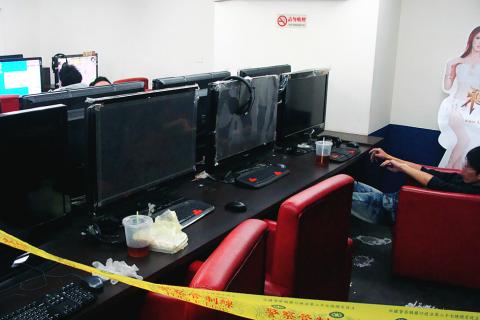
Photo: Cheng Shu-ting, Taipei Times
“I thought that he was only dozing off and paid no particular attention,” the clerk said, adding that when he went to wake Chen up when his 23 hours were up, he saw that his face was blackened and that he was sitting rigidly in the sofa chair.
Seeing Chen’s hands rigidly stretched out in front of him as if he were still gaming when he moved the sofa chair back, the clerk said he called police.
About 10 other players were in the cafe, but said they only knew something had happened after the police started cordoning off the area for forensic sweeps, but to the police officers’ surprise, most either stayed in front of their computers and kept on gaming or took little interest.
A slip for an appointment at National Taiwan University Hospital was found in Chen’s scooter storage space, and the preliminary cause of death is suspected to be organ failure after he stayed up through the night gaming, police said.
The police have asked coroners to perform an autopsy to clarify the cause of death, and they asked Chen’s father to identify the body yesterday.
An initial police investigation found that he might have died of a cardiac arrest triggered by low temperatures.
On the issue of other players in the cafe not paying any attention to someone’s death, National Tsing Hua University Institute of Sociology professor Wang Chin-shou (王俊秀) yesterday said that once people were addicted to games and the Internet, it is easy for them to over-indulge and blur the lines between the virtual and the real world.
Long-time immersion in virtual worlds of killing and violence can cause players to become desensitized to their actual surroundings, Wang said.
Addressing the effect of Internet cafes on health, Paochien Hospital cardiologist Hsieh Pu-lin (謝普霖) said sitting in a cigarette-smoke-filled Internet Cafe can lead to acute vascular obstruction and an irregular heart beat, adding that cramped quarters in Internet cafes were detrimental to circulation, which could lead to minor thrombophlebitis.
If one suddenly stood up in such a situation, a blood clot could rise to the lungs and obstruct breathing, and even in severe instances cause sudden death, he said.
Additional reporting by Hu Ching-hui, Yang Kuo-wen and Hou Chien-chuan
Translated by Jake Chung, Staff Writer

CREDIT-GRABBER: China said its coast guard rescued the crew of a fishing vessel that caught fire, who were actually rescued by a nearby Taiwanese boat and the CGA Maritime search and rescue operations do not have borders, and China should not use a shipwreck to infringe upon Taiwanese sovereignty, the Coast Guard Administration (CGA) said yesterday. The coast guard made the statement in response to the China Coast Guard (CCG) saying it saved a Taiwanese fishing boat. The Chuan Yu No. 6 (全漁6號), a fishing vessel registered in Keelung, on Thursday caught fire and sank in waters northeast of Diaoyutai Islands (釣魚台). The vessel left Keelung’s Badouzih Fishing Harbor (八斗子漁港) at 3:35pm on Sunday last week, with seven people on board — a 62-year-old Taiwanese captain surnamed Chang (張) and six

RISKY BUSINESS: The ‘incentives’ include initiatives that get suspended for no reason, creating uncertainty and resulting in considerable losses for Taiwanese, the MAC said China’s “incentives” failed to sway sentiment in Taiwan, as willingness to work in China hit a record low of 1.6 percent, a Ministry of Labor survey showed. The Directorate-General of Budget, Accounting and Statistics (DGBAS) also reported that the number of Taiwanese workers in China has nearly halved from a peak of 430,000 in 2012 to an estimated 231,000 in 2024. That marked a new low in the proportion of Taiwanese going abroad to work. The ministry’s annual survey on “Labor Life and Employment Status” includes questions respondents’ willingness to seek employment overseas. Willingness to work in China has steadily declined from

The Legislative Yuan’s Finance Committee yesterday approved proposed amendments to the Amusement Tax Act (娛樂稅法) that would abolish taxes on films, cultural activities and competitive sporting events, retaining the fee only for dance halls and golf courses. The proposed changes would set the maximum tax rate for dance halls and golf courses at 50 and 20 percent respectively, with local governments authorized to suspend the levies. Article 2 of the act says that “amusement tax shall be levied on tickets sold or fees charged by amusement places, facilities or activities” in six categories: “Cinema; professional singing, story-telling, dancing, circus, magic show, acrobatics

INFLATION UP? The IMF said CPI would increase to 1.5 percent this year, while the DGBAS projected it would rise to 1.68 percent, with GDP per capita of US$44,181 The IMF projected Taiwan’s real GDP would grow 5.2 percent this year, up from its 2.1 percent outlook in January, despite fears of global economic disruptions sparked by the US-Iran conflict. Taiwan’s consumer price index (CPI) is projected to increase to 1.5 percent, while unemployment would be 3.4 percent, roughly in line with estimates for Asia as a whole, the international body wrote in its Global Economic Outlook Report published in the US on Monday. The figures are comparatively better than the IMF outlook for the rest of the world, which pegged real GDP growth at 3.1 percent, down from 3.3 percent


 RSS
RSS