


About 3 million vehicles hit the roads yesterday on the second day of the Lunar New Year, the day when married daughters return to their parents’ home (Hui Niang Jia), packing several sections of the nation’s highways, the National Freeway Bureau said.
“We estimate that the traffic volume will fall between 2.7 million and 2.9 million vehicle-times,” said Lu Wen-yu (呂文玉), the bureau’s Traffic Management Division vice director, adding that if so, the amount would be 500,000 more than the first day of the Lunar New Year.
The bureau said the first wave of vehicles had been expected to appear from 8am to 12am as some families headed to the homes of wives’ parents, and others headed for amusement parks or recreation areas.
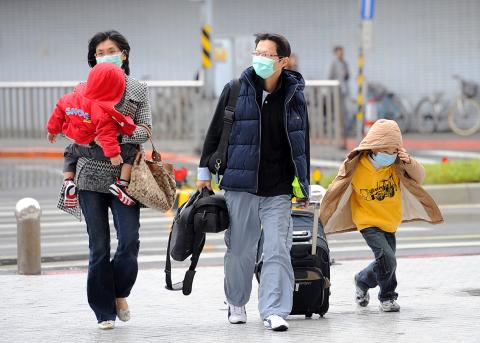
Photo: Luo Pei-der, Taipei Times
Despite the cold, rainy weather in northern Taiwan, vehicles began packing the southbound lanes on the freeways at about 8am, causing average traffic speed to drop to about 30kph at some sections. Traffic congestion between Taoyuan’s Jhongli (中壢) and Neili (內壢), reduced the average speed to as slow as 15kph for a period of time.
Traffic monitoring in the morning showed more cars were heading south, and the congested sections were shortened around midday, the bureau said at noon.
Bureau officials said another wave of cars going north was expected to begin showing up after 3pm.
“We estimate that there will be some waves of cars going north in the afternoon, with sections from Siluo (西螺) to Yuanlin (員林) on Freeway No. 1, from Jhongtou (中投) to Caotun (草屯) on Freeway No. 3, and from Toucheng (頭城) to Pinglin (坪林) Freeway No. 5 being sections that may move slowly,” Traffic Management Division director Hsu Fu-Shen (徐福聲) said.
To ease traffic during the Lunar New Year period, the bureau has implemented toll-free hours between 12am and 7am, and allowed usage of the hard shoulder at more than 20 sections of the freeways.
The bureau estimated that the traffic volume today may even exceed yesterday’s numbers and suggested motorists make use of the toll-free period to get on the freeways before 7am, take alternative roads, or check the online traffic control information before hitting the road, to prevent getting stuck in traffic jams.

PROVOCATIVE: Chinese Deputy Ambassador to the UN Sun Lei accused Japan of sending military vessels to deliberately provoke tensions in the Taiwan Strait China denounced remarks by Japan and the EU about the South China Sea at a UN Security Council meeting on Monday, and accused Tokyo of provocative behavior in the Taiwan Strait and planning military expansion. Ayano Kunimitsu, a Japanese vice foreign minister, told the Council meeting on maritime security that Tokyo was seriously concerned about the situation in the East China and South China seas, and reiterated Japan’s opposition to any attempt to change the “status quo” by force, and obstruction of freedom of navigation and overflight. Stavros Lambrinidis, head of the EU delegation to the UN, also highlighted South China Sea

SILENCING CRITICS: In addition to blocking Taiwan, China aimed to prevent rights activists from speaking out against authoritarian states, a Cabinet department said The Ministry of Foreign Affairs (MOFA) yesterday condemned transnational repression by Beijing after RightsCon, a major digital human rights conference scheduled to be held in Zambia this week, was abruptly canceled due to Chinese pressure over Taiwanese participation. This year’s RightsCon, the world’s largest conference discussing issues “at the intersection of human rights and technology,” was scheduled to take place from tomorrow to Friday in Lusaka, and expected to draw 2,600 in-person attendees from 150 countries, along with 1,100 online participants. However, organizers were forced to cancel the event due to behind-the-scenes pressure from China, the ministry said, expressing its “strongest condemnation”
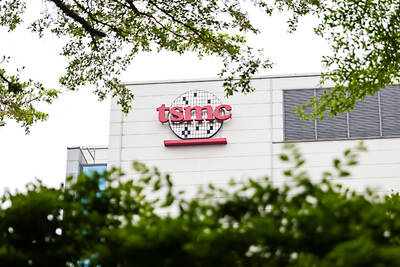
Taiwan Semiconductor Manufacturing Co (TSMC, 台積電), the world’s largest contract chipmaker, said it expects its 2-nanometer (2nm) chip capacity to grow at a compound annual rate of 70 percent from this year to 2028. The projection comes as five fabs begin volume production of 2-nanometer chips this year — two in Hsinchu and three in Kaohsiung — TSMC senior vice president and deputy cochief operating officer Cliff Hou (侯永清) said at the company’s annual technology symposium in Silicon Valley, California, last week. Output in the first year of 2-nanometer production, which began in the fourth quarter of last year, is expected to
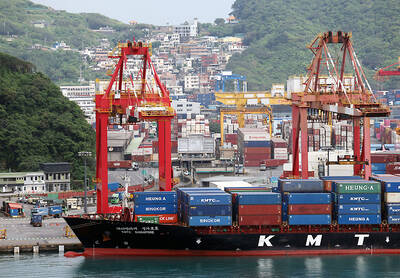
Taiwan’s economy grew far faster than expected in the first quarter, as booming demand for artificial intelligence (AI) applications drove a surge in exports, spilling over into investment and consumption, the Directorate-General of Budget, Accounting and Statistics (DGBAS) said yesterday. GDP growth was 13.69 percent year-on-year during the January-to-March period, beating the DGBAS’ February forecast by 2.23 percentage points and marking the most robust growth in nearly four decades, DGBAS senior official Chiang Hsin-yi (江心怡) told a news conference in Taipei. The result was powered by exports, which remain the backbone of Taiwan’s economy, Chiang said. Outbound shipments jumped 51.12 percent year-on-year to


 RSS
RSS