


Amid ongoing concerns over the shaky relationship with Saint Lucia, the government will look at the suitability of maintaining its embattled ambassador to the Caribbean country in his post, the Ministry of Foreign Affairs (MOFA) said yesterday.
Wu Chin-mu (吳進木), -director-general of the ministry’s Department of Latin American and Caribbean Affairs, said the ministry was “receptive” to whatever views a host government has about Taiwanese representatives to that country.
His comments were a departure from the ministry’s previous stance on friction between Ambassador Tom Chou (周台竹) and the Saint Lucia Labour Party (SLP), which regained power in November.
“We evaluate the suitability of ambassadors and officers stationed overseas regularly and alter their positions in a rotating system, based on length of service and eligibility. Personnel replacements will be made when necessary,” Wu said in response to media inquiries at a regular press briefing.
As to whether the ministry is considering replacing Chou, Wu said the ministry would look into the matter. The SLP has made many complaints against Chou over the years because of alleged interference in the country’s electoral process in favor of the United Workers Party (UWP).
After SLP leader Kenny Anthony was sworn in as prime minister early last month, the ministry said the SLP government had given its assurances that it would continue to maintain relations with Taiwan, as Chou and Minister of Foreign Affairs Timothy Yang (楊進添) held talks with Anthony on bilateral cooperation projects.
However, media in St Lucia continued to cast doubts on the relationship between the two countries. The latest report on Sunday quoted Saint Lucia Foreign Minister Alva Baptiste as saying that “within the next few weeks the new St Lucia government will make a definite decision as to whether it wants to maintain diplomatic relations with Taiwan.”
Baptiste made the remarks after talks with Yang, who last week spent four days in the country, the second leg of his journey to attend swearing-in ceremonies for Nicaraguan President Daniel Ortega yesterday, Guatemalan President Otto Perez on Jan. 14 and Gambian President Yahya J.J. Jammeh on Jan. 19.
“We have articulated our concerns to the Taiwanese foreign minister about the [behavior] of his ambassador during the tenure of the UWP administration, and indicated in no uncertain terms that Mr Chou was too deeply involved in the country’s political affairs,” Baptiste was quoted by local media as saying.
At the press briefing yesterday, Wu said the country’s relationships with Saint Lucia “remain strong.”
“After the election [in November], Anthony had publicly announced that he would maintain relations with Taiwan,” Wu said.
Following Yang’s visit, the relationship between Taiwan and Saint Lucia will continue its steady and fruitful development, Wu said.
Yang twice had cordial meetings with Anthony and had discussions with Governor-General Dame Pearlette Louisy, Saint Lucia’s head of state, as well as ministers in charge of foreign affairs, commerce, tourism, agriculture, education and technology, establishing friendship with the SLP administration, Wu said.
Wu said that diplomatic relations with the 12 countries in Central and South America and the Caribbean that recognize the Republic of China (ROC) are “very stable,” dismissing speculation that some countries may switch ties to China after the elections on Saturday.
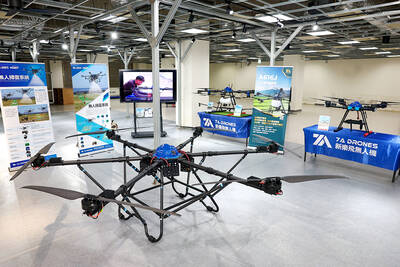
DRONE CENTRAL: Taiwan aims to become Asia’s democratic hub for drones, with most exports focused on high-quality military-grade models, an official said Taiwan’s drone industry is expected to expand significantly by 2030, producing 100,000 units per month and exporting half of them, the Ministry of Economic Affairs said yesterday. Current drone production capacity is about 15,000 units per month, but the industry can quickly scale up as demand increases, Industrial Development Administration Director-General Chiou Chyou-huey (邱求慧) told a news conference in Taipei. Taiwan’s drone output grew 2.5-fold last year to NT$12.9 billion (US$408.3 million) under a government program to develop the uncrewed vehicle sector, he said. The Executive Yuan in October last year approved plans to invest NT$44.2 billion into domestic production of uncrewed aerial
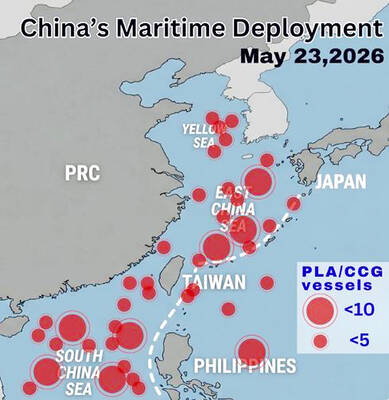
WARNING: China should stop engaging in actions that undermine regional peace and stability, as it would only build resentment among people across the Strait, the CGA said China has deployed more than 100 navy, coast guard and other vessels in waters from the Yellow Sea to the South China Sea and the western Pacific since US President Donald Trump and Chinese President Xi Jinping (習近平) met in Beijing, National Security Council Secretary-General Joseph Wu (吳釗燮) said yesterday. “In this part of the world, #China is the one & only PROBLEM wrecking the #StatusQuo & threatening regional peace & stability,” Wu wrote on X. In a separate post, he said Beijing was coercing Taiwan’s maritime domain, calling it illegal and provocative, after the Coast Guard Administration (CGA) expelled a

VERBOSE VESSELS: A CGA cutter and a China Coast Guard exchanged verbal barbs for more than a day in Taiwanese-controlled waters before the Chinese vessel left The Taiwanese and Chinese coast guards had a standoff near the strategically located Pratas Islands (Dongsha Islands, 東沙群島) in the north of the South China Sea, the Coast Guard Administration (CGA) said yesterday. The two sides engaged in intense radio exchanges over sovereignty claims during the 33-hour standoff. China Coast Guard vessel 3501 eventually left the restricted waters, 26.6 nautical miles (49.2km) west of the Pratas Islands, at 5pm yesterday, the CGA said. Lying approximately between southern Taiwan and Hong Kong, the Taiwan-controlled Pratas are seen by some security experts as vulnerable to Chinese attack due to their distance — more than
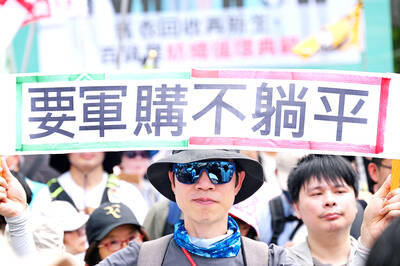
More than 8,000 people took part in a rally in Taipei yesterday to express support for more defense spending, after the opposition slashed the Cabinet’s proposed NT$1.25 trillion (US$39.6 billion) special defense budget and capped it at NT$780 billion. The demonstrators urged the Cabinet to propose another bill. Taiwan Economic Democracy Union convener Lai Chung-chiang (賴中強) said the main problem of the passed budget plan is the removal of funding for critical items, not just that the total amount is smaller. Critical budget items included purchasing or developing uncrewed vehicles, Strong Bow (強弓) missile systems, additional ammunition, artificial intelligence-powered combat systems and Taiwan-US


 RSS
RSS