


Former president Lee Teng-hui (李登輝), the nation’s first directly elected president, is expected to publish an endorsement of the Democratic Progressive Party (DPP) ticket in seven Chinese--language newspapers today, one of Lee’s close aides said yesterday.
The ad, to be titled “Give Taiwan a Chance,” will express Lee’s hopes for the country from his perspective as the nation’s former leader, said the aide, who asked not to be named.
Lee is of the opinion that Taiwan needs a head of state who is competent, strong, responsible, approachable and harbors compassion for the people, and that these traits are especially obvious in Taiwanese women, the aide said.
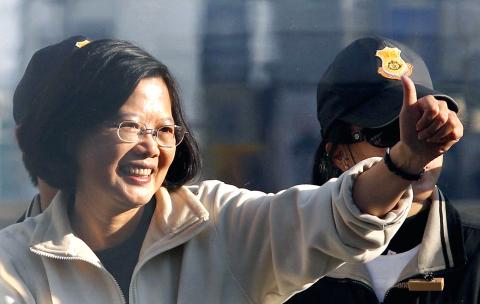
Photo: Pichi Chuang, Reuters
However, it is still not clear if Lee, who had a cancerous tumor removed in early November, will personally attend a campaign rally to endorse DPP presidential candidate Tsai Ing-wen (蔡英文) before the elections on Saturday.
The aide said Lee, who turns 89 on Sunday, remains weak and he still is at risk of infection after the surgery. Even if he does appear at a rally, he will only be present for three to five minutes, the aide said.
In an advertisement yesterday, Nobel laureate Lee Yuan-tseh (李遠哲) and 86 scientists defended Tsai’s role in the TaiMed case, calling her “capable, rational and trustworthy.”
The ad referred to Tsai’s role in the establishment of TaiMed Biologics Co (中裕新藥股份有限公司), formerly known as Yu Chang Biologics Co (宇昌生技股份有限公司), in 2007.
In March of that year, Tsai approved government investment in the new biotech venture in her capacity as vice premier. She then stepped down from her post in May and became chairwoman of the company in September.
The Chinese Nationalist Party (KMT), led by President Ma Ying-jeou (馬英九), has accused Tsai of a conflict of interest.
Academia Sinica president Wong Chi-huey (翁啟惠) denied the charges at the time, saying Tsai was invited by the company’s executive team to be its chairwoman.
In a newspaper ad titled “Scientists’ conscience,” the scientists yesterday said: “The TaiMed case is a successful example of a biotech venture, but has fallen victim to a smear campaign.”
The ad was co-signed by Lee and 86 other scientists, including Patrick Yang (楊育民), executive vice president of Switzerland-based Roche, 23 Academia Sinica researchers and Hsu Chao-hui (許照惠), founder and vice chairman of US-based IVAX Corp.
The scientists also praised Tsai’s contribution to the venture, saying she had done her best for the country’s biotech development, and appealed to people to give Tsai justice.
Wong was not among the signatories to the ad.
When asked by the press for comment, DPP spokesperson Chen Chi-mai (陳其邁) said it was understandable that Wong did not sign the statement, given his official status as head of the academy.
Additional reporting by Lee Hsin-fang and Liu Jung

‘NO SECURITY RISK’: The Railway Bureau reassured the public that the technicians’ activities were limited to technical guidance and did not involve sensitive systems The Railway Bureau yesterday said it had invited eight Chinese technicians to assist with an airport MRT construction project. The bureau issued the confirmation after an Internet user said Chinese nationals had entered the construction zone of Taiwan Taoyuan International Airport’s Terminal 3 project. They asked why “individuals from an enemy state” were allowed access to such a major national infrastructure project, which raised serious concerns over Taiwan’s industrial safety, sensitive systems and information security. The bureau’s Northern Region Engineering Branch Office said subcontractor Taiwan Handle Industrial Co (台灣手把工業) of the Taoyuan airport MRT’s “Contract No. CU05 Project A14 Station Civil, MEP &

The National Chungshan Institute of Science and Technology yesterday showcased its locally developed variants of the Vision 60 robotic patrol dog, which it plans to deploy on the nation’s outlying territories in the South China Sea. The variants were produced under the Joint Lab project — created by the institute and domestic companies — and assembled with domestically produced motors, lenses and artificial intelligence (AI) systems alongside licensed tech from the US, Missile and Rocket Systems Research Division deputy director Jen Kuo-kang (任國光) told the media event at a military base in Taipei’s Dazhi (大直) area. Taiwan has built up its strengths

NOT IMMEDIATE: Taiwan has a chance to appeal the proposed 10 percent tariff before it starts, while other countries face a 12.5 percent tariff from the trade office Taiwan is among 60 economies determined by the US to have failed to impose or enforce a ban on the importation of goods produced with forced labor, according to a notice released on Tuesday by the Office of the US Trade Representative (USTR), which proposed imposing an additional 10 percent or more tariff on them. The USTR in a statement said that following an investigation, it had determined under Section 301 of the Trade Act of 1974 that the failure of the 60 economies to impose and effectively enforce a prohibition on the importation of goods produced with forced labor is
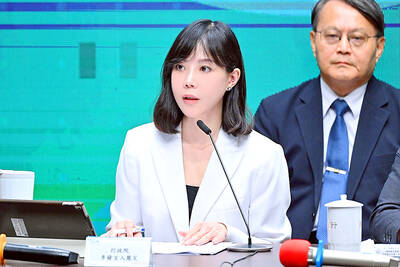
RIGHT DIRECTION: Taiwan’s efforts to prevent forced labor include a proposal to ‘fully prohibit’ employers from withholding workers’ documents, an official said Taiwan is to establish a mechanism to restrict imports of goods linked to forced labor, the Executive Yuan said yesterday, after the US proposed imposing additional tariffs on Taiwanese goods over labor concerns. “The Ministry of Labor and the Ministry of Economic Affairs are to establish an interministerial review procedure,” Executive Yuan spokesperson Michelle Lee (李慧芝) said at a news briefing in Taipei. “The government is to use the Foreign Trade Act [貿易法] as the legal basis to restrict imports of goods produced with forced labor” and bring its supply chain governance more in line with international standards on human rights, resilience


 RSS
RSS