


Iran yesterday said it had successfully test-fired two long-range missiles in a naval exercise in the Persian Gulf, flexing its military muscle to show it could hit Israel and US bases in the region if attacked.
In response to mounting Western pressure over its nuclear ambitions, Iran started a naval drill in the Gulf last week and warned that it could shut the Strait of Hormuz if sanctions were imposed on its oil exports, the country’s main revenue source.
The 10 days of naval war games and the warning over the Strait, a narrow Gulf shipping lane through which 40 percent of world oil passes, have rattled oil markets and pushed up crude prices.
Analysts say Iran’s increasingly strident rhetoric is aimed at sending a message to the West that it should think twice about the economic cost of putting further pressure on Tehran.
“We have successfully test-fired long-range shore-to-sea and surface-to-surface missiles, called Qader [capable] and Nour [Light] today,” Iranian navy deputy commander Mahmoud Mousavi told state television.
Tehran denies Western accusations that it is trying to build atomic bombs, saying it needs nuclear technology to generate electricity.
The US and Israel have not ruled out military action against Iran if diplomacy fails to resolve Tehran’s nuclear row with the West.
Iran said yesterday it had no intention to close the Strait of Hormuz, but it has carried out “mock” exercises on shutting the vital waterway.
“No order has been given for the closure of the Strait of Hormuz, but we are prepared for various scenarios,” state television quoted navy chief Habibollah Sayyari as saying.
The US Fifth Fleet, based in Bahrain, said it would not allow shipping to be disrupted in the strategic waterway.
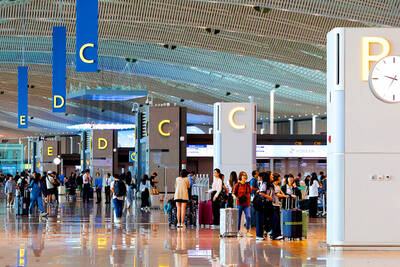
South Korea has adjusted its electronic arrival card system to no longer list Taiwan as a part of China, a move that the Ministry of Foreign Affairs said would help facilitate exchanges between the two sides. South Korea previously listed “Taiwan” as “Taiwan (China)” in the drop-down menus of its online arrival card system, where people had to fill out where they came from and their next destination. The ministry had requested South Korea make a revision and said it would change South Korea’s name on Taiwan’s online immigration system from “Republic of Korea” to “Korea (South),” should the issue not be

The Legislative Yuan’s Finance Committee yesterday approved proposed amendments to the Amusement Tax Act (娛樂稅法) that would abolish taxes on films, cultural activities and competitive sporting events, retaining the fee only for dance halls and golf courses. The proposed changes would set the maximum tax rate for dance halls and golf courses at 50 and 20 percent respectively, with local governments authorized to suspend the levies. Article 2 of the act says that “amusement tax shall be levied on tickets sold or fees charged by amusement places, facilities or activities” in six categories: “Cinema; professional singing, story-telling, dancing, circus, magic show, acrobatics

Tainan, Taipei and New Taipei City recorded the highest fines nationwide for illegal accommodations in the first quarter of this year, with fines issued in the three cities each exceeding NT$7 million (US$220,639), Tourism Administration data showed. Among them, Taipei had the highest number of illegal short-term rental units, with 410. There were 3,280 legally registered hotels nationwide in the first quarter, down by 14 properties, or 0.43 percent, from a year earlier, likely indicating operators exiting the market, the agency said. However, the number of unregistered properties rose to 1,174, including 314 illegal hotels and 860 illegal short-term rental
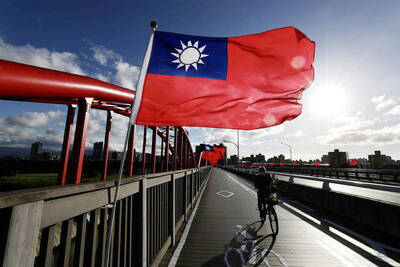
INFLATION UP? The IMF said CPI would increase to 1.5 percent this year, while the DGBAS projected it would rise to 1.68 percent, with GDP per capita of US$44,181 The IMF projected Taiwan’s real GDP would grow 5.2 percent this year, up from its 2.1 percent outlook in January, despite fears of global economic disruptions sparked by the US-Iran conflict. Taiwan’s consumer price index (CPI) is projected to increase to 1.5 percent, while unemployment would be 3.4 percent, roughly in line with estimates for Asia as a whole, the international body wrote in its Global Economic Outlook Report published in the US on Monday. The figures are comparatively better than the IMF outlook for the rest of the world, which pegged real GDP growth at 3.1 percent, down from 3.3 percent


 RSS
RSS