


A Chinese village protest that tested the ruling Chinese Communist Party (CCP) for over a week ended yesterday after officials offered concessions over seized farmland and the death of a village leader, in a rare spectacle of the government backing down to mobilized citizens.
Residents of Wukan, in southern Guangdong Province, had fended off police with barricades and held protests over the death in police custody of activist Xue Jinbo (薛錦波), whose family rejects the government’s position that he died of natural causes, and against the seizure of farmland for development.
However, after talks with officials, village representatives told residents to pull down protest banners and go back to their normal lives — provided the government keeps to its word.
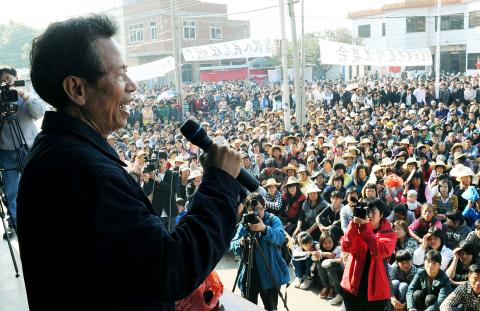
Photo: AFP
“Because this matter has been resolved, we won’t persist in making noise,” village organizer Yang Semao (楊色茂) told an assembly hall of village representatives and reporters, referring to the protests.
“They’ve agreed to our initial requests,” Yang said.
However, he added a caveat: “If the government doesn’t meet its commitments, we’ll protest again.”
Senior officials negotiating with villagers agreed to release three men held over land protests in September, when a government office was trashed, and to re-examine the cause of Xue’s death, a village organizer said earlier.
Xue’s family and fellow villagers believe he was subjected to abuse that left injuries on his body. The government said an autopsy showed he died of heart problems. Xue was detained over the land protests that broke out in September.
The concessions showed how eager higher leaders were to avoid the risk of fresh violence and bloodshed, said Ting Wai (丁偉), a political science professor at Hong Kong Baptist University.
“I think the local government did not want to make concessions, and then of course when time goes on, the people became more and more frustrated, and now it is really like a bomb, so in order to prevent the bomb from exploding the provincial government has to do something,” he said.
Chinese officials sometimes make low-key concessions to local protests, especially after they are over, and also punish protest organizers. However, Wukan turned negotiations into a rare public spectacle, watched by foreign reporters and discussed within China — despite domestic censorship of news.
The CCP chief of Guangdong, Wang Yang (王洋), obliquely acknowledged that the villagers had cause to complain, in comments yesterday in the Southern Daily, the official provincial newspaper.
“This is the outcome of conflicts that accumulated over a long time in the course of economic and social development,” Wang said, seen by many analysts as nursing hopes of a spot in China’s next central leadership.
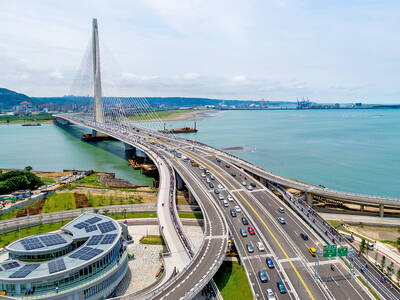
The Ministry of Transportation and Communications yesterday inaugurated the Danjiang Bridge across the Tamsui River in New Taipei City, saying that the structure would be an architectural icon and traffic artery for Taiwan. Feted as a major engineering achievement, the Danjiang Bridge is 920m long, 211m tall at the top of its pylon, and is the longest single-pylon asymmetric cable-stayed bridge in the world, the government’s Web site for the structure said. It was designed by late Iraqi-British architect Zaha Hadid. The structure, with a maximum deck of 70m, accommodates road and light rail traffic, and affords a 200m navigation channel for boats,
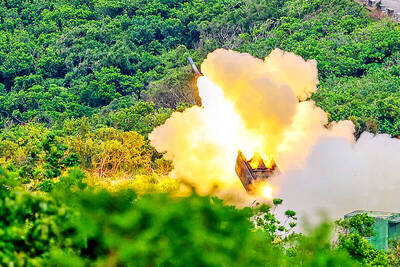
PRECISION STRIKES: The most significant reason to deploy HIMARS to outlying islands is to establish a ‘dead zone’ that the PLA would not dare enter, a source said A High Mobility Artillery Rocket System (HIMARS) would be deployed to Penghu County and Dongyin Island (東引) in Lienchiang County (Matsu) to force the Chinese military to retreat at least 100km from the coastline, a military source said yesterday. Taiwan has been procuring HIMARS and Army Tactical Missile Systems (ATACMS) from the US in batches. Once all batches have been delivered, Taiwan would possess 111 HIMARS units and 504 ATACMS, which have a range of 300km. Considering that “offense is the best defense,” the military plans to forward-deploy the systems to outlying islands such as Penghu and Dongyin so that
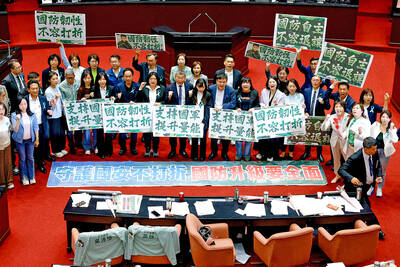
WHAT WAS ALL THAT FOR? Jaw Shaw-kong said that Cheng Li-wen had pushed for more drastic cuts and attacked him, just for the outcome to be nearly identical to his bill The legislature yesterday passed a supplementary budget bill to fund the purchase of separate packages of US military equipment, with the combined amount of spending capped at NT$780 billion (US$24.8 billion). The Chinese Nationalist Party (KMT) and Taiwan People’s Party (TPP) used their legislative majority to pass the bill, which runs until 2033 and has two main funding provisions. One was for NT$300 billion of arms sales already approved by the US for Taiwan on Dec. 17 last year, the other was for NT$480 billion for another arms package expected to be announced by Washington. The bill, which fell short of the NT$1.25

‘CLEAR MESSAGE’: The bill would set up an interagency ‘tiger team’ to review sanctions tools and other economic options to help deter any Chinese aggression toward Taiwan US Representative Young Kim has introduced a bill to deter Chinese aggression against Taiwan, calling for an interagency “tiger team” to preplan coordinated sanctions and economic measures in response to possible Chinese military or political action against Taiwan. “[Chinese President] Xi Jinping [習近平] has directed the People’s Liberation Army to be ready to invade Taiwan by 2027. China has a plan. America should have one too,” Kim said in a news release on Thursday last week. She introduced the “Deter PRC [People’s Republic of China] aggression against Taiwan act” to “ensure the US has a coordinated sanctions strategy ready should


 RSS
RSS