


The Democratic Progressive Party (DPP) yesterday disclosed more information as it reiterated that presidential candidate Tsai Ing-wen (蔡英文) was innocent of alleged illegal involvement in Yu Chang Biologics Co (宇昌生技股份有限公司).
The party also again condemned Council for Economic Planning and Development (CEPD) Minister Christina Liu (劉憶如) for what it said was repeated lying about document forgery.
Liu and the Chinese Nationalist Party (KMT) on Monday accused Tsai of wrongdoing in connection with the biotech start-up while Tsai was vice premier in 2007, backing up the claim with a document which they said was created on March 31, 2007, but was later proved to be produced on Aug. 19, 2007.
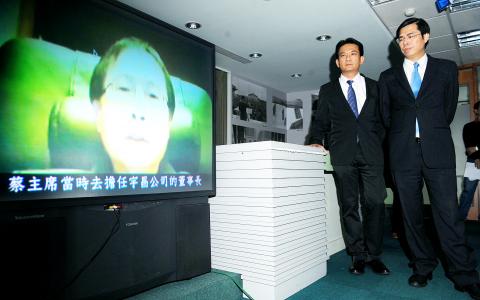
Photo: Taipei Times
Liu later apologized for “confusing the date” of the document, but maintained her attacks on Tsai.
The DPP yesterday said Liu should answer these questions: “Who forged the document? When was the document fabricated? Why was the date changed to March 31?”
Tsai was still serving as vice premier when TaiMed Group, the predecessor of Yu Chang, held an investor conference on March 31, 2007. She left office in May and became Yu Chang’s chairman in September that year.
DPP spokesperson Chuang Ruei-hsiung (莊瑞雄) said Liu should also answer why she mentioned March 31 as a “critical date” five times on Monday and who asked her to repeatedly lie about the forgery.
The “smear campaign” appeared to be an attempt to mislead the public into believing that Tsai was a corrupt official, Chuang said, adding the tactic could result in Tsai being charged with corruption, a felony that comes with a prison term of more than 10 years.
According to the Presidential and Vice Presidential Election and Recall Act (總統副總統選舉罷免法), Tsai’s candidacy would be vacated if she is convicted of corruption, Chuang said.
Several key dates have been the most important factor in the controversy, DPP Legislators Tsai Huang-liang (蔡煌瑯) said at a separate press conference yesterday morning.
A group of scientists and corporate leaders — including current Academia Sinica president Wong Chi-huey (翁啟惠), Taiwan Semiconductor Manufacturing Co chairman Morris Chang (張忠謀) and Yulon Group chief executive officer Kenneth Yen (嚴凱泰) — attended a dinner meeting at Tsai Ing-wen’s residence in July 2007, he said.
“Tsai [Ing-wen] declined Wong’s offer to be Yu Chang’s chairman, a fact which Yen — a confidant of President Ma Ying-jeou (馬英九) — could confirm,” Tsai Huang-liang said, adding that it also showed Tsai Ing-wen had no intention of heading the company as late as July 2007.
The DPP yesterday afternoon also showed a teleconference between Chen Lan-bo (陳良博), a professor at Harvard University who was one of the founders of Yu Chang, and its spokesperson Chen Chi-mai (陳其邁) recorded on Tuesday, in which Chen endorsed Tsai Ing-wen’s innocence.
Chen Lan-bo said the CEPD had fabricated the document and added that the founding group of Yu Chang never considered Tsai Ing-wen as a candidate for the chairmanship before June 2007.
“If it had not been for the initial investment from Tsai’s family, I don’t think Taiwan Global BioFund (上智生技創投) and President International Development Corp (統一國際開發) would have followed suit,” he said.
The forgery and the KMT’s attack was “unfair, conscienceless and heartbreaking” and a devastating blow to Taiwan’s biotech industry, he added, saying “Taiwanese people are neither stupid nor cowardly. They should be angry [at the smear campaign].”
At a separate setting yesterday, KMT lawmakers continued their attacks on Tsai Ing-wen and demanded that she explain her connections with the state-owned National Development Fund (NDF) and the TaiMed Group.
Additional reporting by Shih Hsiu-chuan

‘NO SECURITY RISK’: The Railway Bureau reassured the public that the technicians’ activities were limited to technical guidance and did not involve sensitive systems The Railway Bureau yesterday said it had invited eight Chinese technicians to assist with an airport MRT construction project. The bureau issued the confirmation after an Internet user said Chinese nationals had entered the construction zone of Taiwan Taoyuan International Airport’s Terminal 3 project. They asked why “individuals from an enemy state” were allowed access to such a major national infrastructure project, which raised serious concerns over Taiwan’s industrial safety, sensitive systems and information security. The bureau’s Northern Region Engineering Branch Office said subcontractor Taiwan Handle Industrial Co (台灣手把工業) of the Taoyuan airport MRT’s “Contract No. CU05 Project A14 Station Civil, MEP &

A US uncrewed surface vessel (USV) encountered multiple Chinese warships during an autonomous transit of the Taiwan Strait, US defense company Seasats said in a statement on Wednesday. Seasats announced that a Lightfish USV had completed the first autonomous transit of the Taiwan Strait. Over five days, the USV traversed the entire length of the Strait while constantly monitoring surface vessel traffic, the company said. The Lightfish encountered multiple Chinese warships, one of which was a Chinese People’s Liberation Army Navy (PLAN) Type 056 corvette, it said. The Chinese vessels were operating “well within Taiwan’s exclusive economic zone without transmitting their identity via the

Taiwan is still in the process of assessing the possibility of recruiting workers from Eswatini, the Ministry of Foreign Affairs said yesterday, adding that its goal is to help Eswatini upgrade its vocational training centers. If there are plans to recruit workers from Eswatini, safeguarding national security, protecting public health and ensuring the employment rights of Taiwanese would be prerequisites, Department of West Asian and African Affairs Director-General Yen Chia-liang (顏嘉良) told a news conference. Key considerations would also include filling labor shortages in specific industries, and fostering bilateral professional and technical exchanges, he said. Yen was asked about the progress of labor
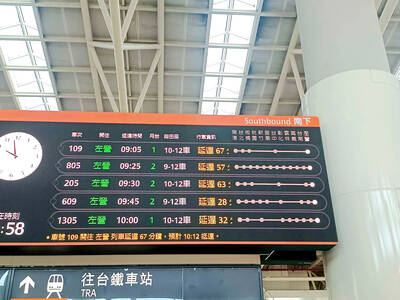
The nation’s usually punctual high-speed rail system yesterday was hit by major disruptions after all scheduled services were canceled and replaced with three hourly trains offering only non-reserved seating, affecting more than 200,000 passengers. Preliminary findings indicate the disruption was caused by a faulty power module in a track switch control cabinet, Taiwan High-Speed Rail Corp (THSRC) said, adding that as a full system inspection could only be conducted after operations end for the day, a decision on whether normal service would resume today would be announced before the first train departs. During a routine inspection early yesterday, a switch signal abnormality


 RSS
RSS