


A UN climate conference reached a hard-fought agreement yesterday on a far-reaching program meant to set a new course for the global fight against climate change.
The 194-party conference agreed to start negotiations on a new accord that would ensure that countries will be legally bound to carry out any pledges they make. It would take effect by 2020 at the latest.
The deal doesn’t explicitly compel any nation to take on emissions targets, although most emerging economies have volunteered to curb the growth of their emissions.

Photo: AFP
Currently, only industrial countries have legally binding emissions targets under the 1997 Kyoto Protocol. Those commitments expire next year, but they will be extended for at least another five years under the accord adopted yesterday — a key demand by developing countries seeking to preserve the only existing treaty regulating carbon emissions.
The proposed Durban platform offered answers to problems that have bedeviled global warming negotiations for years about sharing the responsibility for controlling carbon emissions and helping the world’s poorest and most climate-vulnerable nations cope with changing forces of nature.
The US was a reluctant supporter, concerned about agreeing to join an international climate system that likely would find much opposition in the US Congress.
“This is a very significant package. None of us likes everything in it. Believe me, there is plenty the United States is not thrilled about,” US climate envoy Todd Stern said.
However, the package captured important advances that would be undone if it is rejected, he told the delegates.
Yesterday’s deal also set up the bodies that would collect, govern and distribute tens of billions of dollars a year for poor countries. Other documents in the package lay out rules for monitoring and verifying emissions reductions, protecting forests, transferring clean technologies to developing countries and scores of technical issues.
UN Secretary-General Ban Ki-moon said the deal represents “an important advance in our work on climate change.”
However, the deal’s language left some analysts warning that the wording created huge loopholes countries could use to avoid tying their emissions to legal constraints and said there was no mention of penalties.
Environmentalists criticized the package — as did many developing countries in the debate — for failing to address what they called the most urgent issue, to move faster and deeper in cutting carbon emissions.
“The good news is we avoided a train wreck,” said Alden Meyer, from the Union of Concerned Scientists, recalling predictions a few days ago of a likely failure. “The bad news is that we did very little here to affect the emissions curve.”
Scientists say that unless those emissions — chiefly carbon dioxide from power generation and industry — level out and reverse within a few years, the Earth will be set on a possibly irreversible path of rising temperatures that lead to ever greater climate catastrophes.
The breakthrough yesterday capped 13 days of hectic negotiations that ran a day-and-a-half over schedule, including two round-the-clock days that left negotiators bleary-eyed and stumbling their words.
Delegates were seen nodding off in the final plenary session despite the high drama and uncertainty as to whether the talks would end in triumph or total collapse.

DRONE CENTRAL: Taiwan aims to become Asia’s democratic hub for drones, with most exports focused on high-quality military-grade models, an official said Taiwan’s drone industry is expected to expand significantly by 2030, producing 100,000 units per month and exporting half of them, the Ministry of Economic Affairs said yesterday. Current drone production capacity is about 15,000 units per month, but the industry can quickly scale up as demand increases, Industrial Development Administration Director-General Chiou Chyou-huey (邱求慧) told a news conference in Taipei. Taiwan’s drone output grew 2.5-fold last year to NT$12.9 billion (US$408.3 million) under a government program to develop the uncrewed vehicle sector, he said. The Executive Yuan in October last year approved plans to invest NT$44.2 billion into domestic production of uncrewed aerial
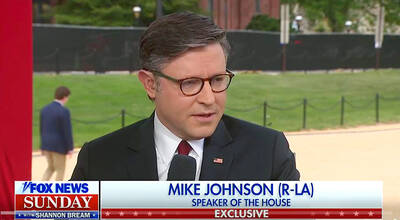
RESOLUTE BACKING: Two Republican senators are planning to introduce legislation that would impose immediate sanctions on China if it attempts to invade Taiwan US House of Representatives Speaker Mike Johnson on Sunday reaffirmed US congressional support for Taiwan, saying the US and “all freedom-loving people” have a stake in preventing China from seizing Taiwan by force. Johnson made the remarks in an interview with Fox News Sunday on US President Donald Trump’s summit with Chinese President Xi Jinping (習近平) last week. In an interview that aired on Friday on Fox News, just as Trump wrapped up a high-stakes visit to China, he said he has yet to green-light a new US$14 billion arms package to Taiwan and that it “depends on China.” “It’s a very good
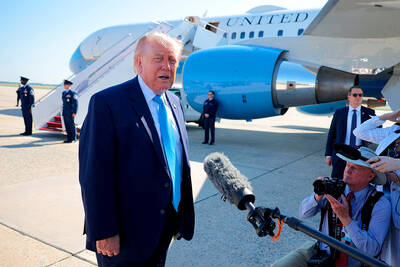
US President Donald Trump yesterday said he would speak to President William Lai (賴清德) as his administration considers whether to move ahead with a US$14 billion weapons sale to Taiwan — a potential arms deal that has drawn criticism from China. “Well, I’ll speak to him. I speak to everybody,” Trump told reporters yesterday when asked if he had any plans to call his counterpart, although he did not offer a time frame for when such a conversation could take place. Trump previously said he would speak to the person “that’s running Taiwan,” without specifying who he meant. “We have that situation very

‘NON-NEGOTIABLE’: Failure to follow through with US obligations to Taiwan could cost countless lives and trigger a global economic downturn, a US senator warned A bipartisan group of US senators on Friday introduced a resolution reaffirming the Taiwan Relations Act (TRA) and the US’ obligation to provide arms of a defensive nature to Taiwan, amid reports that the White House might pause a planned US$14 billion arms sale. Since his meeting with Chinese President Xi Jinping (習近平) earlier this month, US President Donald Trump has declined to say whether his administration would move forward with the sale, saying that it is a “very good negotiating chip for us.” On Thursday, The Hill reported that a Pentagon official told a US Senate subcommittee that Washington was pausing


 RSS
RSS