


Democratic Progressive Party (DPP) presidential candidate Tsai Ing-wen (蔡英文) yesterday apologized for an inaccurate picture that was used in campaign material in an attempt to end a week-long battle of rhetoric between the DPP and the Chinese Nationalist Party (KMT) over the prices of different persimmons.
In a recent campaign flyer printed in the format of a calendar, the DPP listed a dozen types of locally grown fruits, among them persimmons, that have plunged in price this year.
The persimmons shown on the flyer were non-astringent persimmons, which were being sold for at least 10 times the price of astringent persimmons, the fruit the DPP had meant to highlight.

Photo: Taipei Times
President Ma Ying-jeou (馬英九) and the KMT subsequently accused the DPP of misleading the public by quoting incorrect prices and hurting farmers who grow non-astringent persimmons.
“I apologize for the misrepresentative picture and will ask our staff to be cautious with the information they put out in the future,” Tsai told an impromptu press conference in the afternoon.
The controversy over persimmon prices has taken center stage in the presidential campaign.
The KMT had demanded an apology to farmers about the flyer from the DPP, which, until yesterday, had refused to do so, saying the primary objective of the flyer was to highlight the supply and demand imbalance of Taiwan-grown fruits.
Citing “the Judgement of Solomon” — a biblical story in which King Solomon of Israel ruled in the case of two women who both claimed to be the mother of the same child — Tsai said the DPP was like the true mother who did not want to see her child being cut in half and thus decided to let go.
“Like a mother who will always care for her children, the DPP has always stood on the side of farmers and has never stopped caring through our proposed subsidies for elderly farmers ... as we are all children of Taiwan,” she said.
“We do not want to see any farmers getting hurt” by the controversy, she said.
However, the issue of supply-and-demand imbalance and the fact that astringent persimmons were being sold at NT$2 per jin (600g) were all true and the Ma administration should not evade its responsibility by turning the issue into a campaign tool by blowing it out of proportion, she added.
Tsai pledged that if she is elected next month, the government would not shy away from its responsibility of taking care of farmers.
She urged the Ma government to deal with the issue of the wellbeing of farmers from a long-term perspective, instead of handling it as a campaign issue.
Tsai, who on Wednesday said the picture mix-up was “regrettable,” decided yesterday morning to call the press conference and formally apologize, DPP spokesperson Chen Chi-mai (陳其邁) said, adding that the press conference was an attempt to send out a clear message of what the DPP was trying to express, rather than “damage control.”
At a separate setting, Ma’s re-election campaign office spokesman Yin Wei (殷瑋) said the camp recognized Tsai’s willingness to offer an apology over the incident, but added that she and the DPP should apologize to farmers for their negative campaign.
“A belated apology is better than no apology at all. However, Tsai only apologized for putting incorrect -information in the campaign flyer. She should apologize to innocent farmers, who are the real victims of the negative campaign,” he said.
Yin said the KMT’s arguments over the price of persimmons were aimed at stating the truth over the incident, rather than creating -conflict with the DPP.
“It is the DPP that provoked the confrontation and distorted the truth for political gain. As the ruling party, it is the KMT’s responsibility to speak for the farmers and clarify the allegations,” he said.
Additional reporting by Mo Yan-chih

A signaling system malfunction disrupted high-speed rail (HSR) services beginning at 8am today, with trains temporarily reduced to three northbound and three southbound trains per hour as authorities conduct inspections. The malfunction occurred on a section of track in Miaoli County during pre-operation checks early this morning, forcing northbound and southbound trains to use a single track, the HSR operator said. The regular schedule has been replaced with three hourly trains offering only nonreserved seating in each direction, stopping at every station, it said, adding that business class cars would still have reserved seating. Departures from terminal stations are scheduled at the top

Taiwan is still in the process of assessing the possibility of recruiting workers from Eswatini, the Ministry of Foreign Affairs said yesterday, adding that its goal is to help Eswatini upgrade its vocational training centers. If there are plans to recruit workers from Eswatini, safeguarding national security, protecting public health and ensuring the employment rights of Taiwanese would be prerequisites, Department of West Asian and African Affairs Director-General Yen Chia-liang (顏嘉良) told a news conference. Key considerations would also include filling labor shortages in specific industries, and fostering bilateral professional and technical exchanges, he said. Yen was asked about the progress of labor

VERBOSE VESSELS: A CGA cutter and a China Coast Guard exchanged verbal barbs for more than a day in Taiwanese-controlled waters before the Chinese vessel left The Taiwanese and Chinese coast guards had a standoff near the strategically located Pratas Islands (Dongsha Islands, 東沙群島) in the north of the South China Sea, the Coast Guard Administration (CGA) said yesterday. The two sides engaged in intense radio exchanges over sovereignty claims during the 33-hour standoff. China Coast Guard vessel 3501 eventually left the restricted waters, 26.6 nautical miles (49.2km) west of the Pratas Islands, at 5pm yesterday, the CGA said. Lying approximately between southern Taiwan and Hong Kong, the Taiwan-controlled Pratas are seen by some security experts as vulnerable to Chinese attack due to their distance — more than
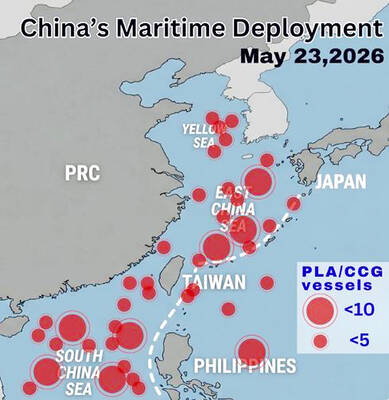
WARNING: China should stop engaging in actions that undermine regional peace and stability, as it would only build resentment among people across the Strait, the CGA said China has deployed more than 100 navy, coast guard and other vessels in waters from the Yellow Sea to the South China Sea and the western Pacific since US President Donald Trump and Chinese President Xi Jinping (習近平) met in Beijing, National Security Council Secretary-General Joseph Wu (吳釗燮) said yesterday. “In this part of the world, #China is the one & only PROBLEM wrecking the #StatusQuo & threatening regional peace & stability,” Wu wrote on X. In a separate post, he said Beijing was coercing Taiwan’s maritime domain, calling it illegal and provocative, after the Coast Guard Administration (CGA) expelled a


 RSS
RSS