


People First Party (PFP) Chairman James Soong (宋楚瑜) yesterday officially signed up for the Jan. 14 presidential election, calling on the public to look beyond party lines and vote for him.
Ending months of speculation about his determination to join the race, Soong and his running mate, Lin Ruey-shiung (林瑞雄), completed the registration process at the Central Election Commission (CEC) and promised to improve the overall environment for Taiwanese at a press conference together with the party’s legislator-at-large candidates.
“Elections in democratic societies look to elect wise and capable candidates, rather than pan-blue or pan-green [candidates]. Taiwan has suffered from the vicious conflict between the two camps in the past 10 years, and people should put a stop to this and find new hope through their ballot,” Soong said.
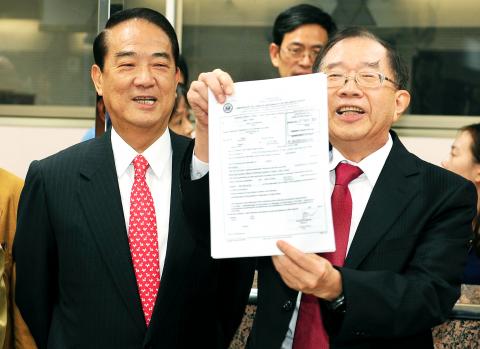
Photo: Chang Chia-ming, Taipei Times
Amid cheers from about 100 supporters chanting “Let’s send Soong to the Presidential Office,” Soong slammed President Ma Ying-jeou (馬英九) and the Chinese Nationalist Party (KMT), accusing them of poor performance and incompetence in leading the nation forward. He also accused the former Democratic Progressive Party (DPP) administration of corruption.
“Ma launched a ‘home stay’ campaign; I think we should let those who don’t have the people in mind ‘stay home,’” he said.
“The DPP’s presidential campaign slogan is ‘Taiwan Next,’ but Taiwan should be the first. I will make Taiwan the pride of Asia,” he said.
The Soong-Lin ticket was the third team to formally throw its hat into the ring, following the lead of the KMT ticket of Ma and Premier Wu Den-yih (吳敦義) and the DPP pairing of Chairperson Tsai Ing-wen (蔡英文) and Su Jia-chyuan (蘇嘉全).
Lin displayed a document he said would dispel rumors that he possesses dual citizenship. The document, issued by the US Department of State on Monday, reads “certificate of loss of nationality of the United States.”
According to the Presidential and Vice Presidential Election and Recall Act (總統副總統選舉罷免法), aspirants should not hold dual nationality on the date they register their candidacies.
“I am no longer a US citizen, and I think this should stop the rumors,” Lin said.
The commission said it would collect the documents provided by Lin and double-check them with related government agencies.
The issue of Lin’s nationality drew attention after Yok Mu-ming (郁慕明), chairman of a KMT splinter group, the New Party, was quoted in a recent newspaper report as saying that the Soong-Lin ticket might not register for the presidential election because Lin was “probably still a US citizen.”
Soong said he looked forward to hearing a public apology from Yok over the nationality issue.
The PFP also unveiled its list of 18 legislator-at-large candidates, with PFP adviser and National Chengchi University professor Thomas Lee (李桐豪), writer Chang Hsiao-feng (張曉風), former Miaoli County commissioner Fu Hsueh-peng (傅學鵬) and Ming Chuan University assistant professor Chen Yi-jie (陳怡潔) topping the list.
Soong’s registration, viewed as a potential election spoiler in the eyes of the KMT, has put an end to a possible cooperation between the two parties.
Former KMT chairman Wu Poh-hsiung (吳伯雄) acknowledged that Soong’s participation in the race has engendered a sense of crisis in the pan-blue camp amid fears of a split in the vote.
“Instead of complaining about each other, we should turn this sense of crisis into strength and join efforts to claim victory in the elections,” he said.
Chuang Po-chun (莊伯仲), director of the KMT’s Culture and Communication Committee, said the KMT respected Soong’s decision, adding that the two parties would engage in a gentleman’s race in the presidential and legislative elections.
Additional reporting by CNA

CREDIT-GRABBER: China said its coast guard rescued the crew of a fishing vessel that caught fire, who were actually rescued by a nearby Taiwanese boat and the CGA Maritime search and rescue operations do not have borders, and China should not use a shipwreck to infringe upon Taiwanese sovereignty, the Coast Guard Administration (CGA) said yesterday. The coast guard made the statement in response to the China Coast Guard (CCG) saying it saved a Taiwanese fishing boat. The Chuan Yu No. 6 (全漁6號), a fishing vessel registered in Keelung, on Thursday caught fire and sank in waters northeast of Diaoyutai Islands (釣魚台). The vessel left Keelung’s Badouzih Fishing Harbor (八斗子漁港) at 3:35pm on Sunday last week, with seven people on board — a 62-year-old Taiwanese captain surnamed Chang (張) and six

The Legislative Yuan’s Finance Committee yesterday approved proposed amendments to the Amusement Tax Act (娛樂稅法) that would abolish taxes on films, cultural activities and competitive sporting events, retaining the fee only for dance halls and golf courses. The proposed changes would set the maximum tax rate for dance halls and golf courses at 50 and 20 percent respectively, with local governments authorized to suspend the levies. Article 2 of the act says that “amusement tax shall be levied on tickets sold or fees charged by amusement places, facilities or activities” in six categories: “Cinema; professional singing, story-telling, dancing, circus, magic show, acrobatics

Tainan, Taipei and New Taipei City recorded the highest fines nationwide for illegal accommodations in the first quarter of this year, with fines issued in the three cities each exceeding NT$7 million (US$220,639), Tourism Administration data showed. Among them, Taipei had the highest number of illegal short-term rental units, with 410. There were 3,280 legally registered hotels nationwide in the first quarter, down by 14 properties, or 0.43 percent, from a year earlier, likely indicating operators exiting the market, the agency said. However, the number of unregistered properties rose to 1,174, including 314 illegal hotels and 860 illegal short-term rental

RISKY BUSINESS: The ‘incentives’ include initiatives that get suspended for no reason, creating uncertainty and resulting in considerable losses for Taiwanese, the MAC said China’s “incentives” failed to sway sentiment in Taiwan, as willingness to work in China hit a record low of 1.6 percent, a Ministry of Labor survey showed. The Directorate-General of Budget, Accounting and Statistics (DGBAS) also reported that the number of Taiwanese workers in China has nearly halved from a peak of 430,000 in 2012 to an estimated 231,000 in 2024. That marked a new low in the proportion of Taiwanese going abroad to work. The ministry’s annual survey on “Labor Life and Employment Status” includes questions respondents’ willingness to seek employment overseas. Willingness to work in China has steadily declined from


 RSS
RSS