


The Democratic Progressive Party (DPP) filed a lawsuit against President Ma Ying-jeou (馬英九) and Premier Wu Den-yih (吳敦義) yesterday, accusing the two of corruption for favoring Performance Workshop Theatre founder Stan Lai (賴聲川) in organizing the ROC Centenary celebration events.
DPP spokesperson Chuang Ruei-hsiung (莊瑞雄) and Kang Yu-cheng (康裕成) filed the lawsuit at the Taipei Prosecutors’ Office in the afternoon, telling reporters that Ma and Wu had leaked secrets and favored Lai with public funds in their behind-the-scenes handling of a series of events organized by the ROC Centenary Foundation.
Of the 20 board members at the foundation, which operates a NT$3.2 billion (US$105.6 million) fund, eight currently hold positions in government, with Vice President Vincent Siew (蕭萬長) acting as honorary chairman and Presidential Office Secretary-General Wu Jin-lin (伍錦霖) as chairman.
The lawsuit and the controversy arising in recent weeks surrounded the Dreamers (夢想家) musical, which was produced by Lai and cost NT$215 million to stage for two nights.
The winning bid for the musical was not decided until December last year, Chuang said.
“However, former Council for Cultural Affairs minister Emile Sheng (盛治仁) had told top Chinese Nationalist Party (KMT) officials, among them Ma and Wu, [that Lai would win the bid] during a meeting of the KMT’s Central Standing Committee on Oct. 13 last year,” Chuang said.
That showed Ma and Wu, who had previously said they did not know anything about the musical, had lied to the public, they said.
TV commentator Sisy Chen (陳文茜) said on a political talk show on Monday that Sheng, who stepped down on Friday, was only a “scapegoat” in the controversy because Ma, Wu and Siew made the final call about the musical, including the designation of Lai as the producer and Greater Taichung as the location of the stage performance.
Chuang said he hoped the court would subpoena Chen as a witness to disclose the details of her knowledge about the case.
ROC Centenary Foundation board members
(Current position in parentheses)
Honorary chairman:
Vincent Siew (蕭萬長) (Vice President)
Chairman:
Wu Jin-lin (伍錦霖) (Secretary-General, Presidential Office)
Vice chairpersons:
- Barry Lam (林百里) (Founder and chairman of Quanta Computer)
- Ovid Tzeng (曾志朗) (Council for Cultural Affairs minister)
- Tsai Shih-ping (蔡詩萍) (Writer, commentator, spokesperson for Ma Ying-jeou’s 2008 presidential campaign)
Directors:
- Wu Se-hwa (吳思華) (President, National Chengchi University)
- Lu Shyue-ching (呂學錦) (Chairman and chief executive, Chunghwa Telecom)
- Wei Duan (韋伯韜) (Chairman, Hong Tai Life Insurance, and former chairman of Taiwan Tobacco and Liquor Corp)
- Douglas Hsu (徐旭東) (Chairman, Far Eastern Group)
- Kao Lang (高朗) (Deputy Secretary-General, Presidential Office)
- Emile Sheng (盛治仁) (Former minister of Council for Cultural Affairs)
- Nelson Chang (張安平) (Chairman, Chia Hsin Cement Corp)
- Chen Chih-yuan (陳致遠) (Chairman, Eyon Holding Group)
- Huang Pi-tuan (黃碧端) (Artistic director, National Chiang Kai-shek Cultural Center)
- Yang Du (楊渡) (Secretary-General, General Association of Chinese Culture; former director of the KMT’s Culture and Communication Committee)
- Tsai Hong-tu (蔡宏圖) (Chairman, Cathay Financial Holdings)
- Daniel M. Tsai (蔡明忠) (Chairman, Fubon Financial Holdings)
- Lo Chih-chiang (羅智強) (Deputy campaign manager, Ma’s re-election campaign office)
- David J.C. Chung (鍾榮吉) (Chairman, Taiwan Fertilizer Co)
- Yen Kai-tai (嚴凱泰) (Chief executive, Yulon Group)
- Stanley Yen (嚴長壽) (Chairman, The Landis Taipei Hotel)

A signaling system malfunction disrupted high-speed rail (HSR) services beginning at 8am today, with trains temporarily reduced to three northbound and three southbound trains per hour as authorities conduct inspections. The malfunction occurred on a section of track in Miaoli County during pre-operation checks early this morning, forcing northbound and southbound trains to use a single track, the HSR operator said. The regular schedule has been replaced with three hourly trains offering only nonreserved seating in each direction, stopping at every station, it said, adding that business class cars would still have reserved seating. Departures from terminal stations are scheduled at the top

DRONE CENTRAL: Taiwan aims to become Asia’s democratic hub for drones, with most exports focused on high-quality military-grade models, an official said Taiwan’s drone industry is expected to expand significantly by 2030, producing 100,000 units per month and exporting half of them, the Ministry of Economic Affairs said yesterday. Current drone production capacity is about 15,000 units per month, but the industry can quickly scale up as demand increases, Industrial Development Administration Director-General Chiou Chyou-huey (邱求慧) told a news conference in Taipei. Taiwan’s drone output grew 2.5-fold last year to NT$12.9 billion (US$408.3 million) under a government program to develop the uncrewed vehicle sector, he said. The Executive Yuan in October last year approved plans to invest NT$44.2 billion into domestic production of uncrewed aerial

VERBOSE VESSELS: A CGA cutter and a China Coast Guard exchanged verbal barbs for more than a day in Taiwanese-controlled waters before the Chinese vessel left The Taiwanese and Chinese coast guards had a standoff near the strategically located Pratas Islands (Dongsha Islands, 東沙群島) in the north of the South China Sea, the Coast Guard Administration (CGA) said yesterday. The two sides engaged in intense radio exchanges over sovereignty claims during the 33-hour standoff. China Coast Guard vessel 3501 eventually left the restricted waters, 26.6 nautical miles (49.2km) west of the Pratas Islands, at 5pm yesterday, the CGA said. Lying approximately between southern Taiwan and Hong Kong, the Taiwan-controlled Pratas are seen by some security experts as vulnerable to Chinese attack due to their distance — more than
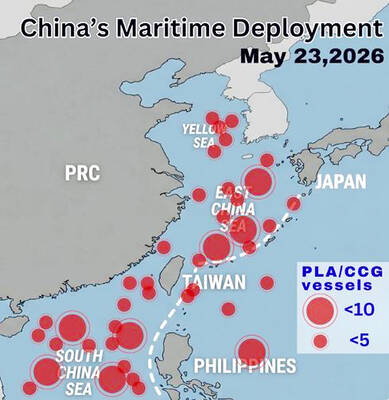
WARNING: China should stop engaging in actions that undermine regional peace and stability, as it would only build resentment among people across the Strait, the CGA said China has deployed more than 100 navy, coast guard and other vessels in waters from the Yellow Sea to the South China Sea and the western Pacific since US President Donald Trump and Chinese President Xi Jinping (習近平) met in Beijing, National Security Council Secretary-General Joseph Wu (吳釗燮) said yesterday. “In this part of the world, #China is the one & only PROBLEM wrecking the #StatusQuo & threatening regional peace & stability,” Wu wrote on X. In a separate post, he said Beijing was coercing Taiwan’s maritime domain, calling it illegal and provocative, after the Coast Guard Administration (CGA) expelled a


 RSS
RSS