


The Taiwanese diplomat who pleaded guilty to a charge of violating a US federal labor law in Kansas City, Missouri, on Friday may have to wait months before she can be released after the judge presiding over the case delayed ruling on a plea bargain agreement.
The ruling was a setback for Jacqueline Liu (劉姍姍), director-general of the Taipei Economic and Cultural Office in Kansas City, who has been detained since Nov. 10, when she was arrested on charges of underpaying and overworking her Filipino housekeeper.
US prosecutors accused Liu of fraudulently hiring two Philippine housekeepers for her residence. One was employed in 2009 and last year, and the other from March 6 to August this year. By pleading guilty, Liu admitted she fraudulently entered into employment contracts with two housekeepers and that she did not intend to comply with the stated terms, US prosecutors said in a press release.
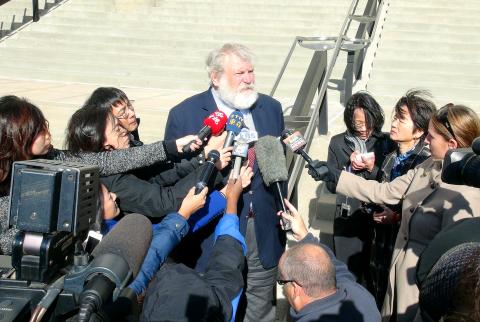
Photo: CNA
After Liu waived her right to a grand jury trial at a detention hearing on Wednesday, she signed a plea agreement with prosecutors, but US District Judge David Gregory Kays did not accept the plea agreement at Friday’s hearing.
Kays said he would consider the plea agreement and a pre-sentencing investigation report, which could take about three months to complete. Liu is to remain in custody while the judge considers the plea agreement.
The Kansas City Star reported Kays asking in the hearing: “Did you do this in your official capacity or as a private individual?” and “Did you use your title when you signed your name [to the contract]?” — to which Liu replied: “No.”
Liu’s answer seemingly contradicted a statement by the Ministry of Foreign Affairs when it first responded to Liu’s arrest that the employment of the housekeeper was related to Liu’s official duties and that the housekeeper did not come under the purview of Liu’s personal life.
The two housekeepers were both paid by the ministry.
When about Liu’s contention that the housekeeper was not hired under her official position, the ministry’s spokesman James Chang (章計平) said in Taipei that “he respected” what Liu had said.
At the conclusion of Friday’s hearing, Liu paid a total of US$80,044 in full restitution to the two victims, which accounts for the hours they worked based on a schedule of 16 to 18 hours of work per day over six-and-a-half days a week.
Under the terms of the plea agreement, Taipei and Liu would jointly recommend a sentence of time served, which would trigger Liu’s immediate deportation from the US upon sentencing.
Liu remains in federal custody until her sentencing hearing, which has yet to be scheduled.
The two housekeepers have been proven to be victims of a severe form of human trafficking under the Trafficking Victims Protection Act, US prosecutors said.
“As a result, they will receive government support for a T visa, which would allow, among other benefits, them to legally remain and work in the US,” they said.
After the “waiver and plea hearing,” Liu’s lawyer Jim Wirken said his client seemed uneasy about the hearing’s outcome.
Wirken had hoped Kays would agree at the hearing to a 24-point plea bargain deal negotiated by him and US Assistant Attorney Cynthia Cordes, who recommended a sentence of time served and deportation.
According to the Kansas City Star, Liu appeared in court on Friday in a prison-issued jumpsuit with her hands and feet shackled, unlike the hearing on Wednesday, in which she appeared unshackled and dressed in street clothes.
Wirken said he had requested that Liu be permitted to wear street clothes, but that Kays had decided that she be treated no differently from any other defendant in pre-trial detention, according to the paper.
Chang said the ministry felt “deeply grieved” that Liu had to wear a prison jumpsuit and be shackled.
“Liu is our director-general of a Taipei Economic and Cultural Office in the US. She should be accorded due respect,” he said.
Liu’s case has been characterized by the ministry as a personal incident rather than one in which the US government failed to treat a Taiwanese diplomat with due respect and to follow due process during its investigation into the allegations against Liu.
The shift coincidently came after Wirken’s first meeting with Liu on Wednesday and followed discussions with ministry officials to devise strategies to settle the case.
Additional reporting by CNA

National Taiwan University (NTU) yesterday said it disqualified a person from an entrance examination for using AI smart glasses to cheat, along with two others for making untruthful statements in their curriculum vitae. The three applicants were given null scores, Taiwan’s highest-ranked university said, calling on prospective students to be honest in the admissions process. NTU registrar Lee Hung-sen (李宏森) said that the cheating applicant wore a hat and thick-rimmed glasses to the second written exam for medical school, claiming that they felt cold. Suspicions were aroused when the applicant stared oddly at the test for long stretches while steadily bringing the paper
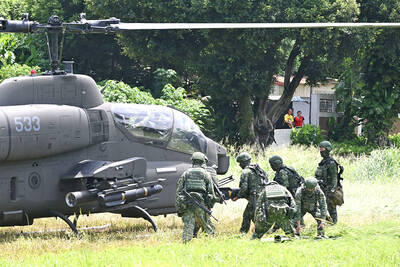
MILITARY ISSUES: A partisan divide between the Cabinet and the legislature ‘raised questions about Taiwan’s ability to adequately fund its defense,’ the report said Taiwan’s defense budget, military personnel numbers and resilience are challenges to its ability to meet national defense goals, the US Naval Institute said in a report published on Tuesday. In response to the perception of a growing military threat posed by China, Taiwan has embarked on an effort to enhance the capabilities needed to deter an attempt by Beijing to annex the nation by force, the institute said in the US Congressional Research Service report, titled Taiwan: Defense and Military Issues, which was filed on Thursday last week. Taiwan’s defense budget increased by about 7.5 percent from 2024 to last year, it

66 FIGHTER JETS: The aircraft is likely undergoing preparations for its transfer to Taiwan — a significant step forward in the nation’s modernization program, a lawmaker said The first of Taiwan’s order of F-16V Block 70 aircraft has been sighted in Texas ahead of delivery, Democratic Progressive Party (DPP) Legislator Wang Ting-yu (王定宇) said. Taiwan’s first F-16V Block 70 two-seat aircraft, tail number 6831, was seen flying from Lockheed Martin’s production facility in Greenville, South Carolina, to Naval Air Station Joint Reserve Base Fort Worth in Texas, Wang wrote on Facebook yesterday. The plane is likely undergoing preparations for its transfer to Taiwan, marking a significant step forward in the Republic of China Air Force’s modernization program, Wang said, citing military analysts. The F-16V Block 70 is a new-build version

NOT JUST NUMBERS: What matters to intelligence work is crucial, reliable information, so even a few credible leads can be highly valuable to national security, a legislator said The National Security Bureau (NSB) yesterday said it has finished the establishment of an information-reporting channel for Chinese nationals, the aim of which is to broaden intelligence gathering on China’s political, military, economic and social developments. Chinese nationals can submit information on the Web page, https://report.nsb.gov.tw, the NSB said in a statement. The move aims to expand the bureau’s diverse intelligence sources and is pursuant to the National Intelligence Services Act (國家情報工作法), it said, adding that it referenced practices adopted by intelligence agencies in the US, the UK and Israel. An increasing number of people are approaching Taiwanese agencies to provide information, as


 RSS
RSS