


The Taiwanese diplomat who pleaded guilty to a charge of violating a US federal labor law in Kansas City, Missouri, on Friday may have to wait months before she can be released after the judge presiding over the case delayed ruling on a plea bargain agreement.
The ruling was a setback for Jacqueline Liu (劉姍姍), director-general of the Taipei Economic and Cultural Office in Kansas City, who has been detained since Nov. 10, when she was arrested on charges of underpaying and overworking her Filipino housekeeper.
US prosecutors accused Liu of fraudulently hiring two Philippine housekeepers for her residence. One was employed in 2009 and last year, and the other from March 6 to August this year. By pleading guilty, Liu admitted she fraudulently entered into employment contracts with two housekeepers and that she did not intend to comply with the stated terms, US prosecutors said in a press release.
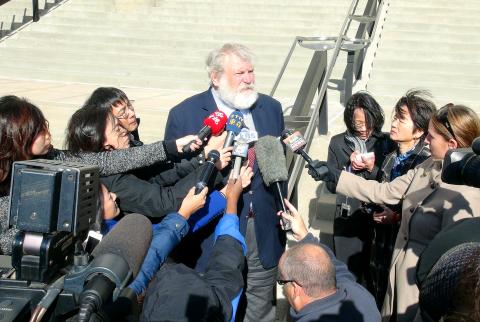
Photo: CNA
After Liu waived her right to a grand jury trial at a detention hearing on Wednesday, she signed a plea agreement with prosecutors, but US District Judge David Gregory Kays did not accept the plea agreement at Friday’s hearing.
Kays said he would consider the plea agreement and a pre-sentencing investigation report, which could take about three months to complete. Liu is to remain in custody while the judge considers the plea agreement.
The Kansas City Star reported Kays asking in the hearing: “Did you do this in your official capacity or as a private individual?” and “Did you use your title when you signed your name [to the contract]?” — to which Liu replied: “No.”
Liu’s answer seemingly contradicted a statement by the Ministry of Foreign Affairs when it first responded to Liu’s arrest that the employment of the housekeeper was related to Liu’s official duties and that the housekeeper did not come under the purview of Liu’s personal life.
The two housekeepers were both paid by the ministry.
When about Liu’s contention that the housekeeper was not hired under her official position, the ministry’s spokesman James Chang (章計平) said in Taipei that “he respected” what Liu had said.
At the conclusion of Friday’s hearing, Liu paid a total of US$80,044 in full restitution to the two victims, which accounts for the hours they worked based on a schedule of 16 to 18 hours of work per day over six-and-a-half days a week.
Under the terms of the plea agreement, Taipei and Liu would jointly recommend a sentence of time served, which would trigger Liu’s immediate deportation from the US upon sentencing.
Liu remains in federal custody until her sentencing hearing, which has yet to be scheduled.
The two housekeepers have been proven to be victims of a severe form of human trafficking under the Trafficking Victims Protection Act, US prosecutors said.
“As a result, they will receive government support for a T visa, which would allow, among other benefits, them to legally remain and work in the US,” they said.
After the “waiver and plea hearing,” Liu’s lawyer Jim Wirken said his client seemed uneasy about the hearing’s outcome.
Wirken had hoped Kays would agree at the hearing to a 24-point plea bargain deal negotiated by him and US Assistant Attorney Cynthia Cordes, who recommended a sentence of time served and deportation.
According to the Kansas City Star, Liu appeared in court on Friday in a prison-issued jumpsuit with her hands and feet shackled, unlike the hearing on Wednesday, in which she appeared unshackled and dressed in street clothes.
Wirken said he had requested that Liu be permitted to wear street clothes, but that Kays had decided that she be treated no differently from any other defendant in pre-trial detention, according to the paper.
Chang said the ministry felt “deeply grieved” that Liu had to wear a prison jumpsuit and be shackled.
“Liu is our director-general of a Taipei Economic and Cultural Office in the US. She should be accorded due respect,” he said.
Liu’s case has been characterized by the ministry as a personal incident rather than one in which the US government failed to treat a Taiwanese diplomat with due respect and to follow due process during its investigation into the allegations against Liu.
The shift coincidently came after Wirken’s first meeting with Liu on Wednesday and followed discussions with ministry officials to devise strategies to settle the case.
Additional reporting by CNA

The Ministry of Transportation and Communications yesterday inaugurated the Danjiang Bridge across the Tamsui River in New Taipei City, saying that the structure would be an architectural icon and traffic artery for Taiwan. Feted as a major engineering achievement, the Danjiang Bridge is 920m long, 211m tall at the top of its pylon, and is the longest single-pylon asymmetric cable-stayed bridge in the world, the government’s Web site for the structure said. It was designed by late Iraqi-British architect Zaha Hadid. The structure, with a maximum deck of 70m, accommodates road and light rail traffic, and affords a 200m navigation channel for boats,

PRECISION STRIKES: The most significant reason to deploy HIMARS to outlying islands is to establish a ‘dead zone’ that the PLA would not dare enter, a source said A High Mobility Artillery Rocket System (HIMARS) would be deployed to Penghu County and Dongyin Island (東引) in Lienchiang County (Matsu) to force the Chinese military to retreat at least 100km from the coastline, a military source said yesterday. Taiwan has been procuring HIMARS and Army Tactical Missile Systems (ATACMS) from the US in batches. Once all batches have been delivered, Taiwan would possess 111 HIMARS units and 504 ATACMS, which have a range of 300km. Considering that “offense is the best defense,” the military plans to forward-deploy the systems to outlying islands such as Penghu and Dongyin so that

Taiwan Semiconductor Manufacturing Co (TSMC, 台積電), the world’s largest foundry service provider, yesterday said that global semiconductor revenue is projected to hit US$1.5 trillion in 2030, after the figure exceeds US$1 trillion this year, as artificial intelligence (AI) demand boosts consumption of token and compute power. “We are still at the beginning of the AI revolution, but we already see a significant impact across the whole semiconductor ecosystem,” TSMC deputy cochief operating officer Kevin Zhang (張曉強) said at the company’s annual technology symposium in Hsinchu City. “It is fair to say that in the past decade, smartphones and other mobile devices were

‘CLEAR MESSAGE’: The bill would set up an interagency ‘tiger team’ to review sanctions tools and other economic options to help deter any Chinese aggression toward Taiwan US Representative Young Kim has introduced a bill to deter Chinese aggression against Taiwan, calling for an interagency “tiger team” to preplan coordinated sanctions and economic measures in response to possible Chinese military or political action against Taiwan. “[Chinese President] Xi Jinping [習近平] has directed the People’s Liberation Army to be ready to invade Taiwan by 2027. China has a plan. America should have one too,” Kim said in a news release on Thursday last week. She introduced the “Deter PRC [People’s Republic of China] aggression against Taiwan act” to “ensure the US has a coordinated sanctions strategy ready should


 RSS
RSS