

Leaked US cables show that China’s diplomatic service was “unhappy” with what was interpreted as Chinese President Hu Jintao’s (胡錦濤) “tacit acceptance” of the “diplomatic truce” strategy advocated by President Ma Ying-jeou (馬英九).
When he assumed the presidency on May 20, 2008, Ma sought a “diplomatic truce” to end a longstanding tug-of-war with China in which both countries tried to poach each other’s diplomatic allies by offering large sums of foreign aid.
A number of leaked US cables released by WikiLeaks suggest that Chinese officials in charge of diplomatic affairs and Taiwan affairs have been divided on the issue.
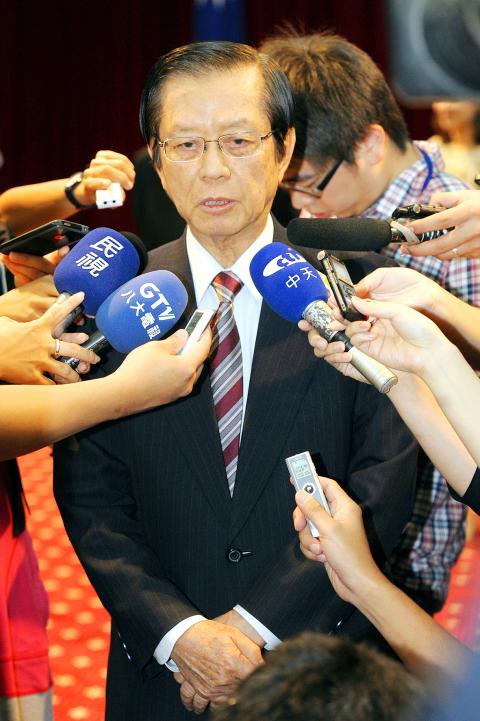
Photo: George Tsorng, Taipei Times
A cable dated Jan. 16, 2009, from the US embassy in Beijing quoted Jin Canrong (金燦榮), a professor at Renmin University, saying that “the MFA [Ministry of Foreign Affairs] is still opposed to the ceasefire, in part because it means ‘fewer ambassadorships’ will be available to MFA career diplomats.”
“Jin claimed the MFA is particularly unhappy because five countries that currently recognize Taiwan are willing to switch their recognition to the PRC [People’s Republic of China], but the MFA has been forced to give up this ‘achievement’ because of pressure from the TAO [Taiwan Affairs Office] to observe the ‘diplomatic ceasefire,’” the cable said.
Jin said the “ceasefire” would hold as long as “Hu continues to side with the TAO” over the MFA, the cable said.
The same cable made a mention of a fifth point addressed by Hu in his speech delivered on Dec. 31, 2009, marking the then-30th anniversary of the “New Year’s Message to Taiwan Compatriots” that stated “avoiding internal strife in external affairs is conducive to furthering the overall interests of the Chinese nation.”
The statement was interpreted by Chinese academics as Hu’s “tacit acceptance” of Ma’s “diplomatic truce” strategy, the cable said.
Zhou Zhihuai (周志懷), Secretary-General of the National Society of Taiwan Studies (NSTS), was quoted in the cable as telling the US embassy that “Hu could not formally mention the ‘diplomatic ceasefire’ because it implies the existence of two countries.”
The cable quoted unidentified US experts, who met with Ma on Jan. 13 that year, as saying that “Ma said this phrase and Hu’s endorsement of a ‘comprehensive economic cooperation agreement’ were the two positive responses from Hu to Ma’s proposals.”
Meanwhile, in another cable dated Aug. 20, 2008, Zhou “commented that the PRC is observing a diplomatic truce, but admitted the issue is divisive in Chinese policymaking circles” as he described to US officials “three political fault lines in the Chinese Government’s internal debate over the diplomatic truce.”
“The first is an institutional dispute between the MFA, which wants to score more diplomatic allies, and the TAO, which wants to avoid inflaming public opinion in Taiwan by orchestrating humiliating diplomatic defections. The second division is along age lines, with older cadres wanting to keep the diplomatic battle going and younger ones less inclined to fight for the last few small states. Lastly, a difference of opinion exists between scholars who are in favor of the truce and some older government officials, who tend to be more cautious,” Zhou was quoted as saying in the cable.
Another cable originating from the American Institute in Taiwan dated Sept. 21, 2009, quoted Minister of Foreign Affairs Timothy Yang (楊進添) as saying that “it was not clear that PRC diplomats had responded to President Ma’s ‘diplomatic truce’ by being less aggressive in efforts to isolate Taiwan.”
“One possible explanation, Yang said, was that PRC diplomats overseas had not yet been given instructions on how to deal with their Taiwan counterparts. Certainly, he noted, the PRC Foreign Ministry was notoriously conservative on Taiwan issues. Finally, it was possible that instances of apparent ill-will by PRC diplomats reflected individual actions, rather than a coordinated MFA effort,” the cable said.
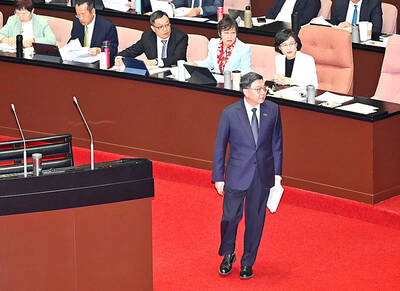
The government is monitoring online rumors that a pneumonic plague outbreak has spread from Russia into China, and it might enhance quarantine measures, Premier Cho Jung-tai (卓榮泰) said yesterday. During a legislative meeting, Democratic Progressive Party Legislator Wang Ting-yu (王定宇) said that rumors had circulated that the disease had spread across several Chinese provinces. He asked Cho whether the government was prepared to prevent the disease spreading to Taiwan, given the volume of traffic between the two sides, and how concerned the government was about the alleged outbreak. The Ministry of Health and Welfare had implemented border quarantine measures after briefing the Executive
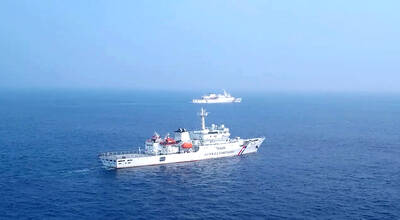
PATROL PARTNERS: The ‘Chiayi’ and the ‘Penghu’ departed for a two-day joint patrol of Palau’s exclusive economic zone, the CGA’s second diplomatic visit to the country The Coast Guard Administration (CGA) set a record for its southernmost deployment of a coast guard vessel as the vessels Chiayi and the Penghu reached Palau’s Pulo Anna Island on Saturday in a cooperative exercise between the two countries. The island, about 217 nautical miles (401km) southwest of Koror in the Palauan state of Sonsorol and 1,220 nautical miles from Taiwan’s southernmost point, Oluanpi (鵝鑾鼻), is the furthest south a CGA vessel has sailed. The two vessels are in Palau for the coast guard’s second diplomatic visit to the country. They docked at Malakal Harbor on Tuesday last week. The coast guard
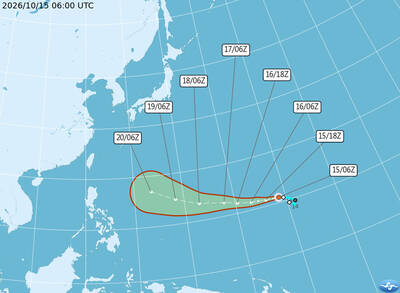
EAST OF GUAM: Tropical Storm Champi is forecast to strengthen into a typhoon, but its effect on Taiwan is uncertain due to the presence of a high-pressure system Tropical Storm Champi formed yesterday and has the potential to increase in strength, the Central Weather Administration (CWA) said yesterday. Forecasters are closely monitoring a Pacific high-pressure system that would dictate whether the storm turns north or moves toward Taiwan next week, the CWA said. The most likely scenario is that it turns northward after passing the Ryukyu Islands, CWA forecaster Cheng Chieh-jen (鄭傑仁) said. As of 8pm yesterday, Champi was east of Guam moving west-northwest at 20kph, CWA data showed. It had maximum sustained winds near the center of 72kph and gusts of up to 101kph, the data showed. If the Pacific high-pressure system
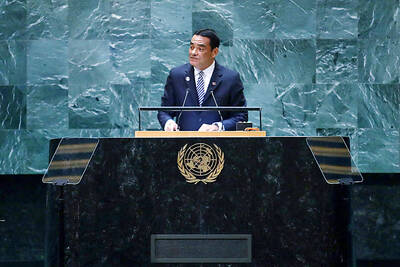
RIGHT TO DIPLOMACY: Under the UN Charter, every state has the right to conduct foreign policy free from external pressure, Belize said in a statement Belize and Paraguay on Monday condemned Beijing sanctions over their countries’ ties with Taiwan, saying China’s actions create unnecessary tensions. Earlier on Monday, Beijing announced sanctions against Paraguayan Minister of Information and Communication Technologies Gustavo Villate and Belizean Minister of Foreign Affairs Francis Fonseca. The Paraguayan Ministry of Foreign Affairs said it rejected the sanctions, writing on X that they created unnecessary friction. It added that it reaffirmed its support for Taiwan and its commitment to democratic values and principles. Villate told the Spanish-language Paraguayan daily ABC Color the sanctions were “predictable” and linked them to several cooperation projects between Taiwan and Paraguay. The projects


 RSS
RSS