


Anti-secrecy Web site WikiLeaks on Friday dumped its full unredacted archive of more than 250,000 US diplomatic cables online, drawing a furious response from its media partners.
The Web site confirmed in a message on Twitter that all 251,287 of the US embassy cables had been posted on the Internet and posted a link to a site containing the documents that can be accessed without a password.
Five media groups that worked with WikiLeaks on the first release last year — The Guardian, the New York Times, German news magazine Der Spiegel, Spanish daily El Pais and France’s Le Monde — condemned the decision to publish the cables without first deleting the names of sources who spoke to US diplomats.
“We deplore the decision of WikiLeaks to publish the unredacted [US] State Department cables, which may put sources at risk,” they said in a joint statement published in The Guardian.
“Our previous dealings with WikiLeaks were on the clear basis that we would only publish cables which had been subjected to a thorough editing and clearance process,” the statement said.
WikiLeaks had been slowly releasing the leaked documents since November and had largely worked with the media organizations, which trawled through the information to erase the names of potentially vulnerable sources.
The decision to dump the remaining documents will also anger the US, which has warned the move could endanger the lives of its sources and was irate last week when some of the cables were published with names unprotected.
“Shining a light on 45 years of US ‘diplomacy,’ it is time to open the archives forever,” WikiLeaks said in a tweet announcing the release on Friday.
Previous releases revealed the often candid views of US diplomats about foreign governments around the world and caused huge embarrassment to the US.
The Guardian said the newly published archives contained more than 1,000 cables identifying individual activists, as well as some labeled with a tag used by the US to mark sources it believed could be in danger if identified.
Meanwhile, Iraq said it would open an investigation into the alleged summary execution of 10 Iraqis, including four women and five children, by US forces in 2006, disclosed in an April 2006 US diplomatic cable released last week.
The document release came amid a row between WikiLeaks and The Guardian over who was behind last week’s release of thousands of unredacted cables.
WikiLeaks accused The Guardian of leaking the password to the archive, but the newspaper denied the allegation.
The joint statement by the five media partners on Friday said the decision to publish the full archive was the decision of WikiLeaks’ Australian frontman Julian Assange, “and his alone.”
Assange is currently living under stringent bail conditions in Britain, fighting extradition to Sweden where he is wanted for questioning over alleged rape and sexual assault.
The US Department of State said on Thursday that WikiLeaks had informed it in advance of the document releases, but ignored US appeals that making them public could endanger lives and put US national security at risk.
WikiLeaks has defended the release of the diplomatic cables as the journalistic exposure of official deception.
US soldier Bradley Manning is suspected of leaking the cables and other military documents to WikiLeaks. He was arrested in June last year while deployed in Iraq and is being held in a US military prison.
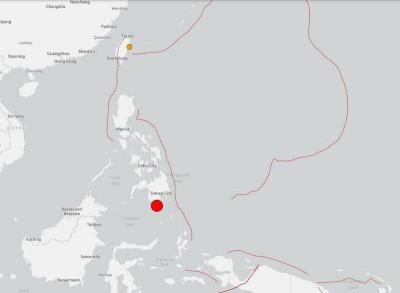
A magnitude 7.8 earthquake struck off the southern coast of Mindanao in the Philippines at 7:38am today, prompting the US Tsunami Warning System to issue an alert for neighboring countries, including Taiwan. The system issued a purple alert indicating a "tsunami threat." The potential threat zone includes Taiwan, the Philippines, Papua New Guinea, Yap and Palau. Philippine authorities were assessing the damage from the quake, with the office of civil defense seeking to verifying initial reports that 15 people had been killed and 129 injured in the region, mostly from falling debris. Arlene Hollero, disaster chief of Maasim town in the Philippines' Sarangani Province,
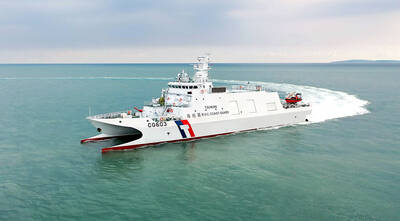
‘GRAY ZONE’ PRESSURE: Beijing’s activities are intended to create the deceitful impression that China has jurisdiction over the area around Taiwan, the CGA said Taiwan’s rights over its territorial waters and exclusive economic zone must not be violated by any country, the Mainland Affairs Council said yesterday, adding that it will not accept any unprovoked actions. The council issued the remarks in response to the China Coast Guard conducting maritime enforcement drills near eastern Taiwan and claiming to fully exercise China’s maritime administrative law enforcement authority. The Coast Guard Administration (CGA) has been closely monitoring the situation and is taking concrete steps to defend the nation’s sovereignty and secure its waters, the council said. China has no sovereign rights over the waters off eastern
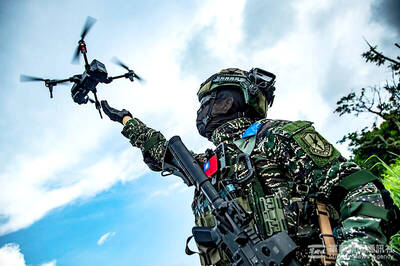
RESILIENCE: Taiwan plays a key role in semiconductors, energy, information infrastructure and advanced manufacturing, AIT Director Raymond Greene said Taiwan’s continued investment in deterrence and resilience remains vital, especially in uncrewed systems and other emerging technologies, American Institute in Taiwan (AIT) Director Raymond Greene said yesterday. Greene made the remarks at the annual National Strategic Summit on Supply Chain Resilience held by the Research Institute for Democracy, Society and Emerging Technology (DSET), a government-backed think tank. As Taiwan last year became the US’ fourth-largest trading partner and supply chain security is becoming more important, cooperation in emerging technologies continues to deepen between the two countries, he said. The US is committed to accelerating innovation, building key infrastructure, strengthening cooperation

RIGHT DIRECTION: Taiwan’s efforts to prevent forced labor include a proposal to ‘fully prohibit’ employers from withholding workers’ documents, an official said Taiwan is to establish a mechanism to restrict imports of goods linked to forced labor, the Executive Yuan said yesterday, after the US proposed imposing additional tariffs on Taiwanese goods over labor concerns. “The Ministry of Labor and the Ministry of Economic Affairs are to establish an interministerial review procedure,” Executive Yuan spokesperson Michelle Lee (李慧芝) said at a news briefing in Taipei. “The government is to use the Foreign Trade Act [貿易法] as the legal basis to restrict imports of goods produced with forced labor” and bring its supply chain governance more in line with international standards on human rights, resilience


 RSS
RSS