


People First Party (PFP) Chairman James Soong (宋楚瑜) yesterday said he would register with the Central Election Commission next month and launch a petition to collect the required number of signatures for presidential aspirants.
In an interview with ERA TV last night, Soong said he would pick up the petition form at the commission between Sept. 16 and Sept. 20 and start collecting signatures from supporters on Sept. 22. However, he refused to confirm whether this would be an indication that he was “determined” to run for president.
The number of signatures required to qualify for registration as a presidential candidate is 250,000. Soong, 69, said he would not join the election unless he collects at least 1 million signatures.
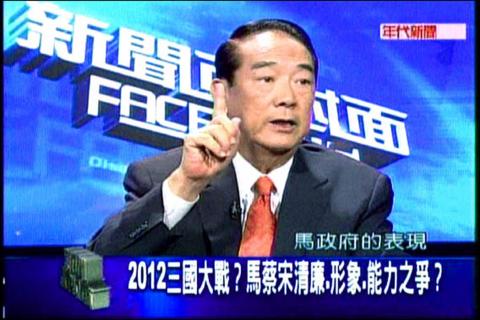
Photo: Screen grab from ERATV
“If we successfully collected 1 million signatures, and with proper financial support, of course I would consider serving the people and meet their expectations [by running for president],” he said.
“Launching the petition is an indication of my willingness to run for the presidency, as it is part of the procedure to obtain an admission ticket to the presidential election ... It would be a great encouragement for me if we collected 1 million signatures, and it would be more likely that I would join the presidential election,” he said.
PFP spokesman Wu Kun-yu (吳崑玉) said the signature drive would last 45 days, and Soong would make a final decision depending on the result of the signature drive.
Soong, the only elected governor of Taiwan Province from 1994 to 1998, talked about his experience as a governor in handling typhoons and other disasters.
He said the government needed re-engineering to improve its efficiency and called on President Ma Ying-jeou (馬英九) and Democratic Progressive Party (DPP) Chairperson Tsai Ing-wen (蔡英文) to stop focusing on cross-strait ideology in their election campaigns.
Soong and the PFP were a close ally of the Chinese Nationalist Party (KMT) until conflict between the two parties over election nominations led to a split, which deepened after King Pu-tsung (金溥聰), executive director of Ma’s re-election campaign office, filed a lawsuit against Soong in November last year for accusing King of manipulating the presidential elections by fabricating polls in 2000 and 2004.
King declined to comment on Soong’s potential bid, saying any comments he made could spark disputes and cause misunderstandings.
DPP spokesman Chen Chi-mai (陳其邁) said his party respected Soong’s decision to run in the presidential race.
Ma and King have no one else to blame but themselves on the division of the pan-blue camp, Chen said.
Additional reporting by Chris Wang

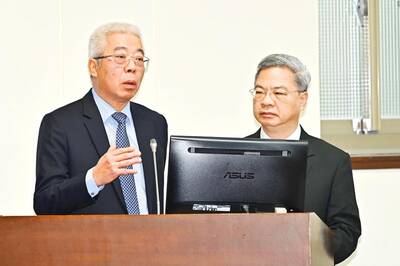
Taiwan has arranged for about 8 million barrels of crude oil, or about one-third of its monthly needs, to be shipped from the Red Sea this month to bypass the Strait of Hormuz and ease domestic supply pressures, CPC Corp, Taiwan (CPC, 台灣中油) said yesterday. The state-run oil company has worked with Middle Eastern suppliers to secure routes other than the Strait of Hormuz, through which about 20 percent of the world’s oil and liquefied natural gas typically passes, CPC chairman Fang Jeng-zen (方振仁) said at a meeting of the legislature’s Economics Committee in Taipei. Suppliers in Saudi Arabia have indicated they
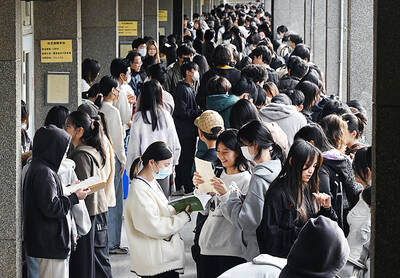
A global survey showed that 60 percent of Taiwanese had attained higher education, second only to Canada, the Ministry of the Interior said. Taiwan easily surpassed the global average of 43 percent and ranked ahead of major economies, including Japan, South Korea and the US, data from the Organisation for Economic Co-operation and Development (OECD) for 2024 showed. Taiwan has a high literacy rate, data released by the ministry showed. As of the end of last year, Taiwan had 20.617 million people aged 15 or older, accounting for 88.5 percent of the total population, with a literacy rate of 99.4 percent, the data
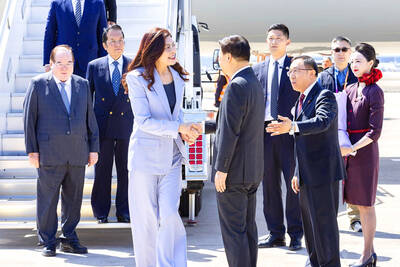
CCP ‘PAWN’? Beijing could use the KMT chairwoman’s visit to signal to the world that many people in Taiwan support the ‘one China’ principle, an academic said Chinese Nationalist Party (KMT) Chairwoman Cheng Li-wun (鄭麗文) yesterday arrived in China for a “peace” mission and potential meeting with Chinese President Xi Jinping (習近平), while a Taiwanese minister detailed the number of Chinese warships currently deployed around the nation. Cheng is visiting at a time of increased Chinese military pressure on Taiwan, as the opposition-dominated Legislative Yuan stalls a government plan for US$40 billion in extra defense spending. Speaking to reporters before going to the airport, Cheng said she was going on a “historic journey for peace,” but added that some people felt uneasy about her trip. “If you truly love Taiwan,

NEW LOW: The council in 2024 based predictions on a pessimistic estimate for the nation’s total fertility rate of 0.84, but last year that rate was 0.69, 17 percent lower An expected National Development Council (NDC) report expects the nation’s population to drop below 12 million by 2065, with the old-age dependency ratio to top 100 percent sooner than 2070, sources said yesterday. The council is slated to release its latest population projections in August, using an ultra-low fertility model, the sources said. The previous report projected that Taiwan’s population would fall to 14.37 million by 2070, but based on a new estimate of the total fertility rate (TFR) — the average number of children born to a woman over her lifetime — the population is expected to reach 12 million by


 RSS
RSS