


Pakistan gave China access to the previously unknown US “stealth” helicopter that crashed during the commando raid that killed al-Qaeda leader Osama bin Laden in May despite explicit requests from the CIA not to, the Financial Times reported on Sunday.
The disclosure, if confirmed, is likely to further shake the US-Pakistan relationship, which has been improving slightly after hitting its lowest point in decades following the killing of bin Laden.
During the raid, one of two modified Blackhawk helicopters, believed to employ unknown stealth capability, malfunctioned and crashed, forcing the commandos to abandon it.
“The US now has information that Pakistan, particularly the ISI [Inter Services Intelligence Directorate], gave access to the Chinese military to the downed helicopter in Abbottabad,” the paper quoted a person “in intelligence circles” as saying on its Web site.
It said Pakistan, which enjoys a close relationship with China, allowed Chinese intelligence officials to take pictures of the crashed aircraft as well as take samples of its special “skin” that allowed the US raid to evade Pakistani radar.
One US official, speaking on condition of anonymity, said there was reason to believe Pakistan had allowed the Chinese to inspect the aircraft, but the official could not confirm it happened with certainty.
No one from the Pakistani army was available for comment, but the ISI, Pakistan’s top spy agency, denied the report. The paper said Pakistan’s top general, Chief of Army Staff Ashfaq Kayani, denied that China had been given access.
The surviving tail section, photographs of which were widely distributed on the Internet, was returned to the US following a trip by US Senator John Kerry in May, a spokesman for the US embassy said.
Shortly after the raid, Pakistan hinted that it might give China access to the helicopter, given its fury over the raid, which it considers a grievous violation of its sovereignty.
“We had explicitly asked the Pakistanis in the immediate aftermath of the raid not to let anyone have access to the damaged remains of the helicopter,” the Financial Times quoted the source as saying.
In an incident such as the helicopter crash, it is standard US procedure to destroy sophisticated technology such as encrypted communications and navigation computers.
Pakistan is a strategic ally to the US, but the relationship has been on a downward spiral since the killing of the al-Qaeda leader in the raid by US forces.
Islamabad was not informed in advance and responded by cutting back on US trainers in the country and placing limits on CIA activities there.
The fact that the al-Qaeda leader lived for years near the Pakistani army’s main academy in the northwestern garrison town of Abbottabad reinforced suspicions in Washington about Islamabad’s reliability in the war against militant Islamists.
There are also growing frustrations with Pakistan over its reluctance to mount offensives against militant factions in the northwest who are fighting US-led foreign forces across the border in Afghanistan.
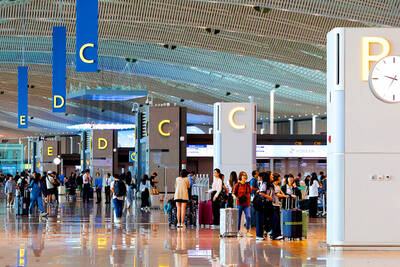
South Korea has adjusted its electronic arrival card system to no longer list Taiwan as a part of China, a move that the Ministry of Foreign Affairs said would help facilitate exchanges between the two sides. South Korea previously listed “Taiwan” as “Taiwan (China)” in the drop-down menus of its online arrival card system, where people had to fill out where they came from and their next destination. The ministry had requested South Korea make a revision and said it would change South Korea’s name on Taiwan’s online immigration system from “Republic of Korea” to “Korea (South),” should the issue not be

Tainan, Taipei and New Taipei City recorded the highest fines nationwide for illegal accommodations in the first quarter of this year, with fines issued in the three cities each exceeding NT$7 million (US$220,639), Tourism Administration data showed. Among them, Taipei had the highest number of illegal short-term rental units, with 410. There were 3,280 legally registered hotels nationwide in the first quarter, down by 14 properties, or 0.43 percent, from a year earlier, likely indicating operators exiting the market, the agency said. However, the number of unregistered properties rose to 1,174, including 314 illegal hotels and 860 illegal short-term rental

ECONOMIC COERCION: Such actions are often inconsistently applied, sometimes resumed, and sometimes just halted, the Presidential Office spokeswoman said The government backs healthy and orderly cross-strait exchanges, but such arrangements should not be made with political conditions attached and never be used as leverage for political maneuvering or partisan agendas, Presidential Office spokeswoman Karen Kuo (郭雅慧) said yesterday. Kuo made the remarks after China earlier in the day announced 10 new “incentive measures” for Taiwan, following a landmark meeting between Chinese President Xi Jinping (習近平) and Chinese Nationalist Party (KMT) Chairwoman Cheng Li-wun (鄭麗文) in Beijing on Friday. The measures, unveiled by China’s Xinhua news agency, include plans to resume individual travel by residents of Shanghai and China’s Fujian

Chinese President Xi Jinping (習近平) and Chinese Nationalist Party (KMT) Chairwoman Cheng Li-wun (鄭麗文) met in Beijing yesterday, where they vowed to bring people on both sides of the Taiwan Strait closer to facilitate the “great rejuvenation of the Chinese nation.” The meeting was held in the East Hall of the Great Hall of the People, a venue typically reserved for meetings between Xi and foreign heads of state. In public remarks prior to a closed-door meeting, Xi, in his role as head of the Chinese Communist Party (CCP), said that Taiwan is historically part of China, and remains an “inalienable” and


 RSS
RSS