


A US court has dealt a new blow to the healthcare reform law seen as US President Barack Obama’s proudest domestic achievement, declaring its centerpiece provision unconstitutional.
The Eleventh Circuit appeals court, based in Atlanta, ruled on Friday that the law’s individual mandate, which requires everyone to own health insurance in the US’ mostly private system or pay a penalty, exceeded the US Congress’ powers.
However, the court ruled that the remainder of the healthcare law, which extended coverage to an extra 32 million people and was a long-held dream of Democrats, was within the bounds of the US Constitution.
About 50 million Americans lack basic health insurance. As a result, hospitals and taxpayers are forced to pay about US$43 billion a year to cover the costs of those who are treated but cannot pay.
The ruling increased the likelihood that the US Supreme Court will be called upon to rule on the healthcare law’s constitutionality, possibly as soon as next year, in the heat of a presidential election campaign.
Republicans strongly oppose the law, which they have dubbed “Obamacare,” as an infringement on individual liberty, and have sworn to repeal it.
By a 2-1 margin, the Eleventh Circuit affirmed a ruling by a lower Florida court that the individual mandate was unconstitutional, in a case brought by 26 state governors and attorneys general, most of them Republican.
However, the judges overturned another part of the Florida court’s ruling that the entire healthcare law, passed last year, was unconstitutional.
“The individual mandate exceeds Congress’s enumerated commerce power and is unconstitutional,” Chief Judge Joel Dubina wrote. “This economic mandate represents a wholly novel and potentially unbounded assertion of congressional authority: the ability to compel Americans to purchase an expensive health insurance product they have elected not to buy, and to make them re-purchase that insurance product every month for their entire lives.”
The White House said it strongly disagreed with the decision and was confident that the law would ultimately be upheld as constitutional.
It also pointed out that four courts, including the Sixth Court of Appeals, had endorsed the law.
“Those who claim this provision exceeds Congress’ power to regulate interstate commerce are incorrect,” said Stephanie Cutter, a special assistant to Obama.
She said those who chose not to buy insurance in the US private medical system hurt everyone else, because taxpayers end up subsidizing their care when the uninsured are taken to emergency rooms.
The White House also justifies the individual mandate by saying that without it people would wait until they get sick to apply for coverage, which would cause insurance premiums to rise.
However, the ruling cheered Republicans, who see the healthcare law as an unacceptable intrusion by government into individual freedoms.
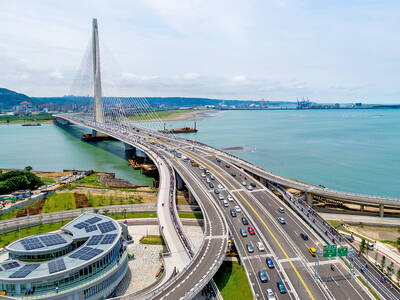
The Ministry of Transportation and Communications yesterday inaugurated the Danjiang Bridge across the Tamsui River in New Taipei City, saying that the structure would be an architectural icon and traffic artery for Taiwan. Feted as a major engineering achievement, the Danjiang Bridge is 920m long, 211m tall at the top of its pylon, and is the longest single-pylon asymmetric cable-stayed bridge in the world, the government’s Web site for the structure said. It was designed by late Iraqi-British architect Zaha Hadid. The structure, with a maximum deck of 70m, accommodates road and light rail traffic, and affords a 200m navigation channel for boats,
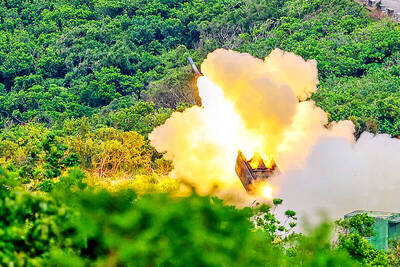
PRECISION STRIKES: The most significant reason to deploy HIMARS to outlying islands is to establish a ‘dead zone’ that the PLA would not dare enter, a source said A High Mobility Artillery Rocket System (HIMARS) would be deployed to Penghu County and Dongyin Island (東引) in Lienchiang County (Matsu) to force the Chinese military to retreat at least 100km from the coastline, a military source said yesterday. Taiwan has been procuring HIMARS and Army Tactical Missile Systems (ATACMS) from the US in batches. Once all batches have been delivered, Taiwan would possess 111 HIMARS units and 504 ATACMS, which have a range of 300km. Considering that “offense is the best defense,” the military plans to forward-deploy the systems to outlying islands such as Penghu and Dongyin so that

‘CLEAR MESSAGE’: The bill would set up an interagency ‘tiger team’ to review sanctions tools and other economic options to help deter any Chinese aggression toward Taiwan US Representative Young Kim has introduced a bill to deter Chinese aggression against Taiwan, calling for an interagency “tiger team” to preplan coordinated sanctions and economic measures in response to possible Chinese military or political action against Taiwan. “[Chinese President] Xi Jinping [習近平] has directed the People’s Liberation Army to be ready to invade Taiwan by 2027. China has a plan. America should have one too,” Kim said in a news release on Thursday last week. She introduced the “Deter PRC [People’s Republic of China] aggression against Taiwan act” to “ensure the US has a coordinated sanctions strategy ready should

Taiwan Semiconductor Manufacturing Co (TSMC, 台積電), the world’s largest foundry service provider, yesterday said that global semiconductor revenue is projected to hit US$1.5 trillion in 2030, after the figure exceeds US$1 trillion this year, as artificial intelligence (AI) demand boosts consumption of token and compute power. “We are still at the beginning of the AI revolution, but we already see a significant impact across the whole semiconductor ecosystem,” TSMC deputy cochief operating officer Kevin Zhang (張曉強) said at the company’s annual technology symposium in Hsinchu City. “It is fair to say that in the past decade, smartphones and other mobile devices were


 RSS
RSS