


The Democratic Progressive Party (DPP) yesterday alleged that President Ma Ying-jeou (馬英九) and former presidential spokesman Lo Chih-chang (羅智強) violated the Anti-Corruption Act (貪污治罪條例) when they turned Ma’s Facebook page from a state property managed by the Presidential Office into a private asset managed by Ma’s re-election campaign office without following proper procedures.
The Presidential Office set up Ma’s Facebook page in late January and its management was transferred to Ma’s re-election campaign office on July 2.
According to DPP spokesman Chuang Ruei-hsiung (莊瑞雄), changes of ownership or rights of operation of all national property should go through open, selective or limited tendering procedures in accordance with the Public Procurement Act (政府採購法).
Saying that the DPP suspected Ma of corruption and Lo, the deputy executive of Ma’s campaign office, of embezzlement, Chuang said he would file a lawsuit with the Supreme Prosecutors’ Office Special Investigation Division (SID) against Ma and Lo today.
Operation of Ma’s Facebook page was part of the Presidential Office’s communications program, which has a budget of about NT$2.5 million (US$86,400).
“That was why the fan page is considered state property,” Chuang said. “And President Ma failed to separate personal affairs from public ones.”
Chuang said that many foreign heads of state, including US President Barack Obama, set up their own Facebook pages, but “none of them made the government-funded Web site their campaign Web site.”
All the electronic information on Ma’s Facebook page is state property, DPP spokesman Chen Chi-mai (陳其邁) added.
In a Facebook message on July 2, Ma said operation of the page would be transferred from the Presidential Office to his campaign office to “prevent the confusion of government affairs with campaign affairs.”
“It was like a government official who has resigned, but takes his public laptop home. That’s embezzlement,” DPP spokesman Liang Wen-jie (梁文傑) said, adding that Ma always said he prides himself of being a person who abides and rules by the law, “however, is this law-abiding behavior?”
In response, Ma’s campaign office spokesman Yin Wei (殷瑋) yesterday said the NT$2.5 million budget was listed for the operation of the Presidential Office’s official Web site and not used to run Ma’s Facebook page.
The Presidential Office has never used the budget to post any ads or commercials on the Facebook page to campaign for Ma, Yin added.
As to the DPP’s challenge over the campaign office’s abuse of state properties, including pictures, articles and messages on Ma’s Facebook page, Yin said all of the president’s pictures and videos, whether they were from the campaign office or the Presidential Office’s Web site, were authorized for free downloading or forwarding.
“Information on Facebook and fans on the president’s Facebook page are not anyone’s assets. Should DPP Chairperson Tsai Ing-wen (蔡英文) consider her fans on her Facebook page as a DPP asset? Such illogical accusations underestimate the wisdom of voters,” he said.
Yin defended the campaign office’s management of Ma’s Facebook page, an online platform that is open for discussions.
Lo will reserve the right to pursue legal action against the DPP in response to the party’s threat to file a lawsuit against him, Yin added.
ADDITIONAL REPORTING BY MO YAN-CHIH
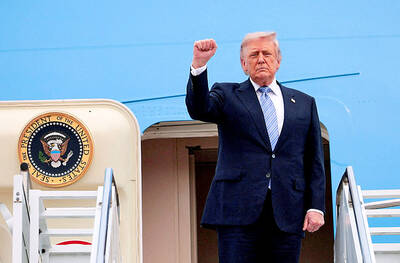
US-CHINA SUMMIT: MOFA welcomed US reassurance of no change in its Taiwan policy; Trump said he did not comment when Xi talked of opposing independence US President Donald Trump yesterday said he has not made a decision on whether to move forward with a major arms package for Taiwan after hearing concerns about it from Chinese President Xi Jinping (習近平). Trump’s comments on Taiwan came as he flew back to Washington after wrapping up critical talks in which both leaders said important progress was made in stabilizing US-China relations even as deep differences persist between the world’s two biggest powers on Iran and Taiwan. “I will make a determination,” Trump said, adding: “I’ll be making decisions. But, you know, I think the last thing we need right
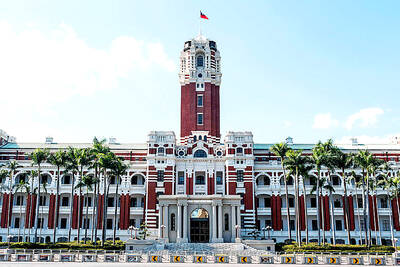
SECURITY: Taipei presses the US for arms supplies, saying the arms sales are not only a reflection of the US security commitment to Taiwan but also serve as a mutual deterrent against regional threats Taiwan is committed to preserving the cross-strait “status quo” and contributing to regional peace and stability, the Presidential Office said yesterday. “It is an undeniable fact that the Republic of China is a sovereign and independent democratic nation,” Presidential Office spokeswoman Karen Kuo (郭雅慧) reiterated, adding that Beijing has no right to claim sovereignty over Taiwan. The statements came after US President Donald Trump warned against Taiwanese independence. Trump wrapped up a state visit to Beijing on Friday, during which Chinese President Xi Jinping (習近平) had pressed him not to support Taiwan. Taiwan depends heavily on US security backing to deter China from carrying
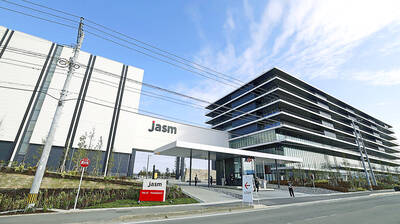
The subsidiary of Taiwan Semiconductor Manufacturing Co (TSMC, 台積電) in Kumamoto, Japan, turned a profit in the first quarter of this year, marking the first time the first fab of the unit has become profitable since mass production started at the end of 2024. According to the contract chipmaker’s financial statement released on Friday, Japan Advanced Semiconductor Manufacturing Inc (JASM), a joint venture running the fab in Kumamoto, posted NT$951 million (US$30.19 million) in profit in the January-to-March period, compared with a loss of NT$1.39 billion in the previous quarter, and a loss of NT$3.25 billion in the first quarter of
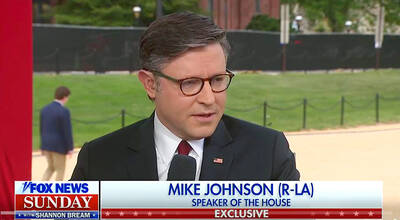
RESOLUTE BACKING: Two Republican senators are planning to introduce legislation that would impose immediate sanctions on China if it attempts to invade Taiwan US House of Representatives Speaker Mike Johnson on Sunday reaffirmed US congressional support for Taiwan, saying the US and “all freedom-loving people” have a stake in preventing China from seizing Taiwan by force. Johnson made the remarks in an interview with Fox News Sunday on US President Donald Trump’s summit with Chinese President Xi Jinping (習近平) last week. In an interview that aired on Friday on Fox News, just as Trump wrapped up a high-stakes visit to China, he said he has yet to green-light a new US$14 billion arms package to Taiwan and that it “depends on China.” “It’s a very good


 RSS
RSS