


State media in China, the largest holder of US debt, chided the US yesterday over a deal to raise its borrowing limit, saying it was hiding “risks and troubles” for the world economy.
The US House of Representatives late on Monday approved a package that would slash spending in return for raising the legal limit on US sovereign debt, in a bid to avoid a catastrophic default.
“Although the United States has basically avoided default, its sovereign debt problems remain unresolved,” a comment piece said in the People’s Daily, a mouthpiece of the Chinese Communist Party. “They are just deferred and there is a tendency for them to grow. This is casting a shadow over the recovery of the US economy and hiding even bigger risks and troubles for the global economy.”
China, sitting on the world’s biggest foreign exchange reserves of about US$3.2 trillion at the end of June, is the largest holder of US Treasuries.
The debate over the debt ceiling, which the newspaper labeled a “political fight,” would hurt the credibility of US Treasuries, though a default was “essentially unlikely,” it said.
The last-minute deal revealed the long-term risks to China’s massive holdings of US Treasuries, a separate article said in the overseas edition of the People’s Daily.
“It is necessary to change the current concentration on US dollar assets, but what is more important is to change the trend of increasing holdings of dollar assets in future,” Li Xiangyang (李祥陽), a researcher at the official Chinese Academy of Social Sciences, wrote in the article. “This requires a fundamental adjustment in the economic growth model.”
The Xinhua news agency chimed in by saying the US remained a “debt economy” and the long-term risks of a default still existed.
The US is very likely to let the US dollar depreciate to pass off the debt to its creditors, which may cause more flows of speculative funds, or hot money, into emerging economies like China and push up inflation, it said.
“If the US chooses to repudiate debt in this hidden manner, it will seriously impact the stable growth of the global economy,” said Xinhua, which last week urged the US to “live within one’s means.”
State television also criticized the agreement in a rare editorial broadcast on the national evening bulletin on Monday, saying it had more “pomp and ceremony than substance.”
“The American taxpayer and global debt holders suddenly finds out that the debt crisis is only a tool ... that the main concern is to get more political capital for the next presidential election,” China Central Television said.
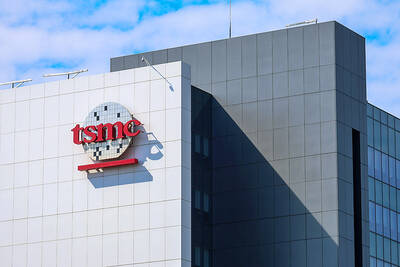
Taiwan Semiconductor Manufacturing Co (TSMC, 台積電), the world’s largest foundry service provider, yesterday said that global semiconductor revenue is projected to hit US$1.5 trillion in 2030, after the figure exceeds US$1 trillion this year, as artificial intelligence (AI) demand boosts consumption of token and compute power. “We are still at the beginning of the AI revolution, but we already see a significant impact across the whole semiconductor ecosystem,” TSMC deputy cochief operating officer Kevin Zhang (張曉強) said at the company’s annual technology symposium in Hsinchu City. “It is fair to say that in the past decade, smartphones and other mobile devices were
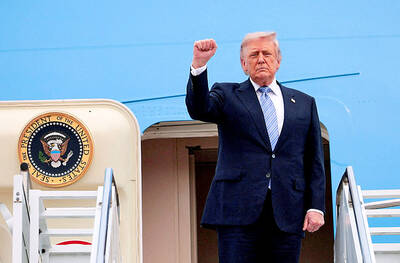
US-CHINA SUMMIT: MOFA welcomed US reassurance of no change in its Taiwan policy; Trump said he did not comment when Xi talked of opposing independence US President Donald Trump yesterday said he has not made a decision on whether to move forward with a major arms package for Taiwan after hearing concerns about it from Chinese President Xi Jinping (習近平). Trump’s comments on Taiwan came as he flew back to Washington after wrapping up critical talks in which both leaders said important progress was made in stabilizing US-China relations even as deep differences persist between the world’s two biggest powers on Iran and Taiwan. “I will make a determination,” Trump said, adding: “I’ll be making decisions. But, you know, I think the last thing we need right
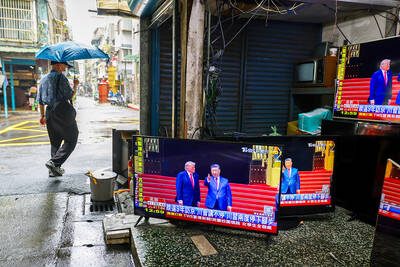
TAIWAN ISSUE: US treasury secretary Scott Bessent said on the first day of meetings that ‘it wouldn’t be a US-China summit without the Taiwan issue coming up’ There were no surprises on the first day of the summit between US President Donald Trump and Chinese President Xi Jinping (習近平), the Mainland Affairs Council (MAC) said yesterday, as the government reiterated that cross-strait stability is crucial to the Asia-Pacific region, as well as the world. As the two presidents met for a highly anticipated summit yesterday, Chinese state media reported that Xi warned Trump that missteps regarding Taiwan could push their two countries into “conflict.” Trump arrived in China with accolades for his host, calling Xi a “great leader” and “friend,” and extending an invitation to visit the White House
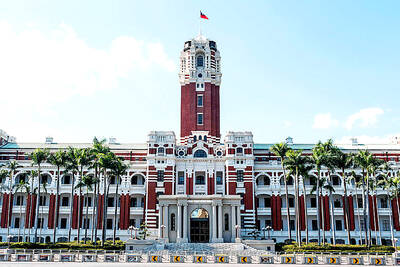
SECURITY: Taipei presses the US for arms supplies, saying the arms sales are not only a reflection of the US security commitment to Taiwan but also serve as a mutual deterrent against regional threats Taiwan is committed to preserving the cross-strait “status quo” and contributing to regional peace and stability, the Presidential Office said yesterday. “It is an undeniable fact that the Republic of China is a sovereign and independent democratic nation,” Presidential Office spokeswoman Karen Kuo (郭雅慧) reiterated, adding that Beijing has no right to claim sovereignty over Taiwan. The statements came after US President Donald Trump warned against Taiwanese independence. Trump wrapped up a state visit to Beijing on Friday, during which Chinese President Xi Jinping (習近平) had pressed him not to support Taiwan. Taiwan depends heavily on US security backing to deter China from carrying


 RSS
RSS