


The US is committed to maintaining its presence in the South China Sea, US Joint Chiefs of Staff Chairman Admiral Mike Mullen said in China yesterday, adding that Washington was worried that disputes over the resource-rich waters could lead to serious conflict.
China has been embroiled in rows with the Philippines and Vietnam in recent months over what each government sees as intrusions and illegitimate claims in the stretch of ocean spanning key shipping lanes.
“The worry, among others that I have, is that the ongoing incidents could spark a miscalculation and an outbreak that no one anticipated,” Mullen said at the start of a four-day visit to China.
Despite unease over China’s growing military capabilities and assertiveness in the disputed waters, US-China military relations have thawed in recent months and Mullen’s trip to China is seen a reciprocal visit for the one by People’s Liberation Army (PLA) Chief of the General Staff Chen Bingde (陳炳德) to Washington in May.
That visit marked the countries’ highest-level military-to-military talks since China severed ties early last year over US$6.4 billion in US arms sale to Taiwan.
The US has pledged its support to the Philippines in the South China Sea, which is believed to harbor rich oil and gas reserves, but Beijing insists on handling disputes on a one-on-one basis rather than multilaterally.
Taiwan, China, the Philippines, Malaysia, Brunei and Vietnam all claim territory in the South China Sea. China’s claim is the largest, incorporating most of the sea’s 1.7 million square kilometers, including the Spratly (南沙群島) and Paracel archipelagos (西沙群島).
China and the US broached the South China Sea issue at talks in Hawaii last month and the topic could dominate the agenda at an upcoming meeting of ASEAN foreign ministers in Indonesia.
The official English-language China Daily newspaper said in an editorial on Friday that ASEAN should not tolerate attempts by outside forces to interfere in bilateral disputes, a thinly veiled swipe at US promises of support for the Philippines and proposed military exercises with Vietnam.
However, Mullen, while emphasizing the US desire to see a peaceful resolution to territorial claims in the South China Sea, also said Washington would not quit the region.
“The US is not going away. Our enduring presence in this region has been important to our allies for decades and will continue to be so,” he said.
Meanwhile, Mullen urged Beijing to use its relationship with North Korea to ensure regional stability, while warning Pyongyang against further provocations.
“North Korea and the leadership of North Korea is only predictable in one sense and that is — if you base it historically — they will continue to provocate,” Mullen told reporters.
Six-party nuclear disarmament talks, grouping the two Koreas, China, Japan, Russia and the US have been stalled since the North abandoned them in April 2009. It staged its second nuclear test a month later.
“The Chinese leadership, they have a strong relationship with the leadership in Pyongyang and they exercise that routinely ... continuing to do that as they have done in the past is really important,” Mullen said.
Mullen’s trip coincided with a joint naval exercise with the US, Japanese and Australian navies in the South China Sea that began on Saturday.
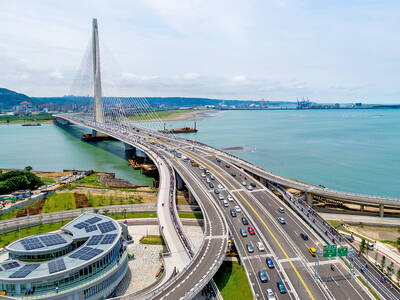
The Ministry of Transportation and Communications yesterday inaugurated the Danjiang Bridge across the Tamsui River in New Taipei City, saying that the structure would be an architectural icon and traffic artery for Taiwan. Feted as a major engineering achievement, the Danjiang Bridge is 920m long, 211m tall at the top of its pylon, and is the longest single-pylon asymmetric cable-stayed bridge in the world, the government’s Web site for the structure said. It was designed by late Iraqi-British architect Zaha Hadid. The structure, with a maximum deck of 70m, accommodates road and light rail traffic, and affords a 200m navigation channel for boats,
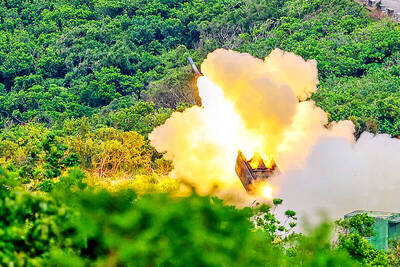
PRECISION STRIKES: The most significant reason to deploy HIMARS to outlying islands is to establish a ‘dead zone’ that the PLA would not dare enter, a source said A High Mobility Artillery Rocket System (HIMARS) would be deployed to Penghu County and Dongyin Island (東引) in Lienchiang County (Matsu) to force the Chinese military to retreat at least 100km from the coastline, a military source said yesterday. Taiwan has been procuring HIMARS and Army Tactical Missile Systems (ATACMS) from the US in batches. Once all batches have been delivered, Taiwan would possess 111 HIMARS units and 504 ATACMS, which have a range of 300km. Considering that “offense is the best defense,” the military plans to forward-deploy the systems to outlying islands such as Penghu and Dongyin so that

Taiwan Semiconductor Manufacturing Co (TSMC, 台積電), the world’s largest foundry service provider, yesterday said that global semiconductor revenue is projected to hit US$1.5 trillion in 2030, after the figure exceeds US$1 trillion this year, as artificial intelligence (AI) demand boosts consumption of token and compute power. “We are still at the beginning of the AI revolution, but we already see a significant impact across the whole semiconductor ecosystem,” TSMC deputy cochief operating officer Kevin Zhang (張曉強) said at the company’s annual technology symposium in Hsinchu City. “It is fair to say that in the past decade, smartphones and other mobile devices were

US-CHINA SUMMIT: MOFA welcomed US reassurance of no change in its Taiwan policy; Trump said he did not comment when Xi talked of opposing independence US President Donald Trump yesterday said he has not made a decision on whether to move forward with a major arms package for Taiwan after hearing concerns about it from Chinese President Xi Jinping (習近平). Trump’s comments on Taiwan came as he flew back to Washington after wrapping up critical talks in which both leaders said important progress was made in stabilizing US-China relations even as deep differences persist between the world’s two biggest powers on Iran and Taiwan. “I will make a determination,” Trump said, adding: “I’ll be making decisions. But, you know, I think the last thing we need right


 RSS
RSS