


President Ma Ying-jeou’s (馬英九) campaign office yesterday crossed swords with Democratic Progressive Party (DPP) Chairperson and presidential nominee Tsai Ing-wen (蔡英文) over the latter’s latest campaign slogan: “I am a Taiwanese (我是台灣人),” which follows two earlier slogans — “Taiwan NEXT” and “Taiwan, what do you want?”
Tsai said in a speech in Nantou County yesterday that if elected, she will “ensure people feel proud about being Taiwanese.”
Tsai said that the willingness to identify oneself as Taiwanese in public, with pride, is a symbol of Taiwan’s democratic values and social progress.
“When we are overseas, we should be able to say: ‘I am Taiwanese’ out loud,” Tsai said, adding that if the DPP regains power next year, she will devote more resources to enhancing Taiwan’s recognition in the international community.
At a campaign event in New Taipei City (新北市) on Friday, Tsai accused the Ma administration of undermining the nation’s sovereignty and identity, and said that the government “made it difficult for people in Taiwan to be Taiwanese.”
“It also seems that President Ma finds it difficult to say the word ‘Taiwanese’ out loud,” she said.
In response, Ma’s campaign office yesterday accused Tsai of seeking to make ethnicity a campaign issue and urged the DPP to abandon what it called “an old election tactic.”
Ma’s campaign office spokesman Yin Wei (殷瑋) accused Tsai of resorting to “Taiwanese rhetoric,” a tactic that he said had been a favorite of the DPP since the campaigns of former president Chen Shui-bian (陳水扁) and one that would be rejected by the public.
“People who grow up and live in Taiwan, regardless of their political affiliations, are all Taiwanese, and being Taiwanese is a natural thing. Which part of being Taiwanese is so difficult?” he said.
Taiwanese identity is not the property of the DPP, Yin said. It is a social reality shared by people in Taiwan, he added
On Tsai’s promise to gain more respect for Taiwan as a member of the international community and raise Taiwanese people’s sense of dignity, Yin defended Ma’s efforts to safeguard the nation’s dignity and the sovereignty of the Republic of China on the international stage by citing the nation’s participation in the WHO and the increasing number of countries granting Taiwanese visa-waiver status.
Compared with the Ma administration’s achievements in raising the nation’s international profile, he said Tsai, a former vice premier, participated in six WHO-related activities under the name “Taiwan, China,” Yin said.
ADDITIONAL REPORTING BY CNA

A signaling system malfunction disrupted high-speed rail (HSR) services beginning at 8am today, with trains temporarily reduced to three northbound and three southbound trains per hour as authorities conduct inspections. The malfunction occurred on a section of track in Miaoli County during pre-operation checks early this morning, forcing northbound and southbound trains to use a single track, the HSR operator said. The regular schedule has been replaced with three hourly trains offering only nonreserved seating in each direction, stopping at every station, it said, adding that business class cars would still have reserved seating. Departures from terminal stations are scheduled at the top

DRONE CENTRAL: Taiwan aims to become Asia’s democratic hub for drones, with most exports focused on high-quality military-grade models, an official said Taiwan’s drone industry is expected to expand significantly by 2030, producing 100,000 units per month and exporting half of them, the Ministry of Economic Affairs said yesterday. Current drone production capacity is about 15,000 units per month, but the industry can quickly scale up as demand increases, Industrial Development Administration Director-General Chiou Chyou-huey (邱求慧) told a news conference in Taipei. Taiwan’s drone output grew 2.5-fold last year to NT$12.9 billion (US$408.3 million) under a government program to develop the uncrewed vehicle sector, he said. The Executive Yuan in October last year approved plans to invest NT$44.2 billion into domestic production of uncrewed aerial
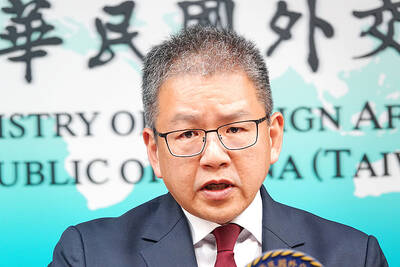
Taiwan is still in the process of assessing the possibility of recruiting workers from Eswatini, the Ministry of Foreign Affairs said yesterday, adding that its goal is to help Eswatini upgrade its vocational training centers. If there are plans to recruit workers from Eswatini, safeguarding national security, protecting public health and ensuring the employment rights of Taiwanese would be prerequisites, Department of West Asian and African Affairs Director-General Yen Chia-liang (顏嘉良) told a news conference. Key considerations would also include filling labor shortages in specific industries, and fostering bilateral professional and technical exchanges, he said. Yen was asked about the progress of labor

VERBOSE VESSELS: A CGA cutter and a China Coast Guard exchanged verbal barbs for more than a day in Taiwanese-controlled waters before the Chinese vessel left The Taiwanese and Chinese coast guards had a standoff near the strategically located Pratas Islands (Dongsha Islands, 東沙群島) in the north of the South China Sea, the Coast Guard Administration (CGA) said yesterday. The two sides engaged in intense radio exchanges over sovereignty claims during the 33-hour standoff. China Coast Guard vessel 3501 eventually left the restricted waters, 26.6 nautical miles (49.2km) west of the Pratas Islands, at 5pm yesterday, the CGA said. Lying approximately between southern Taiwan and Hong Kong, the Taiwan-controlled Pratas are seen by some security experts as vulnerable to Chinese attack due to their distance — more than


 RSS
RSS