

South Korean marines fired rifles at a South Korean commercial aircraft flying near the sea border with North Korea, thinking it was one of the North’s jet fighters, but they never hit their target, military sources said yesterday.
The shooting illustrates the level of tension between the two Koreas, still technically at war after the 1950-1953 Korean conflict ended in a truce rather than a peace treaty, which came close to all-out war last year.
A Republic of Korea (ROK) Marine Corps spokesman said two soldiers guarding an island on the waters off the South’s western city of Incheon fired their K-2 rifles for about 10 minutes at around 4am on Friday.
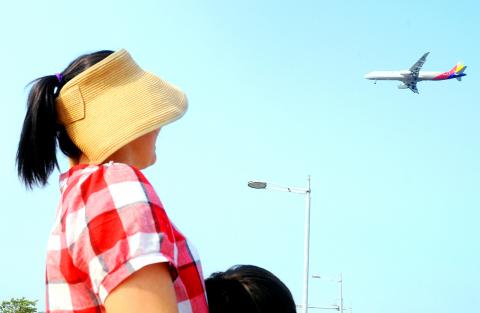
Photo: AFP
The plane was later identified as an Asiana Airlines Airbus A320 flying from China making its descent into Incheon International Airport.
A South Korean defense ministry source said the plane, carrying 119 passengers and crew, was undamaged as it was about 500m to 600m out of the range of the handheld K-2 rifles.
Yonhap news agency and other local media said the soldiers believed the plane was flying north of the normal air corridor. Asiana officials told the news agency the plane never left its scheduled course.
“We checked yesterday through the air force and the airport control center to make sure there were no abnormalities such as being off course,” Yonhap quoted a company official as saying.
An airline official confirmed the plane was an Airbus A320, but made no other comment.
Yonhap and other news reports quoted ROK Marine Corps officers as saying troops would undergo thorough training on how to identify civilian aircraft. Airlines will be asked to ensure their planes do not deviate from set courses.
The North denies responsibility in the sinking in March last year of a South Korean warship and says it was provoked in the second incident, the shelling of the South Korean island of Yeonpyeong after the South test-fired shells into disputed waters.
The two attacks killed about 50 South Koreans.
The North this month rejected a proposal from Seoul for a series of three presidential summits after a secret meeting of officials from the two countries. The North denounced the South’s call for an apology for the two attacks.
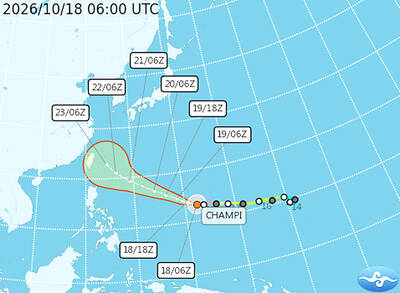
A sea warning for Typhoon Champi could be issued as early as Wednesday night, possibly followed by a land warning on Thursday night or Friday, as the storm approaches Taiwan, the Central Weather Administration (CWA) said yesterday. The typhoon is expected to have its greatest impact on Taiwan on Friday and Saturday, bringing heavy rain to central and northern Taiwan and to Yilan and Hualien counties in the east, CWA forecaster Liu Pei-teng (劉沛滕) said. As of 2pm yesterday, Champi was about 2,470km east-southeast of Oluanpi (鵝鑾鼻), Taiwan’s southernmost tip, moving westnorthwest at 20kph. It had maximum sustained winds of 191kph and a

FRIDAY, SATURDAY: While Typhoon Champi might weaken, officials warned about large waves, while some transport services and tourist spots have been affected Typhoon Champi is forecast to have the greatest effect on Taiwan tomorrow and on Saturday, with a sea warning issued late last night and a land warning expected afternoon today, the Central Weather Administration (CWA) said yesterday. The storm’s projected track has shifted slightly westward and it could begin moving away from Taiwan toward Japan’s Kyushu island on Saturday, with the warnings potentially lifted as early as Saturday afternoon, CWA forecaster Chang Cheng-chuan (張承傳) said. As of yesterday afternoon, Champi was about 910km east-southeast of Oluanpi (鵝鑾鼻), Taiwan proper’s southernmost point, CWA data showed. Its maximum sustained winds had weakened slightly to
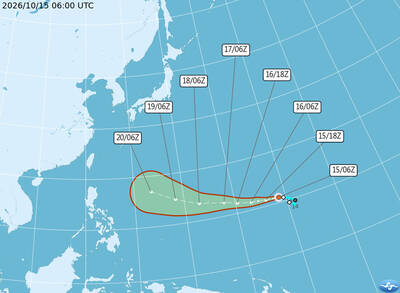
EAST OF GUAM: Tropical Storm Champi is forecast to strengthen into a typhoon, but its effect on Taiwan is uncertain due to the presence of a high-pressure system Tropical Storm Champi formed yesterday and has the potential to increase in strength, the Central Weather Administration (CWA) said yesterday. Forecasters are closely monitoring a Pacific high-pressure system that would dictate whether the storm turns north or moves toward Taiwan next week, the CWA said. The most likely scenario is that it turns northward after passing the Ryukyu Islands, CWA forecaster Cheng Chieh-jen (鄭傑仁) said. As of 8pm yesterday, Champi was east of Guam moving west-northwest at 20kph, CWA data showed. It had maximum sustained winds near the center of 72kph and gusts of up to 101kph, the data showed. If the Pacific high-pressure system
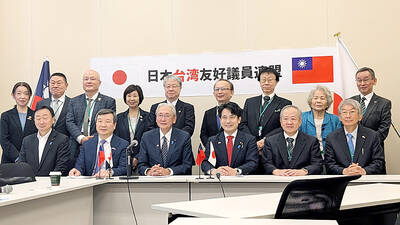
ORIGINS: A Taiwanese doctor practicing in Japan said he no longer needed to cover the nationality label on his license with a sticker, as it used to confuse his patients Starting this month, Taiwanese professionals working in Japan can list “Taiwan” as their place of origin following Tokyo’s easing of rules on “nationality” in official licensing documents. The change was announced yesterday by the Japan-Taiwan Friendship Parliamentarians’ League in Tokyo. The license revision covers 322 professions, including doctors and nurses. Previously, Taiwanese had to list “China” as their nationality on professional certifications and licenses, but the new rules updated the “nationality” to “nationality and region” or “nationality, etc,” allowing Taiwanese to use the name “Taiwan.” The league held a meeting about the revision at the House of Representatives Members’ Office Building in Tokyo


 RSS
RSS