


European lawmakers condemned the WHO in a letter of protest that accused the world body of undermining its own credibility when it referred to Taiwan as a province of China.
In a letter delivered to the head of the WHO, British MEP (EU lawmaker) Charles Tannock said he believed the body’s position on Taiwan to be “politically and morally flawed.”
WHO Director-General Margaret Chan (陳馮富珍), as a Chinese citizen, “risks calling into question [her] own personal impartiality and integrity” by terming Taiwan a part of China, Tannock wrote in a letter also signed by 20 other MEPs.
“No United Nations specialized agency has the right unilaterally to decide on the status in international law of any given country or territory,” the letter said. “As you well know, UN agencies and their staff are required to remain impartial and not to take instructions from, or show favor to, any national government.”
Tannock, who chairs the European Parliament-Taiwan Friendship Group, was asked by President Ma Ying-jeou (馬英九) during a visit to Taiwan last month to speak in favor of the nation using the term “Chinese Taipei.”
The request came in the wake of the release of a WHO internal memo released by a Democratic Progressive Party (DPP) lawmaker that told agencies to refer to Taiwan as a province of China, pursuant to an agreement with Beijing.
Since 2009, Taiwan has been invited to observe the World Health Assembly (WHA), the WHO governing body, as Chinese Taipei, although the memo made clear that “there has been no change in the status of Taiwan Province of China.”
Tannock said he was “dismayed” by the revelation and that the world body’s “explicit reference to Taiwan as a province of China has no basis in international law.”
“It is therefore hard to avoid the conclusion that the People’s Republic of China has deliberately sought to compromise the independence and impartiality of the WHO for its own political purposes,” he wrote. “We urge you to change the WHO’s internal procedures to refer to Taiwan as ‘Chinese Taipei,’ the accepted nomenclature that Taiwan uses in other international organizations and structures.”
The letter was signed by lawmakers from a range of EU political groups, including 10 from the largest, the European People’s Party. Tannock is the foreign affairs spokesman of the smaller European Conservatives and Reformists Group.
The letter also called for Taiwan to be allowed to play a more meaningful role in the WHO, pursuant with a resolution passed by the European parliament last month.
“We believe that Taiwan, with its excellent healthcare sector and world-class doctors, has much to contribute to the WHO ... Healthcare is a basic human right and should never be exploited as a political pawn,” he wrote.
The Republic of China exited the UN, the parent body of the WHO, in 1971 after being replaced by a People’s Republic of China representative.
Government officials have lauded Taiwan’s inclusion as an observer in the WHA since 2009 as a “breakthrough” in international relations, although optimism was later dampened by the release of the WHO memo by DPP Legislator Kuan Bi-ling (管碧玲).
The memo was accompanied by the disclosure of other information reinforcing the claim, including WHO publishing policies and a mislabeled list of Taiwanese experts, leading the government to file a formal letter of protest on May 16.
Kuan said yesterday that she believed the MEPs’ letter to the WHO head was even more strongly worded than the government’s protest letter, which attracted controversy for discrepancies between the English and Chinese versions.
“The remarks in the MEPs’ protest letter makes it seem like they are defending their own country,” Kuan said. “It makes the government’s letter look weak.”

PROVOCATIVE: Chinese Deputy Ambassador to the UN Sun Lei accused Japan of sending military vessels to deliberately provoke tensions in the Taiwan Strait China denounced remarks by Japan and the EU about the South China Sea at a UN Security Council meeting on Monday, and accused Tokyo of provocative behavior in the Taiwan Strait and planning military expansion. Ayano Kunimitsu, a Japanese vice foreign minister, told the Council meeting on maritime security that Tokyo was seriously concerned about the situation in the East China and South China seas, and reiterated Japan’s opposition to any attempt to change the “status quo” by force, and obstruction of freedom of navigation and overflight. Stavros Lambrinidis, head of the EU delegation to the UN, also highlighted South China Sea
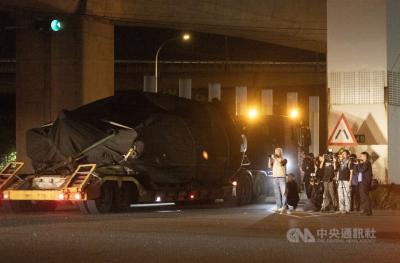
The final batch of 28 M1A2T Abrams tanks purchased from the US arrived at Taipei Port last night and were transported to the Armor Training Command in Hsinchu County’s Hukou Township (湖口), completing the military’s multi-year procurement of 108 of the tanks. Starting at 12:10am today, reporters observed more than a dozen civilian flatbed trailers departing from Taipei Port, each carrying an M1A2T tank covered with black waterproof tarps. Escorted by military vehicles, the convoy traveled via the West Coast Expressway to the Armor Training Command, with police implementing traffic control. The army operates about 1,000 tanks, including CM-11 Brave Tiger
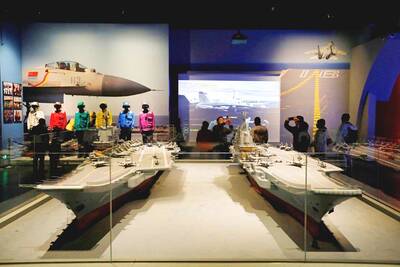
China on Wednesday teased in a video an aircraft carrier that could be its fourth, and the first using nuclear power, while making an allusion to Taiwan and vowing to further build up its islands, as it looks to boost maritime power, secure resources and bolster territorial claims. The video, issued on the eve of the 77th founding anniversary of the Chinese People’s Liberation Army Navy, featured fictional officers with names that are homophones of three commissioned aircraft carriers, the Liaoning (遼寧), Shandong (山東) and Fujian (福建). Titled Into the Deep, it showed a 19-year-old named “Hejian” (何劍) joining the group, sparking
Taiwan Semiconductor Manufacturing Co (TSMC, 台積電), the world’s largest contract chipmaker, said it expects its 2-nanometer (2nm) chip capacity to grow at a compound annual rate of 70 percent from this year to 2028. The projection comes as five fabs begin volume production of 2-nanometer chips this year — two in Hsinchu and three in Kaohsiung — TSMC senior vice president and deputy cochief operating officer Cliff Hou (侯永清) said at the company’s annual technology symposium in Silicon Valley, California, last week. Output in the first year of 2-nanometer production, which began in the fourth quarter of last year, is expected to


 RSS
RSS