


US Representative Dana Rohrabacher is threatening to end his strong legislative support for Taiwan as a result of Chunghwa Telecom’s (CHT, 中華電信) decision to terminate satellite services for “pro--democracy” channel New Tang Dynasty Television (新唐人電視台, NTDTV).
“If Taiwan does not support the struggle for freedom of thought within China, I see no need for America to support Taiwan,” Rohrabacher said in a letter sent on Wednesday to President Ma Ying-jeou (馬英九).
Rohrabacher, a California Republican, has been one of the most ardent pro-Taiwan representatives in Washington.
Over the past few months he has been urging US President Barack Obama to sell advanced F-16 fighter jets to Taiwan.
Two years ago, he resigned from the Taiwan Caucus after saying that Ma was working with autocratic China rather than fighting it.
Rohrabacher said in his letter to Ma: “As a founder of the Taiwan Caucus in the US House of Representatives, I have always felt that democracy and freedom are bonds that tie our two nations together.”
“I would be interested to know if CHT’s decision does reflect higher state policy. The democratic government of Taiwan should be encouraging the spread of ideas favoring freedom and traditional values across the Strait,” he said.
He is seeking a full explanation of why CHT has refused to renew its agreement with NTDTV.
New Tang Dynasty relies on CHT for broadcast services in both Taiwan and China. NTDTV was founded by members of Falun Gong. Beijing has tried to stop the pro-democracy broadcasts in the past and maintains a stringent regime of censorship.
In a statement issued by his office, the congressman said that Taiwan’s Ministry of Transportation and Communications is the largest shareholder of CHT and its board includes several government officials.
The statement added that Rohrabacher, chairman of the US House Foreign Affairs subcommittee on Oversight and Investigations, held a hearing on April 6 exploring the important role broadcasting plays in the promotion of democratic sentiments in tyrannical regimes, including China.
“This action by Chunghwa Telecom is another step in the long road of free nations disarming themselves in the fight against Chinese communist repression,” Rohrabacher’s letter said.
“NTD broadcasts to China help break the Chinese blockade on free information and have a multiplying effect that add to what Voice of America and the Board of Broadcast Governors do to bring truth to the people of China,” he said. “The Chinese regime spends billions every year on worldwide propaganda efforts while free broadcasting to China is being dramatically reduced.”
NTDTV has said in a statement it has been leasing CHT’s ST-1 satellite to air programs from overseas.
The contract expires on Aug. 9 and NTDTV is -obligated to apply to renew the lease three months prior to the contract’s expiration.
CHT refused to renew the contract on the grounds that it will start using a new satellite, ST-2, which it said does not have enough bandwidth to provide quality service because the new satellite will have fewer transponders.
NTDTV has said the decision was made to please Beijing because CHT is expanding its market in China.
CHT on Wednesday again said that, the telecoms company decided not to renew the contract with NTDTV as a result of the decreased bandwidth. It denied the decision was politically motivated.
ADDITIONAL REPORTING BY SHELLEY SHAN
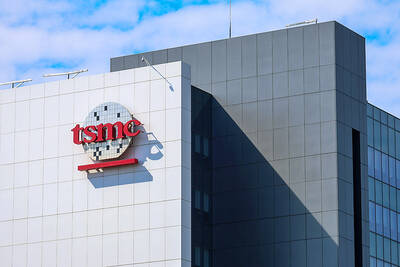
Taiwan Semiconductor Manufacturing Co (TSMC, 台積電), the world’s largest foundry service provider, yesterday said that global semiconductor revenue is projected to hit US$1.5 trillion in 2030, after the figure exceeds US$1 trillion this year, as artificial intelligence (AI) demand boosts consumption of token and compute power. “We are still at the beginning of the AI revolution, but we already see a significant impact across the whole semiconductor ecosystem,” TSMC deputy cochief operating officer Kevin Zhang (張曉強) said at the company’s annual technology symposium in Hsinchu City. “It is fair to say that in the past decade, smartphones and other mobile devices were
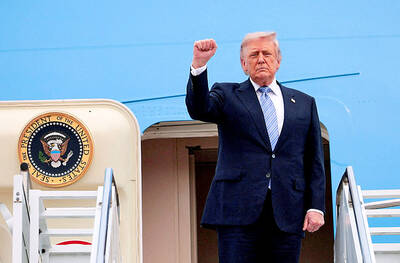
US-CHINA SUMMIT: MOFA welcomed US reassurance of no change in its Taiwan policy; Trump said he did not comment when Xi talked of opposing independence US President Donald Trump yesterday said he has not made a decision on whether to move forward with a major arms package for Taiwan after hearing concerns about it from Chinese President Xi Jinping (習近平). Trump’s comments on Taiwan came as he flew back to Washington after wrapping up critical talks in which both leaders said important progress was made in stabilizing US-China relations even as deep differences persist between the world’s two biggest powers on Iran and Taiwan. “I will make a determination,” Trump said, adding: “I’ll be making decisions. But, you know, I think the last thing we need right
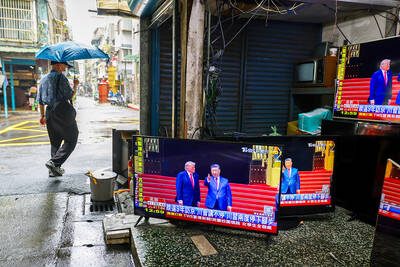
TAIWAN ISSUE: US treasury secretary Scott Bessent said on the first day of meetings that ‘it wouldn’t be a US-China summit without the Taiwan issue coming up’ There were no surprises on the first day of the summit between US President Donald Trump and Chinese President Xi Jinping (習近平), the Mainland Affairs Council (MAC) said yesterday, as the government reiterated that cross-strait stability is crucial to the Asia-Pacific region, as well as the world. As the two presidents met for a highly anticipated summit yesterday, Chinese state media reported that Xi warned Trump that missteps regarding Taiwan could push their two countries into “conflict.” Trump arrived in China with accolades for his host, calling Xi a “great leader” and “friend,” and extending an invitation to visit the White House
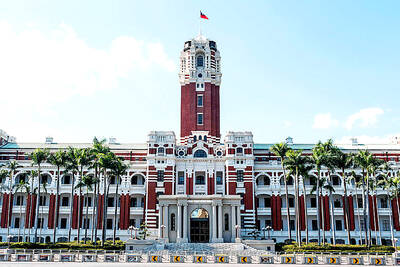
SECURITY: Taipei presses the US for arms supplies, saying the arms sales are not only a reflection of the US security commitment to Taiwan but also serve as a mutual deterrent against regional threats Taiwan is committed to preserving the cross-strait “status quo” and contributing to regional peace and stability, the Presidential Office said yesterday. “It is an undeniable fact that the Republic of China is a sovereign and independent democratic nation,” Presidential Office spokeswoman Karen Kuo (郭雅慧) reiterated, adding that Beijing has no right to claim sovereignty over Taiwan. The statements came after US President Donald Trump warned against Taiwanese independence. Trump wrapped up a state visit to Beijing on Friday, during which Chinese President Xi Jinping (習近平) had pressed him not to support Taiwan. Taiwan depends heavily on US security backing to deter China from carrying


 RSS
RSS