

A leak in the official polls used to select the Democratic Progressive Party’s (DPP) presidential nominee has left candidates and politicians scrambling to defend the integrity of the survey.
The DPP is expected to announce next year’s presidential candidate — likely to be either Tsai Ing-wen (蔡英文) or Su Tseng-chang (蘇貞昌) — today at noon after the polls were conducted on Monday and yesterday. The third candidate, Hsu Hsin-liang (許信良), who has admitted that his chances of winning are slim, is expected to trail the other two by a wide margin.
However, a leak late on Monday night by a blogger connected with the party led to harsh condemnations, including from senior DPP officials Tsai and Su.
Yang Hui-ju (楊蕙如), dubbed the “goddess of cards” by the local media after gaining fame in 2006 by generating more than NT$1 million (US$34,600) in profits in three months by using her credit cards, wrote on the microblogging site Plurk: “Tsai Vs. Ma 13:11, Su Vs. Ma 11:9.”
The numbers, she said, were taken from Tsai’s campaign spokesperson Juan Chao-hsiung (阮昭雄), who was then monitoring the -telephone surveys at an undisclosed polling center. Juan has denied being the source of the leak.
The small sample of the figures won’t be representative of the final poll results, compiled from 15,000 surveys, but criticism has focused on the root of the leak, allegedly coming from Tsai’s campaign — and whether it ended up affecting the survey.
The leak was an “unhelpful” move that could undermine chances of party unity after the final poll results are released, acting DPP chairperson Ker Chien-ming (柯建銘) said.
“What Yang did was not very smart,” Ker said. “We had asked to keep the poll numbers a secret amid concern that they could impact the surveys that were still in progress at the time.”
DPP Legislator Chiu Yi-ying (邱議瑩) called for a new poll, citing the impact of the leak, which was widely reposted on blogs and discussion boards. The suggestion has been rejected.
Both Tsai and Su, at separate campaign stops, also called the leak “improper.”
“There is no gray area on this — the regulations are clear. The official polls cannot be disclosed,” Su said. “I hope that everybody can respect this.”
“I’m also a victim,” Tsai said. “And I want to emphasize that it was an improper thing to do.”
DPP regulations state that the candidates were each allowed a representative in each of the five polling centers used to compile survey results. The representatives were allowed to overhear some of the results as they came in.
Juan was one of the representatives. However, in a call-in on a popular talk show yesterday afternoon, he denied that he was the source of Yang’s information.
“I want to make it clear that I did not give Yang any figures. She needs to come out and clarify this ... and she should apologize,” Juan said, adding that the two had not been in contact.
Yang, who late last month failed to gain a spot in the DPP’s legislative primaries, has also since retracted the comments and apologized to the candidates, calling the post a “private conversation” not meant for public attention in a tearful appearance yesterday.
The post has since been deleted from Yang’s Plurk account.
The poll leak is the latest controversy to hit the DPP election primary, coming just one day before the tightly fought two-month campaign ends. The official telephone polls ended last night.
The DPP’s comparative polling matches each candidate against President Ma Ying-jeou (馬英九). In the event that any of the candidates poll higher than Ma, the one with the most support is chosen, regardless of the margin.
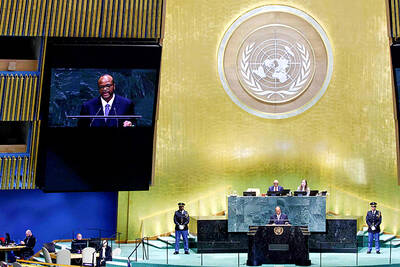
UNITY: Lai thanked the nations who spoke up for Taiwan, saying that democracies must stand together to face global authoritarian expansion Taiwan yesterday thanked eight European and Indo-Pacific countries for opposing unilateral changes to the “status quo” in the Taiwan Strait in a joint statement earlier this week, as well as three of Taiwan’s allies for speaking up for the nation’s participation in the UN at the body’s General Assembly in New York. Minister of Foreign Affairs Lin Chia-lung (林佳龍) welcomed the support and expressed his appreciation for the countries’ stance, the Ministry of Foreign Affairs said in a statement. Foreign ministers and senior representatives of Australia, France, Germany, Japan, New Zealand, Poland, South Korea and the UK issued a statement on Tuesday
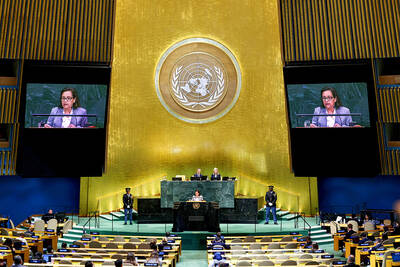
PLEA: How the UN addresses Taiwan’s security issue would be a test of its strength and relevance, Marshall Islands President Hilda Heine told the UN General Assembly Only Taiwan’s elected government can represent the people of Taiwan, Marshall Islands President Hilda Heine said on Friday at the UN General Assembly, calling for the nation’s inclusion in the UN. Taiwan and its 23 million people are a reality, and only its democratically elected government can represent it, Heine said when addressing the 81st session of the UN General Assembly General Debate. Appropriate ways must be found for Taiwan’s substantive participation in UN meetings if the UN is to be truly inclusive and effective in years to come, she said. UN member states would experience pressure to accept a

AT-RISK GROUPS: Of the accumulated 1,586 severe cases and 304 related deaths in this flu season, 65.8% were older people and 83.2% had chronic diseases, an official said The Centers for Disease Control (CDC) yesterday said that 165 severe flu cases and 30 flu-related deaths were reported last week, the highest weekly numbers in this flu season, and that cases might continue to increase, urging people to take precautions. Medical visits for flu-like illnesses increased by 1.4 percent to 141,374 last week, with 11.8 percent being emergency visits, showing that the seasonal flu is still in its epidemic period, CDC Epidemic Intelligence Center Director Guo Hung-wei (郭宏偉) said. From Tuesday last week to Monday, 165 severe flu cases and 30 flu-related deaths were confirmed, the highest weekly numbers
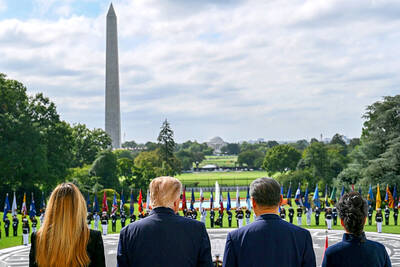
FACTS DISTORTION: The MAC rejected Xi’s remarks that the US and ‘China’ fought side-by-side during WWII, saying the ROC was Washington’s true ally during the war Taiwan yesterday denounced Chinese President Xi Jinping’s (習近平) comments to US President Donald Trump on the nation’s future, after Xi appeared to push Trump for a subtle change in stance that could erode US support for Taiwan. Xi told Trump in Washington on Thursday that he hoped the US would adhere to the “correct position” of opposing Taiwanese independence, according to a Chinese readout of the talks. That would be a tougher version of Washington’s long-standing formulation that it does not “support” independence. There was no immediate White House readout of the exchange. Xi’s remarks represent “the consistent Chinese approach of distorting facts


 RSS
RSS