


President Ma Ying-jeou (馬英九) was shouted down in Changhua County yesterday while attending a protest he had been invited to over the planned construction of a controversial petrochemical complex.
Before Ma was ready to address the crowd over the Kuokuang Petrochemical Technology Co (國光石化科技) project, some protesters asked him to sign a letter promising he would express opposition to the project, but the president refused to do so.
Ma’s refusal angered the protesters, who barred him from delivering the speech with repeated chants demanding that he “step down” and asked that he remain seated.
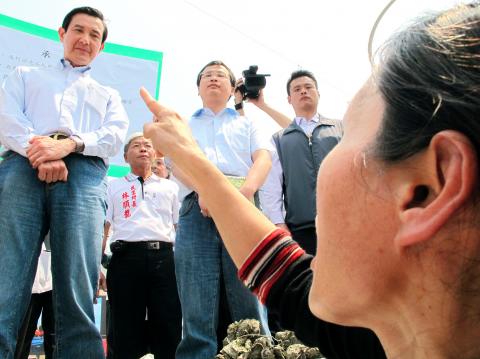
Photo: Juan I-yu, Taipei Times
LISTENING
He told a provisional press conference after the event that he was there to listen to the voices of local residents and that he regretted that he could not go on stage to tell the participants what he thought.
Public opinion would serve as an important reference for his administration’s future decision on whether to build the plant, he said.
It would be an “important” and “key” part of his administration’s decision on the matter, Ma said, adding that he would also ask the Environmental Protection Administration to strengthen environmental controls and regulate particulate matter produced by petrochemical plants.
Kuokuang Petrochemical Technology is an affiliate of state-run oil refiner CPC Corp, Taiwan (CPC, 台灣中油), which is seeking to expand oil-refining capacity and production of chemicals such as ethylene.
The government argues the capacity is needed to keep the nation competitive in the petrochemical sector in the face of stiff competition from Japan, South Korea and Singapore.
Environmentalists believe the complex will create losses that outweigh its economic benefits, including damaging the local agricultural sector and the Dacheng Wetlands (大城濕地), where the complex would be located, while putting the health of local residents at risk.
DPP APPEARANCES
Democratic Progressive Party (DPP) presidential hopefuls Tsai Ing-wen (蔡英文) and Su Tseng-chang (蘇貞昌) also made rare appearances together, arriving within 10 minutes of each other, at the gathering against the plant, a facility both vowed to stop if elected.
The two frontrunners for the DPP nominations have been dodging each other on the campaign trial and the anti-petrochemical plant protest is one of the few events for which both have appeared, signaling strong opposition to the facility.
In addition to Ma, Tsai and Su had been invited by environmental and medical groups that say the NT$600 billion (US$20.5 billion) project could lead to local health concerns and damage sensitive coastal wetlands.
“With both Ma and Su here today, it shows just how important this petrochemical issue has become. Everybody cares about Taiwan’s future,” Tsai said.
However, Tsai and Su separately said they were disappointed to learn that Ma had failed to sign a statement to promise to phase out expansion of the industry and press for stricter air quality regulations. Both the DPP candidates signed the pledge.
In her address, Tsai said the planned project was “not a solution for us now” and would not be “a solution for us in the future.”
She added that now was a time for the country to reconsider its industrial policies.
Su acknowledged the DPP had pushed the construction of the complex when it was in power between 2000 and 2008.
At the time, however, the DPP government chose to build the complex in neighboring Yunlin County to the south, rather than in the Changhua County wetlands, he said.
It was not known if Ma’s decision to attend the rally meant the government had changed its mind on the project.
Vice Minister of Economic Affairs Huang Jung-chiou (黃重球) said the environmental impact of the project was being reviewed by a panel of experts, but the government did not plan to move it overseas, the United Daily News reported yesterday.
CPC expects the environmental review to be finished by May.Though some shareholders have said they could no longer wait and wanted to move it overseas, CPC, which has a 43 percent stake in the project, wants to make the investment domestically.
Some officials said in private that the project could “die,” judging from the current political atmosphere in Taiwan.
ADDITIONAL REPORTING BY VINCENT Y. CHAO AND CNA, WITH STAFF WRITER
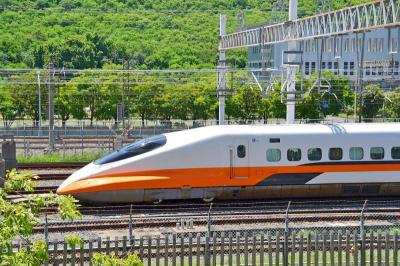
A signaling system malfunction disrupted high-speed rail (HSR) services beginning at 8am today, with trains temporarily reduced to three northbound and three southbound trains per hour as authorities conduct inspections. The malfunction occurred on a section of track in Miaoli County during pre-operation checks early this morning, forcing northbound and southbound trains to use a single track, the HSR operator said. The regular schedule has been replaced with three hourly trains offering only nonreserved seating in each direction, stopping at every station, it said, adding that business class cars would still have reserved seating. Departures from terminal stations are scheduled at the top
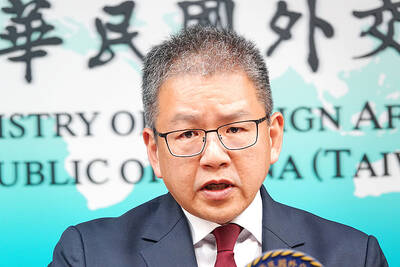
Taiwan is still in the process of assessing the possibility of recruiting workers from Eswatini, the Ministry of Foreign Affairs said yesterday, adding that its goal is to help Eswatini upgrade its vocational training centers. If there are plans to recruit workers from Eswatini, safeguarding national security, protecting public health and ensuring the employment rights of Taiwanese would be prerequisites, Department of West Asian and African Affairs Director-General Yen Chia-liang (顏嘉良) told a news conference. Key considerations would also include filling labor shortages in specific industries, and fostering bilateral professional and technical exchanges, he said. Yen was asked about the progress of labor
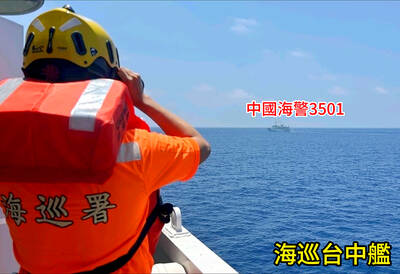
VERBOSE VESSELS: A CGA cutter and a China Coast Guard exchanged verbal barbs for more than a day in Taiwanese-controlled waters before the Chinese vessel left The Taiwanese and Chinese coast guards had a standoff near the strategically located Pratas Islands (Dongsha Islands, 東沙群島) in the north of the South China Sea, the Coast Guard Administration (CGA) said yesterday. The two sides engaged in intense radio exchanges over sovereignty claims during the 33-hour standoff. China Coast Guard vessel 3501 eventually left the restricted waters, 26.6 nautical miles (49.2km) west of the Pratas Islands, at 5pm yesterday, the CGA said. Lying approximately between southern Taiwan and Hong Kong, the Taiwan-controlled Pratas are seen by some security experts as vulnerable to Chinese attack due to their distance — more than

A US uncrewed surface vessel (USV) encountered multiple Chinese warships during an autonomous transit of the Taiwan Strait, US defense company Seasats said in a statement on Wednesday. Seasats announced that a Lightfish USV had completed the first autonomous transit of the Taiwan Strait. Over five days, the USV traversed the entire length of the Strait while constantly monitoring surface vessel traffic, the company said. The Lightfish encountered multiple Chinese warships, one of which was a Chinese People’s Liberation Army Navy (PLAN) Type 056 corvette, it said. The Chinese vessels were operating “well within Taiwan’s exclusive economic zone without transmitting their identity via the


 RSS
RSS