


In a few years, visitors could pass through unmanned immigration booths following instructions given by smiling robots when they step off the plane at Taiwan’s international airports, National Immigration Agency (NIA) -Director--General Hsieh Li-kung (謝立功) said yesterday.
The first unmanned immigration inspection booths were installed on Tuesday at Shueitou Pier (水頭碼頭) in Kinmen County, from which ferries depart to Xiamen, China.
“At this point, automatic immigration inspection booths have been installed only at Shueitou Pier, and are open only to [Republic of China (ROC)] nationals,” Hsieh told the Taipei Times during a telephone interview. “We plan to install the system at Taiwan Taoyuan International Airport next month — but only for [ROC] nationals as well.”
Passing through immigration checks will be like going through a subway station ticket gate.
“Before using the system, you need to register yourself with two government-issued photo IDs, such as a passport, national ID card or National Health Insurance card, at a machine and have your picture taken there,” he said. “The registration process takes no more than two minutes, then you can scan your passport to pass through the first gate and then have your face scanned by the machine to pass through the second gate before going to the boarding gates.”
Hsieh said that if everything goes smoothly, foreign nationals would also be able to use the system by the end of next year or the year after.
After developing the system, Hsieh said he had another idea after visiting the lab of National Taiwan University electrical engineering professor Luo Ren-chuan (羅仁權), a pioneer in developing robots in Taiwan.
At Luo’s lab, Hsieh met with advanced robots “Monica,” “Luo Guide” and “Luo Head.”
Monica is able to walk, find her own way, record and store images, and greet people by talking; Luo Guide is able to understand spoken directions, search for books in the bookshelf and deliver documents, while Luo Head has a face modeled after a 27-year-old Albert Einstein and, with 36 micromotors, can imitate human facial expressions.
“We’re also looking into the possibility of bringing professor Luo’s robots into the nation’s major international airports,” Hsieh said. “We’re not planning to make robots immigration inspectors, but we’ll use them as guides to greet visitors and give them a surprise, while also showcasing Taiwan’s technological achievements.”

‘NO SECURITY RISK’: The Railway Bureau reassured the public that the technicians’ activities were limited to technical guidance and did not involve sensitive systems The Railway Bureau yesterday said it had invited eight Chinese technicians to assist with an airport MRT construction project. The bureau issued the confirmation after an Internet user said Chinese nationals had entered the construction zone of Taiwan Taoyuan International Airport’s Terminal 3 project. They asked why “individuals from an enemy state” were allowed access to such a major national infrastructure project, which raised serious concerns over Taiwan’s industrial safety, sensitive systems and information security. The bureau’s Northern Region Engineering Branch Office said subcontractor Taiwan Handle Industrial Co (台灣手把工業) of the Taoyuan airport MRT’s “Contract No. CU05 Project A14 Station Civil, MEP &

A US uncrewed surface vessel (USV) encountered multiple Chinese warships during an autonomous transit of the Taiwan Strait, US defense company Seasats said in a statement on Wednesday. Seasats announced that a Lightfish USV had completed the first autonomous transit of the Taiwan Strait. Over five days, the USV traversed the entire length of the Strait while constantly monitoring surface vessel traffic, the company said. The Lightfish encountered multiple Chinese warships, one of which was a Chinese People’s Liberation Army Navy (PLAN) Type 056 corvette, it said. The Chinese vessels were operating “well within Taiwan’s exclusive economic zone without transmitting their identity via the

Taiwan is still in the process of assessing the possibility of recruiting workers from Eswatini, the Ministry of Foreign Affairs said yesterday, adding that its goal is to help Eswatini upgrade its vocational training centers. If there are plans to recruit workers from Eswatini, safeguarding national security, protecting public health and ensuring the employment rights of Taiwanese would be prerequisites, Department of West Asian and African Affairs Director-General Yen Chia-liang (顏嘉良) told a news conference. Key considerations would also include filling labor shortages in specific industries, and fostering bilateral professional and technical exchanges, he said. Yen was asked about the progress of labor
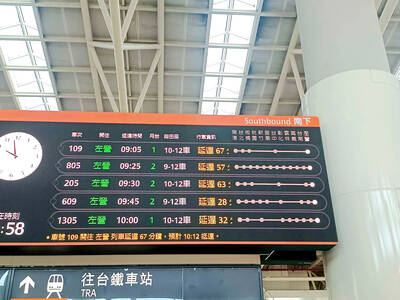
The nation’s usually punctual high-speed rail system yesterday was hit by major disruptions after all scheduled services were canceled and replaced with three hourly trains offering only non-reserved seating, affecting more than 200,000 passengers. Preliminary findings indicate the disruption was caused by a faulty power module in a track switch control cabinet, Taiwan High-Speed Rail Corp (THSRC) said, adding that as a full system inspection could only be conducted after operations end for the day, a decision on whether normal service would resume today would be announced before the first train departs. During a routine inspection early yesterday, a switch signal abnormality


 RSS
RSS