


Democratic Progressive Party (DPP) lawmakers yesterday called on the legislature to approve a referendum on nuclear power, the latest in an effort to scrap the Fourth Nuclear Power Plant in New Taipei City (新北市).
Construction of the NT$273.5 billion (US$9.3 billion) facility is scheduled for completion sometime before 2013, but its location close to active fault lines and underwater volcanoes has prompted lawmakers to demand a rethink on whether it should become operational.
Debate was reopened by DPP presidential hopeful Tsai Ing-wen (蔡英文) on Thursday after she told reporters in a briefing she would seek to halt construction of the plant and phase out the three older plants if elected next year.
The comment was immediately dismissed as an election ploy by the Chinese Nationalist Party (KMT), which maintains an overwhelming majority in the legislature and the procedural committee, making passage of a referendum bill unlikely.
“It’s no laughing matter,” KMT Legislator Hsieh Kuo-liang (謝國樑) said. “If construction of the Fourth Nuclear Power Plant is stopped or phased out, the losses will be in [the billions of dollars]. The KMT cannot accept a resolution that would cost the public so much money.”
The Fourth Nuclear Power Plant has already been beset by delays and cost overruns, some arising from the one-year moratorium on construction imposed by former president Chen Shui-bian (陳水扁) in 2000.
Citing nuclear safety concerns after the radiation leaks in Japan, the DPP said it aimed to wind down the nuclear industry, albeit -pending the introduction of alternative sources such as renewable energy.
DPP Legislator Gao Jyh-peng (高志鵬), the main backer of the nuclear referendum, said the issue of a “nuclear-free homeland” was an important question in which the public deserved to have a say.
“What we aren’t calling for is an immediate freeze in construction of the Fourth Nuclear Power Plant. What we want is to turn this issue over to a nationwide referendum,” Gao said.
The DPP caucus said it had acquired the necessary 10 co-signers for a referendum bill. However, it would have to go through a procedural committee decision before it could be submitted to a full reading by the legislature.
KMT lawmakers, who control 14 of the 19 seats on the committee, have already said they would not allow the proposal to pass.
“Nuclear safety is important, but discussion about the industry can also be held through policy debate,” KMT Policy Committee director Lin Yi-shih (林益世) said.
The proposal by the DPP is believed to be the first-ever referendum bid about the nuclear industry launched in the legislature.
By starting it in the legislature, it can bypass strict regulations on public-initiated proposals that require 86,600 petitions in the first stage and 866,000, or 5 percent of voters, in the second.
Taking on the nuclear industry is a risky move for the DPP. An election promise by Chen to scrap the Fourth Nuclear Power Plant backfired when later polls showed a majority opposed his plan. Chen was forced to restart construction in 2001 after public pressure.
Tsai has defended her plan to create a “nuclear-free homeland” by 2025 against critics such as former president Lee Teng-hui (李登輝), who on Sunday said alternative energy sources would have to be found before the proposal could become viable.
“Lee probably didn’t read my proposal, there has probably been some miscommunication,” said Tsai, talking about her four-page document on increasing renewable energy sources, efficiency at coal-fired plants and building new natural gas plants when needed.
“The 2025 ‘nuclear-free homeland’ proposal is a viable goal and whether this country chooses to continue to rely on nuclear power is a question we can no longer avoid,” she said. “When the Fourth Nuclear Power Plant comes online, we will lose the opportunity for change.”
Meanwhile, public health researchers urged the government to tell the public when they intend to make Taiwan a nuclear-free country, adding that they could not evade problems facing the nation’s three nuclear power plants any longer.
Yesterday marked the 32nd anniversary of the Three Mile Island accident in the US, where a partial core meltdown occurred in the Three Mile Island Nuclear Generating Station in Pennsylvania.
Chan Chang-chuan (詹長權), a professor at the Institute of Occupational Medicine and Industrial Hygiene at National Taiwan University, said the causes of the Three Mile Island, Chernobyl and Fukushima incidents may be different, but the situation seemed to be getting worse each time.
“People are concerned about the consequences of the Fukushima accident because what happened was unprecedented,” Chan said. “It is very difficult to estimate the potential impact of the accident.”
ADDITIONAL REPORTING BY SHELLEY SHAN

‘NO SECURITY RISK’: The Railway Bureau reassured the public that the technicians’ activities were limited to technical guidance and did not involve sensitive systems The Railway Bureau yesterday said it had invited eight Chinese technicians to assist with an airport MRT construction project. The bureau issued the confirmation after an Internet user said Chinese nationals had entered the construction zone of Taiwan Taoyuan International Airport’s Terminal 3 project. They asked why “individuals from an enemy state” were allowed access to such a major national infrastructure project, which raised serious concerns over Taiwan’s industrial safety, sensitive systems and information security. The bureau’s Northern Region Engineering Branch Office said subcontractor Taiwan Handle Industrial Co (台灣手把工業) of the Taoyuan airport MRT’s “Contract No. CU05 Project A14 Station Civil, MEP &

A US uncrewed surface vessel (USV) encountered multiple Chinese warships during an autonomous transit of the Taiwan Strait, US defense company Seasats said in a statement on Wednesday. Seasats announced that a Lightfish USV had completed the first autonomous transit of the Taiwan Strait. Over five days, the USV traversed the entire length of the Strait while constantly monitoring surface vessel traffic, the company said. The Lightfish encountered multiple Chinese warships, one of which was a Chinese People’s Liberation Army Navy (PLAN) Type 056 corvette, it said. The Chinese vessels were operating “well within Taiwan’s exclusive economic zone without transmitting their identity via the
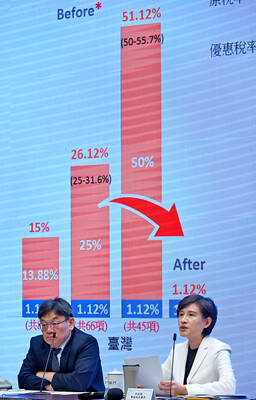
GREATER REACH? Auto parts and wood products would face tariffs of up to 15%, matching those targeting the EU, Japan and South Korea, Vice Premier said The US has announced that preferential tariff treatment for Taiwan’s non-semiconductor Section 232 goods would take effect retroactively from May 1, the Executive Yuan said yesterday. The US government yesterday posted a notice on the Federal Register’s public inspection Web site previewing tariff concessions for Taiwan under a memorandum of understanding (MOU) on Taiwan-US investment after two months of negotiations. The MOU signed on Jan. 15 stipulated three major preferential tariff arrangements: a 15 percent “reciprocal” tariff rate for Taiwan without stacking most-favored nation (MFN) rates; preferential Section 232 treatment for semiconductors and related products; and preferential Section 232 treatment for non-semiconductor

The National Chungshan Institute of Science and Technology yesterday showcased its locally developed variants of the Vision 60 robotic patrol dog, which it plans to deploy on the nation’s outlying territories in the South China Sea. The variants were produced under the Joint Lab project — created by the institute and domestic companies — and assembled with domestically produced motors, lenses and artificial intelligence (AI) systems alongside licensed tech from the US, Missile and Rocket Systems Research Division deputy director Jen Kuo-kang (任國光) told the media event at a military base in Taipei’s Dazhi (大直) area. Taiwan has built up its strengths


 RSS
RSS