


Five convicts on death row were executed yesterday, the Ministry of Justice announced yesterday evening.
Minister of Justice Tseng Yung-fu (曾勇夫) signed documents yesterday morning authorizing the executions, Deputy Minister of Justice Chen Shou-huang (陳守煌) told a press conference last night.
Chen said Kuan Chung-yan (管鍾演) and Chung Teh-chu (鐘德樹) were executed in Taipei Prison. Wang Chih-huang (王志煌) was executed in Greater Taichung Prison, while Wang Kuo-hua (王國華) and Chuang Tien-chu (莊天祝) were executed in Greater Kaohsiung Prison.
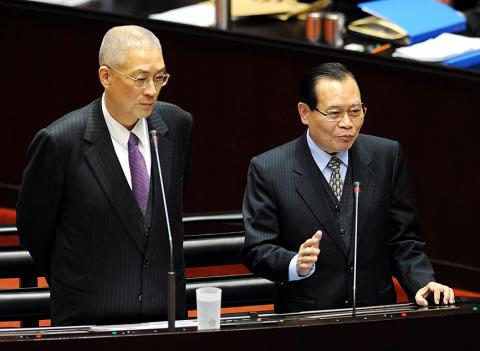
Photo: Fang Pin-chao, Taipei Times
Kuan was convicted of robbery and seven murders; Chung threw a Molotov cocktail into a private school in Taoyuan County and started a fire that killed three and injured 15; Wang Chih-huang was convicted of killing two drug dealers, who were shot in the head and left on the side of a highway in Taichung County with their pants unzipped.
Wang Kuo-hua was convicted of robbery and sexually assaulting several young women after meeting them online. He also killed a young woman by tying a plastic bag over her head and throwing her into a river. Chuang was sentenced to death for murdering two prostitutes and then two women after breaking into their homes in Kaohsiung City in 2002 and 2004.
The ministry said that Wang Kuo-hua, Chuang and Kuan signed documents donating their organs, so their bodies were taken to a hospital for their organs to be harvested immediately after the execution.
Kaohsiung Prison said Wang Kuo-hua and Chuang were calm when they were told about the execution order and taken to the execution ground.
After yesterday’s executions, 40 convicts remain on death row, according to the ministry.
The executions came after -local daily papers yesterday reported that the ministry was on the verge of ordering the executions of death row inmates. The Chinese-language Liberty Times (the Taipei Times’ sister paper) reported that up to five convicts could be put to death, while the Chinese-language United Daily News reported that the ministry’s task force on executions met to finalize the list of those to be executed and forwarded at least two execution orders to Tseng for his signature.
When grilled by lawmakers on the matter at the legislature earlier yesterday, Tseng declined to reveal any information.
“Could you please not sign executions today? You are tied up in the question-and-answer session all day today. Wait until tomorrow and then you will have ten more hours to think about this,” Democratic Progressive Party (DPP) Legislator Lee Chun-yee (李俊毅) said.
Tseng refused to promise not to order any executions, but added that he hadn’t signed any orders at that point.
Pressed by a follow-up question as to whether he would sign execution orders after the session, Tseng said “anything is possible.”
Late last night, Tseng apologized for being economical with the truth, citing the need for secrecy in the matter of executions.
Yesterday’s executions came less than a year after the ministry resumed the enforcement of capital punishment verdicts last April, when four death row inmates were executed, ending an unofficial moratorium on capital punishment that had been in place since 2005.
Soon after the ministry -announced the executions yesterday, members of the Taiwan Alliance to End the Death Penalty (TAEDP) and other human rights activists staged a silent protest outside the ministry building. Holding up two white banners with black characters and wearing surgical masks, the anti-death penalty activists lit five candles in memory of the five executed convicts.
“President Ma Ying-jeou’s [馬英九] government signs international human rights covenants on one hand, while killing people on the other,” one banner read. “Ma visited Chiang Kuo-ching’s (江國慶) family and then executed death row inmates who might have been wrongfully sentenced,” read -another banner.
Chiang was a young man serving in the air force 15 years ago who was believed to have sexually assaulted a girl, and was executed. However, it was recently discovered that he admitted to the crime under duress and that he may not have committed the crime.
“The Legislative Yuan has ratified the International Covenant on Civil and Political Rights and the International Covenant on Economic, Social and Cultural Rights, and granted them the status of domestic law,” TAEDP executive director Lin Hsin-yi (林欣怡) said earlier in the day in an attempt to remind the government that such executions could be in -violation of the two covenants.
“Government officials — including President Ma Ying-jeou — have always said that they would act according to the law, so why are they not doing so?”
Lin said that, according to another law detailing how the two international human rights covenants should be implemented, all government agencies are required to review laws under their jurisdictions and make any necessary revisions to ensure they comply with the covenants within two years.
“Instead of making an effort to abolish capital punishment, the government seems to be rushing to execute more people — what’s the hurry?” Lin asked.
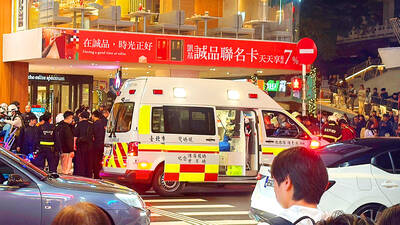
TRAGEDY STRIKES TAIPEI: The suspect died after falling off a building after he threw smoke grenades into Taipei Main Station and went on a killing spree in Zhongshan A 27-year-old suspect allegedly threw smoke grenades in Taipei Main Station and then proceeded to Zhongshan MRT Station in a random killing spree that resulted in the death of the suspect and two other civilians, and seven injured, including one in critical condition, as of press time last night. The suspect, identified as a man surnamed Chang Wen (張文), allegedly began the attack at Taipei Main Station, the Taipei Fire Department said, adding that it received a report at 5:24pm that smoke grenades had been thrown in the station. One man in his 50s was rushed to hospital after a cardiac arrest
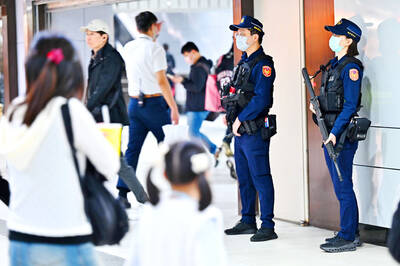
PUBLIC SAFETY: The premier said that security would be tightened in transport hubs, while President Lai commended the public for their bravery The government is to deploy more police, including rapid response units, in crowded public areas to ensure a swift response to any threats, President William Lai (賴清德) said yesterday after a knife attack killed three people and injured 11 in Taipei the previous day. Lai made the remarks following a briefing by the National Police Agency on the progress of the investigation, saying that the attack underscored the importance of cooperation in public security between the central and local governments. The attack unfolded in the early evening on Friday around Taipei Main Station’s M7 exit and later near the Taipei MRT’s Zhongshan
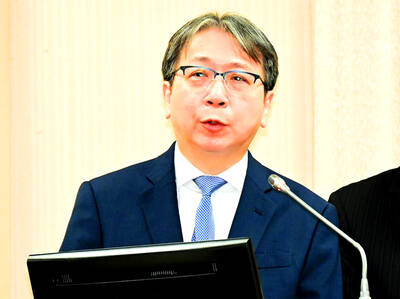
ON ALERT: Taiwan’s partners would issue warnings if China attempted to use Interpol to target Taiwanese, and the global body has mechanisms to prevent it, an official said China has stationed two to four people specializing in Taiwan affairs at its embassies in several democratic countries to monitor and harass Taiwanese, actions that the host nations would not tolerate, National Security Bureau (NSB) Director-General Tsai Ming-yen (蔡明彥) said yesterday. Tsai made the comments at a meeting of the legislature’s Foreign Affairs and National Defense Committee, which asked him and Minister of National Defense Wellington Koo (顧立雄) to report on potential conflicts in the Taiwan Strait and military preparedness. Democratic Progressive Party (DPP) Legislator Michelle Lin (林楚茵) expressed concern that Beijing has posted personnel from China’s Taiwan Affairs Office to its
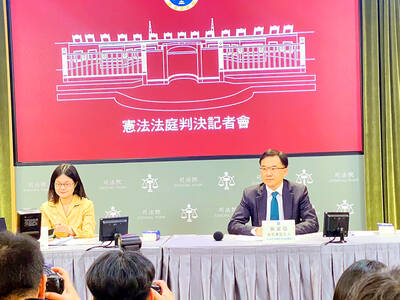
‘ILLEGAL RULING’: The KMT and the TPP slammed the Constitutional Court judgement, saying it contravened the law and was trying to clear the way for a ‘green dictatorship’ The Constitutional Court yesterday ruled that amendments to the Constitutional Court Procedure Act (憲法訴訟法) passed by the Legislative Yuan last year are unconstitutional, as they contravene due legislative process and separation of powers. The Legislative Yuan on Dec. 20 last year passed amendments stipulating that no fewer than 10 grand justices must take part in deliberations of the Constitutional Court, and at least nine grand justices must agree to declare a law unconstitutional. The Executive Yuan on Jan. 2 requested that lawmakers reconsider the bill, but the Legislative Yuan, under a combined majority of Chinese Nationalist Party (KMT) and Taiwan People’s Party


 RSS
RSS