


The defector whose claims that Iraq had biological weapons were used to justify the 2003 US invasion has admitted that he lied to help get rid of former Iraqi president Saddam Hussein, the Guardian newspaper said on Tuesday.
Rafid Ahmed Alwan al-Janabi told the BND, Germany’s secret service, that Iraq had mobile bioweapons trucks and had built clandestine factories.
Even after he went back on his story after being confronted with denials from another source, the BND continued to take him seriously, he told the Guardian.
The false information formed the cornerstone of former US secretary of state Colin Powell’s key address to the UN on Feb. 5, 2003.
During the speech, Powell described Janabi as “an Iraqi chemical engineer” who “supervised one of these facilities.”
“He actually was present during biological agent production runs and was also at the site when an accident occurred in 1998,” Powell told the UN.
“Maybe I was right, maybe I was not right,” Janabi told the British newspaper.
“They gave me this chance. I had the chance to fabricate something to topple the regime. I and my sons are proud of that and we are proud that we were the reason to give Iraq the margin of democracy,” he said. “I had to do something for my country, so I did this and I am satisfied because there is no dictator in Iraq any more.”
Janabi told the Guardian he was “shocked” by Powell’s speech, but played down his role in the conflict.
“Powell didn’t say I was the only reason for war, he talked about three things: Uranium, al-Qaeda in Iraq and my story [biological weapons],” he said.
He accused the BND of having broken an agreement that they would not hand over his information to other countries.
A German official approached Janabi after identifying him as a Baghdad-trained chemical engineer with possible inside intelligence of Saddam’s regime.
Janabi, who fled Iraq in 1995, lied to the BND, telling them Saddam had mobile bioweapons trucks and weapons factories.
Later however, the BND confronted Janabi with a statement from Bassil Latif, his former boss at the Military Industries Commission in Iraq, who said there were no trucks or factories.
Janabi told the BND: “OK, when [Latif says] there no trucks then [there are none],” the paper said.
Despite his admission, Janabi said security officials continued to take his claims seriously.
They told him in 2002 that his pregnant wife might not be allowed to join him in Germany if he refused to cooperate.
However, he denied that he had lied to the BND in order to secure asylum, claiming he did it purely to topple the government.
“I was granted asylum on March 13, 2000. The story ... had nothing to do with my asylum claim,” Janabi said.
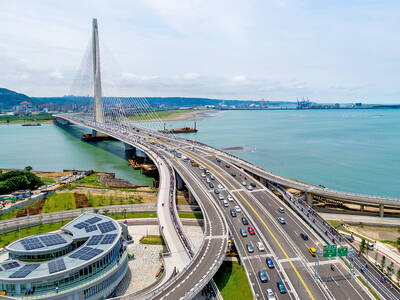
The Ministry of Transportation and Communications yesterday inaugurated the Danjiang Bridge across the Tamsui River in New Taipei City, saying that the structure would be an architectural icon and traffic artery for Taiwan. Feted as a major engineering achievement, the Danjiang Bridge is 920m long, 211m tall at the top of its pylon, and is the longest single-pylon asymmetric cable-stayed bridge in the world, the government’s Web site for the structure said. It was designed by late Iraqi-British architect Zaha Hadid. The structure, with a maximum deck of 70m, accommodates road and light rail traffic, and affords a 200m navigation channel for boats,
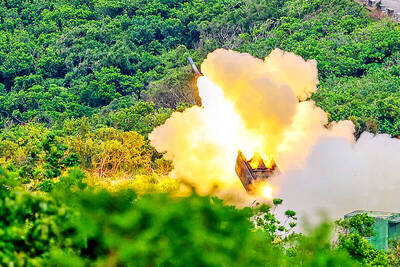
PRECISION STRIKES: The most significant reason to deploy HIMARS to outlying islands is to establish a ‘dead zone’ that the PLA would not dare enter, a source said A High Mobility Artillery Rocket System (HIMARS) would be deployed to Penghu County and Dongyin Island (東引) in Lienchiang County (Matsu) to force the Chinese military to retreat at least 100km from the coastline, a military source said yesterday. Taiwan has been procuring HIMARS and Army Tactical Missile Systems (ATACMS) from the US in batches. Once all batches have been delivered, Taiwan would possess 111 HIMARS units and 504 ATACMS, which have a range of 300km. Considering that “offense is the best defense,” the military plans to forward-deploy the systems to outlying islands such as Penghu and Dongyin so that

Taiwan Semiconductor Manufacturing Co (TSMC, 台積電), the world’s largest foundry service provider, yesterday said that global semiconductor revenue is projected to hit US$1.5 trillion in 2030, after the figure exceeds US$1 trillion this year, as artificial intelligence (AI) demand boosts consumption of token and compute power. “We are still at the beginning of the AI revolution, but we already see a significant impact across the whole semiconductor ecosystem,” TSMC deputy cochief operating officer Kevin Zhang (張曉強) said at the company’s annual technology symposium in Hsinchu City. “It is fair to say that in the past decade, smartphones and other mobile devices were

‘CLEAR MESSAGE’: The bill would set up an interagency ‘tiger team’ to review sanctions tools and other economic options to help deter any Chinese aggression toward Taiwan US Representative Young Kim has introduced a bill to deter Chinese aggression against Taiwan, calling for an interagency “tiger team” to preplan coordinated sanctions and economic measures in response to possible Chinese military or political action against Taiwan. “[Chinese President] Xi Jinping [習近平] has directed the People’s Liberation Army to be ready to invade Taiwan by 2027. China has a plan. America should have one too,” Kim said in a news release on Thursday last week. She introduced the “Deter PRC [People’s Republic of China] aggression against Taiwan act” to “ensure the US has a coordinated sanctions strategy ready should


 RSS
RSS