


Taiwan vowed yesterday to take whatever action necessary to defend its official title in an Asian medical student group.
Lin Wen-tong (林文通), director of the Ministry of Education’s Bureau of International Cultural and Educational Relations, said that Taiwan would not oppose the Asian Medical Students Association (AMSA) accepting China as a member, but said that a proposal by Beijing to change Taiwan’s title from “AMSA-Taiwan” to “AMSA-Taiwan, China” was totally unacceptable.
The name-change proposal is to be voted on in a Feb. 27 AMSA members’ meeting.
AMSA, a non-governmental organization founded by Taiwan, Thailand, Japan, South Korea, Australia, Hong Kong, the Philippines, Malaysia and Indonesia in 1985, now has 20 members.
AMSA-Taiwan said it launched a campaign last week to solicit the support of other AMSA members to safeguard Taiwan’s name.
“AMSA-Taiwan is excited about the potential of our Chinese medical student friends to join AMSA, and to play a more active role in this international medical students’ platform, as we believe friendship and medicine should be beyond borders,” a statement in English released by AMSA-Taiwan read. “However, we are regretful to learn that AMSA-China has brought political interference into AMSA, a non-political students’ organization. We consider such unnecessary political interference to be detrimental to the progress and development of AMSA.”
As of press time yesterday, the on-line signature drive has garnered more than 1,100 signatures from students in Indonesia, Malaysia, Taiwan and the US.
AMSA-Taiwan chairperson Chen Ying-chi (陳映綺), a student at Chung Shan Medical University’s School of Medicine, slammed China’s proposal as unreasonable.
“It’s an undeniable fact that Taiwan is a founding member of AMSA. To change AMSA-Taiwan’s name undoubtedly runs counter to the AMSA’s history,” she said.
Democratic Progressive Party Legislator Huang Wei-cher (黃偉哲) said “the incident again proves that President Ma Ying-jeou’s (馬英九) modus vivendi diplomatic truce with China is naive.”
ADDITIONAL REPORTING BY STAFF WRITER

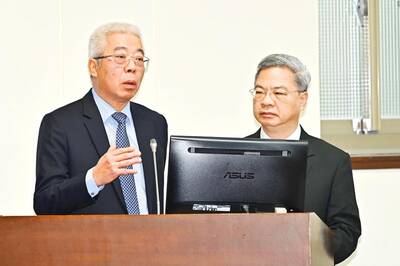
Taiwan has arranged for about 8 million barrels of crude oil, or about one-third of its monthly needs, to be shipped from the Red Sea this month to bypass the Strait of Hormuz and ease domestic supply pressures, CPC Corp, Taiwan (CPC, 台灣中油) said yesterday. The state-run oil company has worked with Middle Eastern suppliers to secure routes other than the Strait of Hormuz, through which about 20 percent of the world’s oil and liquefied natural gas typically passes, CPC chairman Fang Jeng-zen (方振仁) said at a meeting of the legislature’s Economics Committee in Taipei. Suppliers in Saudi Arabia have indicated they
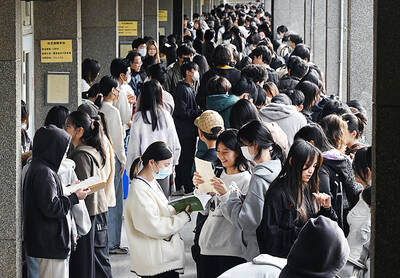
A global survey showed that 60 percent of Taiwanese had attained higher education, second only to Canada, the Ministry of the Interior said. Taiwan easily surpassed the global average of 43 percent and ranked ahead of major economies, including Japan, South Korea and the US, data from the Organisation for Economic Co-operation and Development (OECD) for 2024 showed. Taiwan has a high literacy rate, data released by the ministry showed. As of the end of last year, Taiwan had 20.617 million people aged 15 or older, accounting for 88.5 percent of the total population, with a literacy rate of 99.4 percent, the data
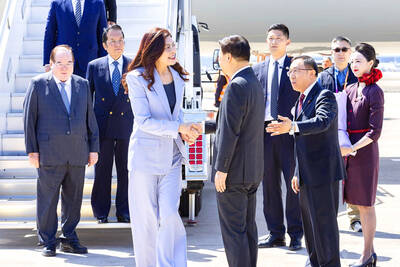
CCP ‘PAWN’? Beijing could use the KMT chairwoman’s visit to signal to the world that many people in Taiwan support the ‘one China’ principle, an academic said Chinese Nationalist Party (KMT) Chairwoman Cheng Li-wun (鄭麗文) yesterday arrived in China for a “peace” mission and potential meeting with Chinese President Xi Jinping (習近平), while a Taiwanese minister detailed the number of Chinese warships currently deployed around the nation. Cheng is visiting at a time of increased Chinese military pressure on Taiwan, as the opposition-dominated Legislative Yuan stalls a government plan for US$40 billion in extra defense spending. Speaking to reporters before going to the airport, Cheng said she was going on a “historic journey for peace,” but added that some people felt uneasy about her trip. “If you truly love Taiwan,

NEW LOW: The council in 2024 based predictions on a pessimistic estimate for the nation’s total fertility rate of 0.84, but last year that rate was 0.69, 17 percent lower An expected National Development Council (NDC) report expects the nation’s population to drop below 12 million by 2065, with the old-age dependency ratio to top 100 percent sooner than 2070, sources said yesterday. The council is slated to release its latest population projections in August, using an ultra-low fertility model, the sources said. The previous report projected that Taiwan’s population would fall to 14.37 million by 2070, but based on a new estimate of the total fertility rate (TFR) — the average number of children born to a woman over her lifetime — the population is expected to reach 12 million by


 RSS
RSS