


China is developing “counterspace” weapons that could shoot down satellites or jam signals, a Pentagon official said on Friday as the US unveiled a 10-year strategy for security in space.
“The investment China is putting into counterspace capabilities is a matter of concern to us,” US Deputy Secretary of Defense for Space Policy Gregory Schulte told reporters as the defense and intelligence communities released their 10-year National Security Space Strategy (NSSS).
The NSSS marks a huge shift from past practice, charting a 10-year path in space to make the US “more resilient” and able to defend its assets in a dramatically more crowded, competitive, challenging and sometimes hostile environment, Schulte said.
“Space is no longer the preserve of the US and the Soviet Union, at the time in which we could operate with impunity,” Schulte said.
“There are more competitors, more countries that are launching satellites ... and we increasingly have to worry about countries developing counterspace capabilities that can be used against the peaceful use of space,” he said.
“China is at the forefront of the development of those capabilities,” he said.
US concerns over China’s space activities have led US Secretary of Defense Robert Gates to seek to include space in the stability dialogue with the Chinese, Schulte said.
In 2007, Beijing shot down one of its own weather satellites using a medium-range ground missile, sparking international concern not only about how China was “weaponizing” space, but also about debris from the satellite.
Years later, Chinese space junk is still floating around in space. Last year, debris from the satellite passed so close to the International Space Station that crewmembers had to change orbit and take cover.
Shooting down the satellite not only focused the world’s attention on the amount of junk in space, but also on Chinese counterspace capabilities, which go beyond shooting down spacecraft, Schulte said.
Among other counterspace activities, Beijing has jammed satellite signals and is developing directed energy weapons, which emit energy toward a target without firing a projectile, he said.
And China isn’t the only country flexing its counterspace muscle. Iran and Ethiopia are, too, he said.
“They’ve jammed commercial satellites ... If Ethiopia can jam a commercial satellite, you have to worry about what others can do against our military satellites,” he said.
“Fifteen years ago we didn’t have to worry about that, but now we have to think differently, to think about how we can continue to conduct the critical functions that are performed from space, or, if they’re degraded, we have to have alternative solutions,” Schulte said.
The 10-year strategy document proposes ways to protect US space assets, including by setting up international partnerships along the lines of NATO, under which an attack on one member would be an attack on all, drawing a unified response from members of the alliance.
The US also “retains the option to respond in self-defense to attacks in space, and the response may not be in space, either,” Schulte said.

CREDIT-GRABBER: China said its coast guard rescued the crew of a fishing vessel that caught fire, who were actually rescued by a nearby Taiwanese boat and the CGA Maritime search and rescue operations do not have borders, and China should not use a shipwreck to infringe upon Taiwanese sovereignty, the Coast Guard Administration (CGA) said yesterday. The coast guard made the statement in response to the China Coast Guard (CCG) saying it saved a Taiwanese fishing boat. The Chuan Yu No. 6 (全漁6號), a fishing vessel registered in Keelung, on Thursday caught fire and sank in waters northeast of Diaoyutai Islands (釣魚台). The vessel left Keelung’s Badouzih Fishing Harbor (八斗子漁港) at 3:35pm on Sunday last week, with seven people on board — a 62-year-old Taiwanese captain surnamed Chang (張) and six

RISKY BUSINESS: The ‘incentives’ include initiatives that get suspended for no reason, creating uncertainty and resulting in considerable losses for Taiwanese, the MAC said China’s “incentives” failed to sway sentiment in Taiwan, as willingness to work in China hit a record low of 1.6 percent, a Ministry of Labor survey showed. The Directorate-General of Budget, Accounting and Statistics (DGBAS) also reported that the number of Taiwanese workers in China has nearly halved from a peak of 430,000 in 2012 to an estimated 231,000 in 2024. That marked a new low in the proportion of Taiwanese going abroad to work. The ministry’s annual survey on “Labor Life and Employment Status” includes questions respondents’ willingness to seek employment overseas. Willingness to work in China has steadily declined from

LEVERAGE: China did not ‘need to fire a shot’ to deny Taiwan airspace over Africa when it owns ‘half the continent’s debt,’ a US official said, calling it economic warfare The EU has raised concerns about overflight rights following the delay of President William Lai’s (賴清德) planned state visit to the Kingdom of Eswatini after three African nations denied overflight clearance for his charter at the last minute. Taiwanese allies Paraguay and Saint Kitts and Nevis, as well as several US lawmakers and the Inter-Parliamentary Alliance on China (IPAC) condemned China for allegedly pressuring the countries. Lai was scheduled to fly directly to Taiwan’s only African ally from yesterday to Sunday to celebrate the 40th anniversary of King Mswati III’s accession and his 58th birthday, but Seychelles, Mauritius and Madagascar suddenly revoked
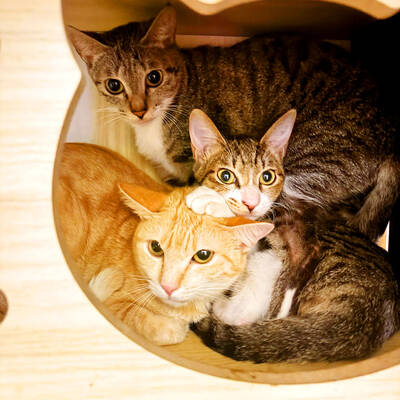
The number of pet cats in Taiwan surpassed that of pet dogs for the first time last year, reaching 1,742,033, a 32.8 percent increase from 2023, the Ministry of Agriculture said yesterday, citing a survey. By contrast, the number of pet dogs declined slightly by 1.2 percent over the same period to 1,462,528, the ministry said. Despite the shift, households with dogs still slightly outnumber those with cats by 1.2 percent. However, while the number of households with multiple dogs has remained relatively stable, households keeping more than two cats have increased, contributing to the overall rise in the feline population. The trend


 RSS
RSS