


Egyptian President Hosni Mubarak, clinging to power despite unprecedented demands for an end to his 30-year rule, met yesterday with the powerful military that is widely seen as holding the key to Egypt’s future.
Mubarak held talks with Egyptian Vice President Omar Suleiman, whose appointment on Saturday has possibly set the scene for a transition in power, Defense Minister Mohamed Hussein Tantawi, chief-of-staff Sami al-Anan and other senior commanders.
An earthquake of unrest is shaking Mubarak’s grip on power and the high command’s support is vital as other pillars of his ruling apparatus crumble, analysts said.
Egyptians faced lawlessness on their streets yesterday with security forces and ordinary people trying to stop looters after five days of popular protest.
Through the night, Cairo residents armed with clubs, chains and knives formed vigilante groups to guard neighborhoods from marauders after the unpopular police force withdrew following clashes with protesters that left more than 100 dead.
Cairo’s streets were mostly deserted, with the army guarding the interior ministry, and citizens putting their trust in the military, hoping they would restore order but not open fire to keep key US ally Mubarak, 82, in power.
Amid a heavy military presence, nearly 4,000 people gathered in Tahrir Square, which has become a rallying point to express anger at poverty, repression and corruption in the Arab world’s most populous nation.
“Hosni Mubarak, Omar Suleiman, both of you are agents of the Americans,” shouted protesters, referring to the appointment of intelligence chief Suleiman as vice president, the first time Mubarak has appointed a deputy in 30 years of office.
Sunday is normally a working day in Egypt, but banks and financial markets were shut. The bourse and the central bank said they would stay closed today.
Meanwhile, 34 members of Islamist opposition group, the Muslim Brotherhood, including seven of its leaders, walked out of prison after relatives of prisoners overcame the guards, a Brotherhood official said.
The relatives stormed the prison in Wadi el-Natroun, 120km northwest of Cairo, and set free several thousand of the inmates, Brotherhood office manager Mohamed Osama told reporters. No one was hurt, he added.
Opposition forces also agreed yesterday to support former head of the International Atomic Energy Agency Mohamed ElBaradei to negotiate with the government, a leading member of the Brotherhood said
The tumult was affecting Egypt’s tourist industry and the US, Turkey and Iraq said they were offering evacuation flights for citizens anxious to leave. Other governments advised their citizens to leave Egypt or to avoid traveling there.
Egypt said it had shut down the operations of satellite broadcaster al-Jazeera, which has shown footage of the demonstrations taking place in Cairo, Suez and Alexandria and heavy-handed police tactics to the rest of the Arab world.
In Cairo, the biggest immediate fear was of looting as public order collapsed. Mobs stormed banks, supermarkets, jewelry shops and government offices. Some suggested the chaos could herald a security forces crackdown.
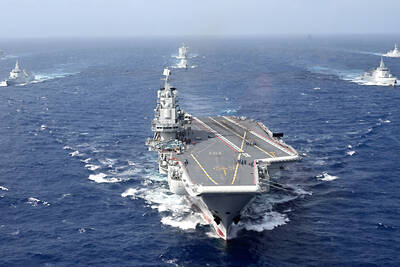
PROVOCATIVE: Chinese Deputy Ambassador to the UN Sun Lei accused Japan of sending military vessels to deliberately provoke tensions in the Taiwan Strait China denounced remarks by Japan and the EU about the South China Sea at a UN Security Council meeting on Monday, and accused Tokyo of provocative behavior in the Taiwan Strait and planning military expansion. Ayano Kunimitsu, a Japanese vice foreign minister, told the Council meeting on maritime security that Tokyo was seriously concerned about the situation in the East China and South China seas, and reiterated Japan’s opposition to any attempt to change the “status quo” by force, and obstruction of freedom of navigation and overflight. Stavros Lambrinidis, head of the EU delegation to the UN, also highlighted South China Sea
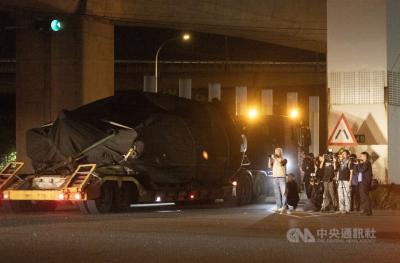
The final batch of 28 M1A2T Abrams tanks purchased from the US arrived at Taipei Port last night and were transported to the Armor Training Command in Hsinchu County’s Hukou Township (湖口), completing the military’s multi-year procurement of 108 of the tanks. Starting at 12:10am today, reporters observed more than a dozen civilian flatbed trailers departing from Taipei Port, each carrying an M1A2T tank covered with black waterproof tarps. Escorted by military vehicles, the convoy traveled via the West Coast Expressway to the Armor Training Command, with police implementing traffic control. The army operates about 1,000 tanks, including CM-11 Brave Tiger
Taiwan Semiconductor Manufacturing Co (TSMC, 台積電), the world’s largest contract chipmaker, said it expects its 2-nanometer (2nm) chip capacity to grow at a compound annual rate of 70 percent from this year to 2028. The projection comes as five fabs begin volume production of 2-nanometer chips this year — two in Hsinchu and three in Kaohsiung — TSMC senior vice president and deputy cochief operating officer Cliff Hou (侯永清) said at the company’s annual technology symposium in Silicon Valley, California, last week. Output in the first year of 2-nanometer production, which began in the fourth quarter of last year, is expected to

Taiwan’s drone exports surged past US$100 million in the first quarter, exceeding last year’s full-year total, with the Czech Republic emerging as the largest buyer, the Ministry of Economic Affairs said. Exports of complete drones reached US$115.85 million in the period, about 1.2 times the total recorded for all of last year, the ministry said in a report. Exports to the Czech Republic accounted for about US$100 million, far outpacing other markets. Poland, last year’s top destination, recorded about US$11.75 million in the first quarter. Taiwan’s drone exports have expanded rapidly in the past few years, with last year’s total


 RSS
RSS