


The US will try to keep Taiwan as far down the agenda as possible during Chinese President Hu Jintao’s (胡錦濤) three-day state visit to Washington this week.
During a lengthy White House briefing on the visit, US National Security Adviser Tom Donilon detailed the main topics to be covered during all of Hu’s talks with US President Barack Obama and never once mentioned Taiwan.
China experts agree that US arms sales to Taiwan are of enormous importance to Beijing and conclude that Washington has -decided to play the issue down and leave it up to the other side to introduce it.
Obama has met Hu eight times in the last two years and it is believed that Hu raised Taiwan on each of these occasions.
Hu will arrive in Washington tomorrow evening and will have dinner that night in the private White House residence with Obama, US Secretary of State Hillary Rodham Clinton and Donilon. The Chinese president will be accompanied by two senior aides.
Both sides have agreed that the topic of conversation that night will be the overall relationship.
Donilon said they would talk about the tone of the relationship, its purpose, areas of cooperation and whether the right mechanisms for dealing with problems are in place.
They will also discuss how they see the relationship developing over the next 10, 15 and 20 years.
The next morning Obama and Hu will meet again with very few aides in the Oval Office before moving to the Cabinet Room for a much-expanded meeting including US Treasury officials.
Later they will meet with Chinese business leaders, hold a short press conference and there will be a formal state dinner that night.
On Thursday, Hu will make his only public speech of the visit before leaving for Chicago.
Donilon has revealed that during the two closed summits in the White House — first in the Oval Office and then in the Cabinet Room — there will be three separate “baskets” of topics under discussion.
The first discussion will concentrate on security and political issues. The topics will be North Korea, Iran, Sudan and military-to-military relations.
However, it is during this session in the Oval Office that Hu is most likely to challenge the US about its continuing arms sales to Taiwan.
The next session, in the Cabinet Room, will deal with economic issues and US exports to China, which are growing at twice the rate of US exports to the rest of the world.
Lastly, they will discuss “global issues of special concern.”
“Human rights would fall into that category,” Donilon said.
Despite US efforts not to emphasize Taiwan, Obama and his national security team must be well aware of a letter delivered to the White House at the end of last week that was signed by 25 members of the US Senate — just more than a quarter — urging the president to “remain mindful” of the vital security interests of Taiwan during his talks with Hu.
“The United States and Taiwan have a long history of trade and friendship that we are pleased to have seen strengthen over the years. We ask that during President Hu’s visit, you emphasize that the US’s position on Taiwan remains clear: The US will support Taiwan’s security and continue to provide Taiwan with defensive arms,” it says. “The PRC [People’s Republic of China] has engaged in a large-scale military build-up over the past few years and has not abandoned the threat of force, with an estimated 1,000 active missiles pointed directly at Taiwan. For these reasons, it is of utmost importance that President Hu understands the United States’ unwavering commitment to providing Taiwan with the tools necessary for its self-defense.”
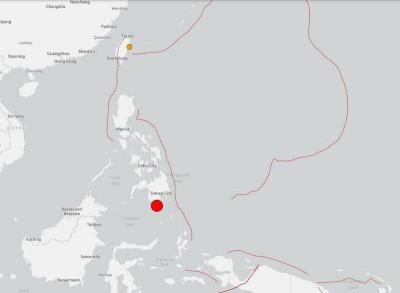
A magnitude 7.8 earthquake struck off the southern coast of Mindanao in the Philippines at 7:38am today, prompting the US Tsunami Warning System to issue an alert for neighboring countries, including Taiwan. The system issued a purple alert indicating a "tsunami threat." The potential threat zone includes Taiwan, the Philippines, Papua New Guinea, Yap and Palau. Philippine authorities were assessing the damage from the quake, with the office of civil defense seeking to verifying initial reports that 15 people had been killed and 129 injured in the region, mostly from falling debris. Arlene Hollero, disaster chief of Maasim town in the Philippines' Sarangani Province,
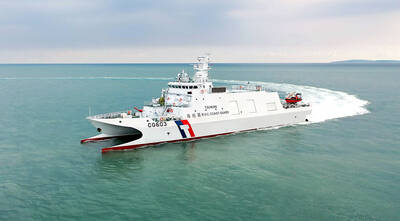
‘GRAY ZONE’ PRESSURE: Beijing’s activities are intended to create the deceitful impression that China has jurisdiction over the area around Taiwan, the CGA said Taiwan’s rights over its territorial waters and exclusive economic zone must not be violated by any country, the Mainland Affairs Council said yesterday, adding that it will not accept any unprovoked actions. The council issued the remarks in response to the China Coast Guard conducting maritime enforcement drills near eastern Taiwan and claiming to fully exercise China’s maritime administrative law enforcement authority. The Coast Guard Administration (CGA) has been closely monitoring the situation and is taking concrete steps to defend the nation’s sovereignty and secure its waters, the council said. China has no sovereign rights over the waters off eastern
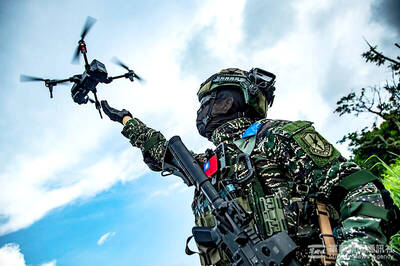
RESILIENCE: Taiwan plays a key role in semiconductors, energy, information infrastructure and advanced manufacturing, AIT Director Raymond Greene said Taiwan’s continued investment in deterrence and resilience remains vital, especially in uncrewed systems and other emerging technologies, American Institute in Taiwan (AIT) Director Raymond Greene said yesterday. Greene made the remarks at the annual National Strategic Summit on Supply Chain Resilience held by the Research Institute for Democracy, Society and Emerging Technology (DSET), a government-backed think tank. As Taiwan last year became the US’ fourth-largest trading partner and supply chain security is becoming more important, cooperation in emerging technologies continues to deepen between the two countries, he said. The US is committed to accelerating innovation, building key infrastructure, strengthening cooperation

The National Chungshan Institute of Science and Technology yesterday showcased its locally developed variants of the Vision 60 robotic patrol dog, which it plans to deploy on the nation’s outlying territories in the South China Sea. The variants were produced under the Joint Lab project — created by the institute and domestic companies — and assembled with domestically produced motors, lenses and artificial intelligence (AI) systems alongside licensed tech from the US, Missile and Rocket Systems Research Division deputy director Jen Kuo-kang (任國光) told the media event at a military base in Taipei’s Dazhi (大直) area. Taiwan has built up its strengths


 RSS
RSS