


As the US-China Economic and Security Review Commission officially released its annual report to the US Congress on Wednesday, commissioner Dan Blumenthal said there was unanimous agreement that “something must be done” to improve Taiwan’s air defense capabilities.
Addressing a packed hearing room in the US Senate, Blumenthal said there was “no silver bullet” that could balance the military forces facing each other across the Taiwan Strait, but that Congress needed to review the situation in a comprehensive manner.
Blumenthal, a China analyst with the American Enterprise Institute, said it was not up to the commission to recommend the sale of specific arms packages to Taipei, such as the 66 advanced F-16C/D fighter aircraft that Taiwan wants to buy.
Other sources said a number of the 12 bipartisan commissioners wanted US President Barack Obama to sell the aircraft to Taiwan, but that to get a unanimous report it decided not to include that specific recommendation in the document.
Blumenthal said all the commissioners agreed that, given the “sober facts on the eroding cross-strait air balance,” Congress had to take some action.
He hoped the report would result in the Pentagon working more closely with Taiwan on “a host” of issues that would lead to more stability in the Taiwan Strait.
Details of the report’s recommendations concerning Taiwan were published yesterday in the Taipei Times.
Created 10 years ago to advise Congress on policy toward China, the commission’s report this year was largely negative toward Beijing.
Commission vice chairwoman Carolyn Bartholomew warned that in addition to improving its air force, China had boosted its offensive air and missile capabilities and strengthened its capacity to threaten US forces and bases in the region.
“Currently, China’s conventional missile capabilities alone may be sufficient to temporarily knock out five of the six US air bases in East Asia,” she said.
“Saturation missile strikes could destroy US air defenses, runways, parked aircraft, and fuel and maintenance facilities. Complicating this scenario is the future deployment of China’s anti-ship ballistic missile, which could hold US aircraft carriers at bay outside their normal operating range,” Bartholomew said.
The 316-page report paints a dark picture of what could happen if China attacked Taiwan in the current circumstances.
According to one expert who testified before the commission, China could potentially deliver “a staggering blow” to the Taiwanese air force in the first minutes and hours of any cross-strait conflict.
Using just a quarter of its short-range ballistic missile force, China could “cut every runway at Taiwan’s ten main fighter operating bases and damage or destroy virtually every unsheltered aircraft located on them.”
“The PLA [People’s Liberation Army] Air Force would likely target any aircraft that survived the initial onslaught,” the report says.
“At this stage, without outside military support for Taiwan, the PLA would possess air superiority over the island and be able to conduct attacks on a wide range of military and economic targets with minimal losses,” it says.
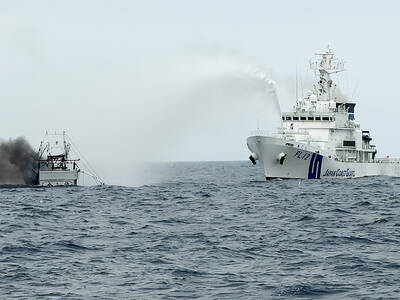
CREDIT-GRABBER: China said its coast guard rescued the crew of a fishing vessel that caught fire, who were actually rescued by a nearby Taiwanese boat and the CGA Maritime search and rescue operations do not have borders, and China should not use a shipwreck to infringe upon Taiwanese sovereignty, the Coast Guard Administration (CGA) said yesterday. The coast guard made the statement in response to the China Coast Guard (CCG) saying it saved a Taiwanese fishing boat. The Chuan Yu No. 6 (全漁6號), a fishing vessel registered in Keelung, on Thursday caught fire and sank in waters northeast of Diaoyutai Islands (釣魚台). The vessel left Keelung’s Badouzih Fishing Harbor (八斗子漁港) at 3:35pm on Sunday last week, with seven people on board — a 62-year-old Taiwanese captain surnamed Chang (張) and six

RISKY BUSINESS: The ‘incentives’ include initiatives that get suspended for no reason, creating uncertainty and resulting in considerable losses for Taiwanese, the MAC said China’s “incentives” failed to sway sentiment in Taiwan, as willingness to work in China hit a record low of 1.6 percent, a Ministry of Labor survey showed. The Directorate-General of Budget, Accounting and Statistics (DGBAS) also reported that the number of Taiwanese workers in China has nearly halved from a peak of 430,000 in 2012 to an estimated 231,000 in 2024. That marked a new low in the proportion of Taiwanese going abroad to work. The ministry’s annual survey on “Labor Life and Employment Status” includes questions respondents’ willingness to seek employment overseas. Willingness to work in China has steadily declined from

LEVERAGE: China did not ‘need to fire a shot’ to deny Taiwan airspace over Africa when it owns ‘half the continent’s debt,’ a US official said, calling it economic warfare The EU has raised concerns about overflight rights following the delay of President William Lai’s (賴清德) planned state visit to the Kingdom of Eswatini after three African nations denied overflight clearance for his charter at the last minute. Taiwanese allies Paraguay and Saint Kitts and Nevis, as well as several US lawmakers and the Inter-Parliamentary Alliance on China (IPAC) condemned China for allegedly pressuring the countries. Lai was scheduled to fly directly to Taiwan’s only African ally from yesterday to Sunday to celebrate the 40th anniversary of King Mswati III’s accession and his 58th birthday, but Seychelles, Mauritius and Madagascar suddenly revoked
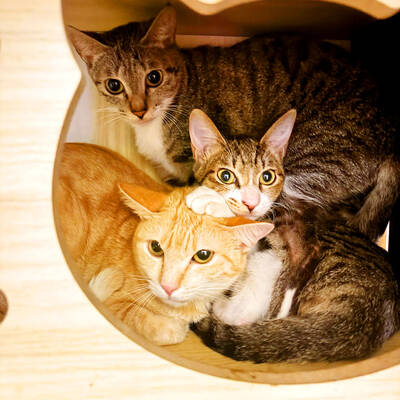
The number of pet cats in Taiwan surpassed that of pet dogs for the first time last year, reaching 1,742,033, a 32.8 percent increase from 2023, the Ministry of Agriculture said yesterday, citing a survey. By contrast, the number of pet dogs declined slightly by 1.2 percent over the same period to 1,462,528, the ministry said. Despite the shift, households with dogs still slightly outnumber those with cats by 1.2 percent. However, while the number of households with multiple dogs has remained relatively stable, households keeping more than two cats have increased, contributing to the overall rise in the feline population. The trend


 RSS
RSS