


Campaigns for the Nov. 27 special municipality elections shifted up a gear yesterday as election hopefuls drew numbers to decide their numerical designations in the elections.
In an obvious attempt to leave voters with a strong impression, as well as seeking an auspicious start, several candidates opted to show up at the drawing in costumes, with some dressed up as Power Rangers, brides, a fairy and a soldier.
Taichung Mayor Jason Hu (胡志強) of the Chinese Nationalist Party (KMT), seeking re-election, came decked out as a “Chilean miner” in reference to the miners who were rescued earlier this month after being trapped underground for 69 days.
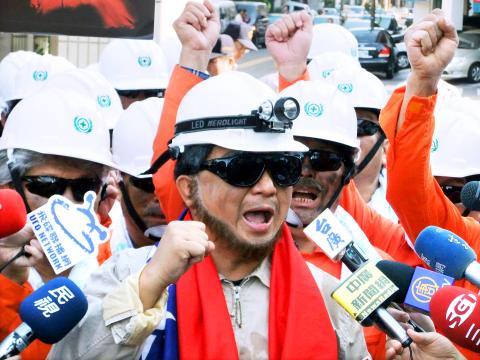
Photo: CNA
Hu’s attire drew objections from Hung Heng-chu (洪恆珠), the wife of his Democratic Progressive Party (DPP) counterpart, Su Jia-chyuan (蘇嘉全), who questioned Hu’s identity because his appearance did not match the pictures on his identification card.
RESPECT
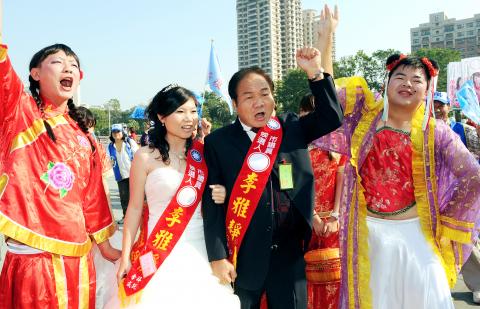
Photo: Chang Chung-yi, Taipei Times
Saying that the drawing should proceed in a serious manner, Su also said Hu lacked respect for the occasion by making such changes to his appearance.
Pointing to Hu’s “miner” helmet, which bore the words “Council of Labor Affairs,” Su also questioned whether there had been a violation of administrative neutrality.
Hu, who dressed up as operatic tenor Luciano Pavarotti in the candidate number drawing for the Taichung mayoral election in 2005, said his Chilean miner look yesterday signified that he would bring residents of Greater Taichung out of difficulties and toward a brighter future.
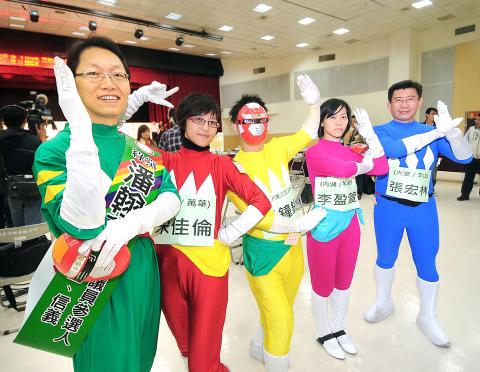
Photo: Fang Pin-chao, Taipei Times
After failing to quell Hung’s doubts, Taichung City Election Commission director Huang Chung-sheng (黃仲生) drew the number on Hu’s behalf.
Hu got No. 2 and Su was No. 1.
In Taipei City, Taipei Mayor and KMT candidate Hau Lung-bin (郝龍斌) attended the lot-drawing event at the Taipei Election Commission and drew No. 2, attracting a wave of cheers from KMT Taipei City councilor candidates, who chanted “Victory for No. 2, Taipei Fly High.”
“Four years ago, I stood here and promised to carry out my campaign platforms and I did. In the next four years, I will also live up to my words ... I devoted my efforts to developing Taipei in the last four years and I call on Taipei residents to give me another four years to work for them,” said Hau, surrounded by party councilors and supporters.
SCUFFLE
Before arriving at the commission, Hau and his campaign team staff were confronted by DPP Taipei City council candidate Tung Chung-yen (童仲彥), who pushed the group causing abrasions to two of Hau’s campaign staff workers.
Hau’s campaign spokesman Fan Chiang Tai-chi (范姜泰基) later accused Tung of violence, and said the camp would not tolerate any forms of violence during the election campaign.
DPP Taipei mayoral candidate Su Tseng-chang (蘇貞昌), meanwhile, yesterday chose to skip the lot-drawing and instead inspected a municipal monument on Xining N Road.
“The lot drawing is nothing but a ritual, and Taipei residents do not care about what number I get. What they care about is who will do better work for the city,” he said.
Staff of the commission office drew the number on Su’s behalf, drawing the No. 5. DPP Taipei City councilors cheered the result, and shouted “victories for five special municipalities,” while KMT Taipei City councilors shouted “Bottom of the race!”
Another three candidates in the Taipei mayoral race were independent Wu Yen-cheng (吳炎成), Hsiao Shu-hua (蕭淑華) and Wu Wu-ming (吳武明), who were No. 1, No. 3 and No. 4 respectively.
In Taipei County, which will be renamed Sinbei City after it is upgraded to a special municipality in December, representatives for the KMT’s Sinbei mayoral candidate Eric Chu (朱立倫) and Tsai Ing-wen (蔡英文) from the DPP drew No. 1 and No. 2 respectively.
Both parties attempted to play up their selection following the ceremony, with an official at Chu’s campaign immediately saying that the No. 1 fit perfectly with the candidate’s most common trademark, one thumb up.
“He had a feeling that [one] would be chosen, as when he talks, he commonly uses the thumbs up sign,” said Chiang Cheng-yan (江政彥), a manager at his campaign office. “We would have been worried if we picked No. 2.”
His campaign team immediately thought up a slogan: “Chu is No. 1, he will definitely win,” a play on the word “definitely,” which in Chinese partly contains the character for “one.”
Sending two of her spokespersons to select her number, Tsai also expressed satisfaction with the result, saying that the No. 2 represented that she was on the “second” stage to victory.
It showed that her campaign was slowly and steadily inching its way forward before Nov. 27, she added.
Both spokespersons Luo Chih-cheng (羅致政) and Cheng Li-chiun (鄭麗君) immediately gave the victory sign following the choice and said it was a good number because not only did it represent success, but also “a doubling of happiness … which is what Tsai aims to give Sinbei City residents.”
“This number will bring Tsai a lot of confidence in this final month,” Cheng said.
In Greater Kaohsiung, KMT Secretary-General King Pu-tsung (金溥聰) and Legislative Speaker Wang Jin-pyng (王金平) accompanied the party’s Kaohsiung -mayoral -candidate Huang Chao-shun (黃昭順) to draw lots. She made a “V” sign hand gesture for victory in the election after drawing No. 2.
Kaohsiung County Commissioner Yang Chiu-hsing (楊秋興), who is running the election as an independent candidate after withdrawing from the DPP in August, got No. 1 in the number drawing, while incumbent Mayor Chen Chu (陳菊) of the DPP got No. 3
In Greater Tainan, the KMT’s Kuo Tien-tsai (郭添財) was No. 1 and the DPP’s William Lai (賴清德) drew No. 2.
Additional reporting by Rich Chang and CNA
WHAT WAS ALL THAT FOR? Jaw Shaw-kong said that Cheng Li-wen had pushed for more drastic cuts and attacked him, just for the outcome to be nearly identical to his bill The legislature yesterday passed a supplementary budget bill to fund the purchase of separate packages of US military equipment, with the combined amount of spending capped at NT$780 billion (US$24.8 billion). The Chinese Nationalist Party (KMT) and Taiwan People’s Party (TPP) used their legislative majority to pass the bill, which runs until 2033 and has two main funding provisions. One was for NT$300 billion of arms sales already approved by the US for Taiwan on Dec. 17 last year, the other was for NT$480 billion for another arms package expected to be announced by Washington. The bill, which fell short of the NT$1.25
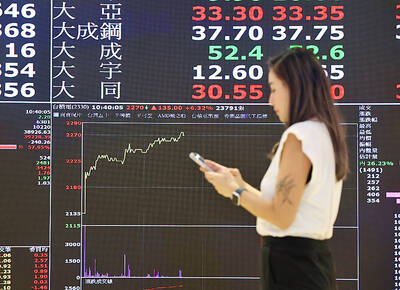
Taiwanese shares yesterday posted a record daily gain of more than 1,700 points to close above 40,000 points for the first time, led by large-cap semiconductor stocks such as Taiwan Semiconductor Manufacturing Co (TSMC, 台積電) and MediaTek Inc (聯發科) amid optimism about the artificial intelligence (AI) boom. The TAIEX ended up 1,778.51 points, or 4.57 percent, at 40,705.14 after moving between 39,228.39 and 40,755.52, while the New Taiwan dollar closed up NT$0.038 at NT$31.610 per US dollar, ending three consecutive sessions of declines. Turnover on the main board totaled NT$1.007 trillion (US$31.9 billion), with foreign institutional investors buying a net NT$66.98 billion
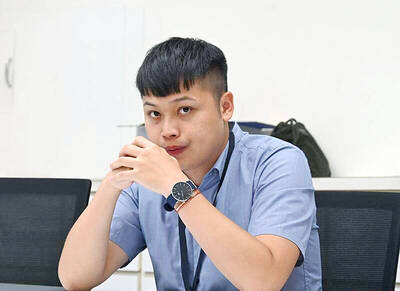
A former television news host and six military personnel — active and retired — have been indicted on espionage charges, Kaohsiung prosecutors said yesterday. Lin Chen-you (林宸佑), a former CTi News host and YouTuber, last year allegedly made videos at the direction of a Chinese agent criticizing the Democratic Progressive Party’s recall campaign, the Ciaotou District Prosecutors’ Office told a news conference in Kaohsiung. He allegedly received 4,325 tether coins for the videos from an unidentified person surnamed Huang (黃), believed to be an agent of a hostile foreign power, they said. Lin, also known as Ma Te (馬德), has a show named
NON-INTERFERENCE: The US called Taiwan a trusted and capable partner, while an African Union leader urged nations to reflect on respect for sovereign choices Taiwan is a “trusted and capable” partner of the US and Taipei’s global relationships, including with Eswatini, provide significant benefits, the US Department of State said of President William Lai’s (賴清德) trip to the southern African kingdom. Lai arrived in the former Swaziland on Saturday on a surprise visit after a planned trip last month was canceled when Seychelles, Mauritius and Madagascar denied overflight permission for his aircraft due to Chinese pressure. “Taiwan is a trusted and capable partner of the United States and many others, and its relationships around the world provide significant benefits to the citizens of those countries,


 RSS
RSS