


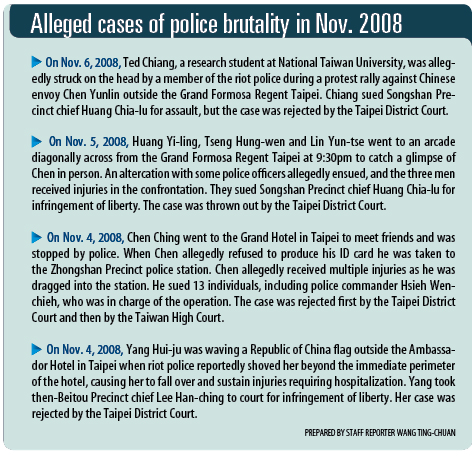
The Taipei High Administrative Court has ruled that a protester who was dragged and beaten by unidentified police officers during demonstrations against Chinese envoy Chen Yunlin (陳雲林) in Taipei in 2008 was eligible to receive national compensation after video evidence revealed that he was unarmed and was facing away from police.
In the first compensation decision over the police response to the protests in November 2008, the court said on Wednesday that the Taipei City Government would have to pay Ted Chiang (江一德), a graduate student at National Taiwan University at the time, NT$300,000 in damages and NT$1,680 in medical costs.
The identity of the officers involved in the act was not revealed in the ruling and the officers have yet to be disciplined amid claims of a cover-up after the incident.
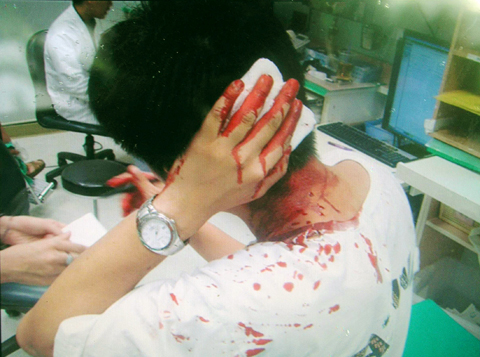
PHOTO: YANG KUO-WEN, TAIPEI TIMES
In its verdict on the precedent-setting case, the court said police officers failed to intervene after the clubbing, even as Chiang lay on the ground bleeding. The ruling added that the Taipei City Government failed to account for public safety and that there was a lack of police discipline.
Chiang told the Taipei Times yesterday he was satisfied with the ruling, adding that “it was never about the money — it was about principle and concern over the conduct of police.”
Chiang, who now works as a marketing manager, said he joined the demonstration after seeing footage on TV of police confiscating the national flag as part of the crackdown on the protests.
Soon after the attack, Chiang filed a lawsuit against the commanding officer at the scene. After he lost the lawsuit, he applied for national compensation from the Taipei City Government.
While Taipei Mayor Hau Lung-bin (郝龍斌) yesterday said the city government would not appeal, opposition lawmakers said they hoped the case would reinvigorate other cases of alleged police brutality currently in court.
“In the past, the court always sided against the public on these issues,” Democratic Progressive Party Legislator Wong Chin-chu (翁金珠) said. “This time, however, the judge stood up for the public interest and protected our constitutionally protected freedom of expression.”
Chiang’s lawyer, Wong Kuo-yan (翁國彥), said he respected the Taipei City Government’s decision not to appeal, but said city authorities would have to “determine clearly which [police officers] were involved in the incident.”
The scuffle took place late on the night of Nov. 6, 2008, after about 2,000 students and activists surrounded and blockaded the Grand Formosa Regent hotel, where Chen was attending a dinner hosted by then-Chinese Nationalist Party (KMT) chairman Wu Poh-hsiung (吳伯雄).
Hundreds of police in full riot gear later descended on the protesters and escorted the Chinese envoy out of the hotel at about 2am, resulting in clashes with the mostly unarmed crowd. The rally was dispersed shortly thereafter, but not before allegations of police brutality surfaced.
“We were shocked at what took place that night,” Chiang said.
Video footage showed that along with several other white-shirted protesters, Chiang was looking away from the police line before he was dragged underneath riot shields and beaten with a club.
“Just as I was getting up again, a blow smashed into the back of my head. My whole body went limp and it felt like I was getting shocked by a taser,” he said.
“I had a serious concussion and for a month every time I closed my eyes, it felt like I was on a rollercoaster ride — everything would spin round and round,” he said, adding that his wound required seven stitches.
The cases of police brutality that surfaced following the sporadic protests held throughout that week prompted 25 civic groups and 218 academics to file a petition with the Control Yuan calling for an investigation into the entire National Police Agency-led crackdown.
Hundreds of university students also took part in sit-ins in front of the Executive Yuan and at Liberty Square days later in protest over the police’s actions.
According to the agency, 27 officers of the about 3,000 deployed were injured during the week of protests.
The government maintains that police action taken during “Operation Concord,” as the crackdown was known, was justified.
Taipei City Police Department Spokesman Chou Shou-sung (周壽松) declined to say whether the force would take action against the officers who injured Chiang.
ADDITIONAL REPORTING BY KO SHU-LING

SILENCING CRITICS: In addition to blocking Taiwan, China aimed to prevent rights activists from speaking out against authoritarian states, a Cabinet department said The Ministry of Foreign Affairs (MOFA) yesterday condemned transnational repression by Beijing after RightsCon, a major digital human rights conference scheduled to be held in Zambia this week, was abruptly canceled due to Chinese pressure over Taiwanese participation. This year’s RightsCon, the world’s largest conference discussing issues “at the intersection of human rights and technology,” was scheduled to take place from tomorrow to Friday in Lusaka, and expected to draw 2,600 in-person attendees from 150 countries, along with 1,100 online participants. However, organizers were forced to cancel the event due to behind-the-scenes pressure from China, the ministry said, expressing its “strongest condemnation”
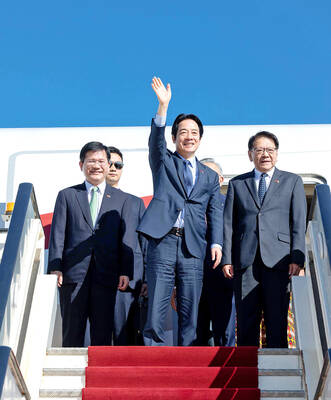
DELAYED BUT DETERMINED: The president’s visit highlights Taiwan’s right to international engagement amid regional pressure from China President Willaim Lai (賴清德) yesterday arrived in Eswatini, more than a week after his planned visit to Taiwan’s sole African ally was suspended because of revoked overflight permits. “The visit, originally scheduled for April 22, was postponed due to unforeseen external factors,” Lai wrote on social media. “After several days of careful arrangements by our diplomatic and national security teams, we successfully arrived today.” Lai said he looked forward to further deepening Taiwan-Eswatini relations through closer cooperation in the economy, agriculture, culture and education, as well as advancing the nation’s international partnerships. The president was initially scheduled to arrive in time to celebrate
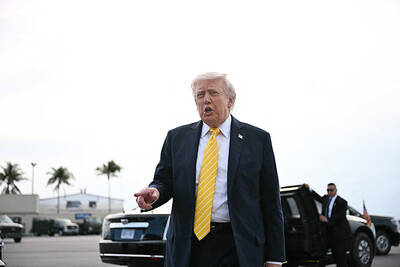
Iran’s Islamic Revolutionary Guard Corp (IRGC) yesterday said the US faced a choice between an “impossible” military operation or a “bad deal” with Tehran, after US President Donald Trump disparaged Iran’s latest peace proposal. Negotiations between the two countries have been deadlocked since a ceasefire came into effect on April 8, with only one round of direct peace talks held so far. Iran’s Tasnim and Fars news agencies reported that Tehran had submitted a 14-point proposal to mediator Pakistan, but Trump was quick to cast doubt on it. “I will soon be reviewing the plan that Iran has just sent to us, but

A group affiliated with indicted Chinese immigrant Xu Chunying (徐春鶯) is to be dissolved for monitoring Chinese immigrants in Taiwan, a source said yesterday. Xu, the secretary-general of the Cross-Strait Marriage and Family Service Alliance, was indicted on March 24 on charges of violating the Anti-Infiltration Act (反滲透法). The alliance “illegally monitored" Chinese immigrants living in Taiwan on behalf of the Chinese Communist Party (CCP) and the Ministry of the Interior is expected to dissolve the organization in the coming days under provisions of the Civil Associations Act (人民團體法), the source said. Xu, who married a Taiwanese in 1993 and became a Republic


 RSS
RSS