


Taipei Mayor Hau Lung-bin (郝龍斌) yesterday said he was willing to be investigated and remove himself from a task force mandated with determining whether corruption was involved in a procurement scandal, and urged the opposition to stop its “political machinations” in the run-up to the November elections.
Hau said that when he promised last week that there would be “no limits” to the investigation, he meant anyone related to the matter would be looked into.
“It of course includes myself,” he said. “If they put me under investigation, I will be happy to leave the task force.”
On Friday, Hau set up a task force — headed by himself — to determine if corruption or bribery was involved in purchase plans for the Xinsheng Overpass and the Taipei International Flora Expo.
Two Democratic Progressive Party (DPP) city councilors last week said the contract price for flowers used to spruce up the overpass was unreasonably high.
The city government failed to clarify the matter and did not take any action until Thursday, when it punished the responsible officials and launched an investigation. The city’s initial probe showed that the civil servants who handled the project were seriously negligent.
Two other DPP city councilors said on Friday that water pipes contracted for the overpass were bought at 10 times the market price.
The latest findings showed that in addition to the flowers and plants for the overpass, the contractor also overcharged on at least seven other purchase plans. As a result, the city government paid up to 12 times the market price for project materials.
DPP city councilors filed a lawsuit against Hau on Thursday, accusing him of negligence.
DPP City Councilor Chuang Ruei-hsiung (莊瑞雄) further raised eyebrows when he alleged on Saturday that the city government became aware of the overpricing when city auditors pointed out the problems in May 2008.
Hau yesterday told city councilors that city auditors found it was “inappropriate” for Join Engineering Consultants (昭凌工程顧問) to set prices by averaging the figures proposed by bidders in six previous failed biddings.
Doing so was “not illegal,” Hau said, but since the matter had caused public concern, he was duty bound to uncover the truth and bear the consequences.
Hau admitted reacting slowly to the allegations and apologized again, saying the matter had undermined the city government’s image and caused public concern.
However, he said that the purchase plans of the flora expo were conducted in a more discrete manner and that so far, only four items out of 1,000 were found to be overpriced.
Hau said he regretted that “somebody” was using the controversy as ammunition ahead of the November elections.
“It’s OK for them to have doubts about me or the city government. It’s OK for me to lose the election, but please don’t let Taiwan miss a chance to shine in the international arena,” he said.
While Join Engineering Consultants had historic ties with the Chinese Nationalist Party (KMT), Yeh Ching-yuan (葉慶元), head of the city’s Law and Regulations Commission, said the bidding process was open and did not favor any particular bidder.
In addition to the the city government probe, the Control Yuan yesterday launched its own investigation into the procurement scandal.
Control Yuan member Yeh Yao-peng (葉耀鵬) told reporters that launching an investigation was necessary because the city government’s handling of the procurement bids was “ridiculous.”
Yeh said Hau could be interviewed, if necessary.
ADDITIONAL REPORTING BY FLORA WANG

‘NO SECURITY RISK’: The Railway Bureau reassured the public that the technicians’ activities were limited to technical guidance and did not involve sensitive systems The Railway Bureau yesterday said it had invited eight Chinese technicians to assist with an airport MRT construction project. The bureau issued the confirmation after an Internet user said Chinese nationals had entered the construction zone of Taiwan Taoyuan International Airport’s Terminal 3 project. They asked why “individuals from an enemy state” were allowed access to such a major national infrastructure project, which raised serious concerns over Taiwan’s industrial safety, sensitive systems and information security. The bureau’s Northern Region Engineering Branch Office said subcontractor Taiwan Handle Industrial Co (台灣手把工業) of the Taoyuan airport MRT’s “Contract No. CU05 Project A14 Station Civil, MEP &

A signaling system malfunction disrupted high-speed rail (HSR) services beginning at 8am today, with trains temporarily reduced to three northbound and three southbound trains per hour as authorities conduct inspections. The malfunction occurred on a section of track in Miaoli County during pre-operation checks early this morning, forcing northbound and southbound trains to use a single track, the HSR operator said. The regular schedule has been replaced with three hourly trains offering only nonreserved seating in each direction, stopping at every station, it said, adding that business class cars would still have reserved seating. Departures from terminal stations are scheduled at the top
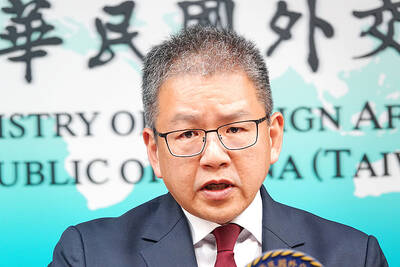
Taiwan is still in the process of assessing the possibility of recruiting workers from Eswatini, the Ministry of Foreign Affairs said yesterday, adding that its goal is to help Eswatini upgrade its vocational training centers. If there are plans to recruit workers from Eswatini, safeguarding national security, protecting public health and ensuring the employment rights of Taiwanese would be prerequisites, Department of West Asian and African Affairs Director-General Yen Chia-liang (顏嘉良) told a news conference. Key considerations would also include filling labor shortages in specific industries, and fostering bilateral professional and technical exchanges, he said. Yen was asked about the progress of labor

A US uncrewed surface vessel (USV) encountered multiple Chinese warships during an autonomous transit of the Taiwan Strait, US defense company Seasats said in a statement on Wednesday. Seasats announced that a Lightfish USV had completed the first autonomous transit of the Taiwan Strait. Over five days, the USV traversed the entire length of the Strait while constantly monitoring surface vessel traffic, the company said. The Lightfish encountered multiple Chinese warships, one of which was a Chinese People’s Liberation Army Navy (PLAN) Type 056 corvette, it said. The Chinese vessels were operating “well within Taiwan’s exclusive economic zone without transmitting their identity via the


 RSS
RSS