


The Taiwan Solidarity Union (TSU) yesterday vowed to continue to push for a referendum on the Economic Cooperation Framework Agreement (ECFA) after the Referendum Review Committee — for the second time — killed its proposal to let the public have a say on the recently signed cross-strait pact.
The committee yesterday rejected the TSU’s proposal in a 10 to two vote, saying the party failed to present a convincing argument.
“We have believed all along that the right to a referendum is a basic right of the people. We won’t give up until this is achieved,” TSU Chairperson Huang Kun-huei (黃昆輝) said following the committee’s decision.
The verdict has also prompted a rare outburst from former president Lee Teng-hui (李登輝), who condemned the decision as undemocratic and accused President Ma Ying-jeou’s (馬英九) administration of interfering with the committee, which is supposed to be non-partisan.
“The democratic spirit that I established for Taiwan during my administration is all but gone,” Lee said. “The Ma government has forgotten about the people’s needs and Taiwan’s sovereignty. If we continue on like this, Taiwan has no future.”
The 87 year-old former president also spoke against the ECFA, saying that a referendum was essential because the trade pact would lead to a “one China” market and subject the country’s future to increasing Chinese control.
“No matter my age, I will still come out to [oppose the pact],” he said over the deal’s potential implications on Taiwan’s sovereignty and democracy.
Democratic Progressive Party (DPP) Chairperson Tsai Ing-wen (蔡英文) also denounced the committee’s decision, calling it another “large set-back for Taiwan’s democracy.”
“We believe that not only will the ECFA impact Taiwan’s income gap, but that it will also touch on this country’s strategic position and future development. It’s an important issue that deserves to be put to a public vote,” she said.
Yesterday’s verdict was the latest in a long line of rejections by the committee, which had previously rejected similar applications by both the DPP and the TSU, all based on alleged contradictions between the question and text of the proposal.
On June 3, the committee voted down the TSU’s application for a referendum on the question: “Do you agree that the government should sign an ECFA with China?”
The TSU made a second proposal with the same question on June 30, a day after Taiwan and China signed the ECFA. That attempt was turned down yesterday.
“A referendum proposed by the people should be in opposition with the government’s policy direction,” Chao Yung-mau (趙永茂), chairman of the committee, told a news conference after a three-and-a-half hour meeting.
“However, with the way the question is asked in the proposed referendum, the government’s current policies would not have to be reversed even if the referendum were passed ... hence, it does not meet the qualification of a referendum as an expression of public approval or disapproval on a major policy as stipulated in the Referendum Act (公民投票法),” Chao said.
Chao said another reason the committee members voted it down was because Huang apparently is opposed to ECFA — according to what he stated as reasons to propose the referendum — however, the question asks whether voters agree with the government’s plan to sign the ECFA.
“This is contradicting and could cause confusion to voters,” Chao said. “The TSU may appeal the decision, or submit a new referendum proposal on the issue if it wishes to do so.”
Executive secretary of the committee Teng Tien-yu (鄧天祐) said eight of the 21 committee members did not take part in the meeting because they had other engagements or were out of the country. The chairman did not cast a vote.
Committee members Chen Miao-fen (陳妙芬) and Kuo Lin-yung (郭林勇), who voted for the referendum, said in a written statement that the proposal met all criteria of a referendum and should not be blocked.
While the TSU has said it would submit another referendum proposal in the coming weeks, it is unclear how long the party, which regards Lee as its spiritual leader, can continue its efforts.
Speaking privately, TSU officials expressed worries on the heavy financial toll the referendum proposals have taken on its annual budget of NT$23 million (US$720,000), mostly acquired through donations as it does not qualify for government subsidies due to its size.
Each proposal that it sends in for review by the committee has to comprise of at least 86,000 petition forms as required by the Referendum Law. If passed by the committee, it would subsequently have to gather a total of 860,000 signatures before its proposal can be put to a nationwide vote.
Currently, the agreement is pending a review by the legislature and is widely expected to be given the go-ahead before the end of the month and becomes valid next year.
Opposition requests for a clause-by-clause vote on the ECFA have so far been rebuffed.
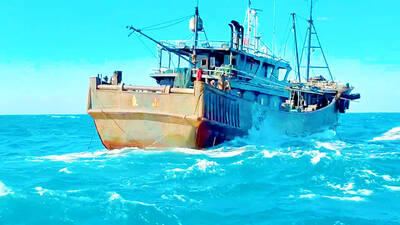
MAKING WAVES: China’s maritime militia could become a nontraditional threat in war, clogging up shipping lanes to prevent US or Japanese intervention, a report said About 1,900 Chinese ships flying flags of convenience and fishing vessels that participated in China’s military exercises around Taiwan last month and in January have been listed for monitoring, Coast Guard Administration (CGA) Deputy Director-General Hsieh Ching-chin (謝慶欽) said yesterday. Following amendments to the Commercial Port Act (商港法) and the Law of Ships (船舶法) last month, the CGA can designate possible berthing areas or deny ports of call for vessels suspected of loitering around areas where undersea cables can be accessed, Oceans Affairs Council Minister Kuan Bi-ling (管碧玲) said. The list of suspected ships, originally 300, had risen to about 1,900 as
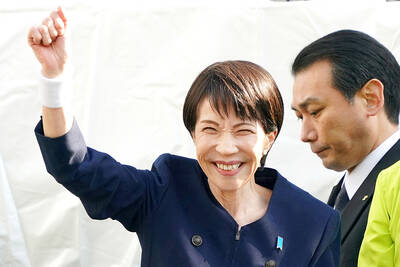
Japan’s strategic alliance with the US would collapse if Tokyo were to turn away from a conflict in Taiwan, Japanese Prime Minister Sanae Takaichi said yesterday, but distanced herself from previous comments that suggested a possible military response in such an event. Takaichi expressed her latest views on a nationally broadcast TV program late on Monday, where an opposition party leader criticized her for igniting tensions with China with the earlier remarks. Ties between Japan and China have sunk to the worst level in years after Takaichi said in November that a hypothetical Chinese attack on Taiwan could bring about a Japanese

Right-wing political scientist Laura Fernandez on Sunday won Costa Rica’s presidential election by a landslide, after promising to crack down on rising violence linked to the cocaine trade. Fernandez’s nearest rival, economist Alvaro Ramos, conceded defeat as results showed the ruling party far exceeding the threshold of 40 percent needed to avoid a runoff. With 94 percent of polling stations counted, the political heir of outgoing Costa Rican President Rodrigo Chaves had captured 48.3 percent of the vote compared with Ramos’ 33.4 percent, the Supreme Electoral Tribunal said. As soon as the first results were announced, members of Fernandez’s Sovereign People’s Party
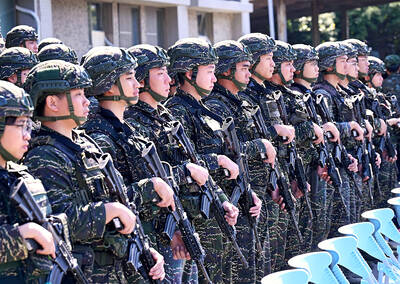
MORE RESPONSIBILITY: Draftees would be expected to fight alongside professional soldiers, likely requiring the transformation of some training brigades into combat units The armed forces are to start incorporating new conscripts into combined arms brigades this year to enhance combat readiness, the Executive Yuan’s latest policy report said. The new policy would affect Taiwanese men entering the military for their compulsory service, which was extended to one year under reforms by then-president Tsai Ing-wen (蔡英文) in 2022. The conscripts would be trained to operate machine guns, uncrewed aerial vehicles, anti-tank guided missile launchers and Stinger air defense systems, the report said, adding that the basic training would be lengthened to eight weeks. After basic training, conscripts would be sorted into infantry battalions that would take


 RSS
RSS