


The government’s reconstruction policy after Typhoon Morakot struck in August last year was a far bigger disaster than the natural calamity because it is leading to the extinction of Aborigines, Lituan Takilulu, convener of the Indigenous Peoples Action Coalition of Taiwan, said yesterday.
“Aborigines will never be able to return home. They are compelled to live in separate places. We are on our way to extinction,” Lituan said at a forum held by the Taiwan Association of University Professors on the eve of the first anniversary of Morakot.
Lituan, a Rukai priest, said Aborigines are not scared of natural disasters, because “disasters are part of the lives of Aborigines,” adding that the most important problem facing Aborigines was that “people are dispersed” and “connections with fellow tribe members are cut off.”
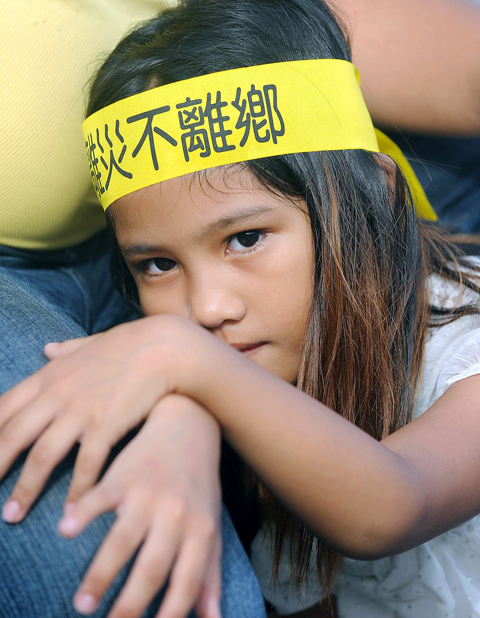
PHOTO: LIAO CHEN-HUEI, TAIPEI TIMES
About 72 percent, or 13,911, of the 19,191 people in 6,316 households were living in areas deemed “unsafe” by the government after it investigated 291 sites in the wake of the catastrophe. Of these, 7,484 people in 2,433 households resettled in permanent houses, while 11,707 in 3,883 households remained at their original place of residence.
Government officials cited statistics to rebut allegations of forced relocation while continuing to reason with Aborigines to move out of their mountain villages, saying that “migration is the best way to avoid the consequences of climate change,” as President Ma Ying-jeou (馬英九) has said.
Lituan said Aboriginal victims were compelled to leave their hometown within one week of the typhoon and asked to decide within a short period whether to resettle in permanent houses.
“More than 80 percent of Aboriginal victims signed up for permanent houses, [but did so] when they had no idea about the conditions in their villages. Some tribe members then found safe places in their villages and wanted to go back, but they were not allowed to,” Lituan said.
There also was no financial support for Aborigines who wished to rebuild their homes in their original villages, he said.
“Some people borrowed money from friends to buy land to resettle,” Lituan said.
The government’s reconstruction policy was to force Aborigines to relocate in permanent houses, which not only made Aborigines leave their lands, but will also compound the breakup of Aborigine families, he said.
If people establish their own families through marriage or other means, they can’t live in the community, where the number of houses are limited, and must move out, becoming separated from their families, Lituan said.
Elan Pavavajung, a Paiwan tribe member who produced a documentary on how Aborigines living in Davalan, Sandimen Township (三地門), Pingtung County, dealt with the disaster, said older Aborigines blamed widespread deforestation and reforestation by the Forestry Bureau and road-widening for the catastrophe.
Also See: Grouper industry mostly recovered after Morakot
Also See: Shelter from the storm

A signaling system malfunction disrupted high-speed rail (HSR) services beginning at 8am today, with trains temporarily reduced to three northbound and three southbound trains per hour as authorities conduct inspections. The malfunction occurred on a section of track in Miaoli County during pre-operation checks early this morning, forcing northbound and southbound trains to use a single track, the HSR operator said. The regular schedule has been replaced with three hourly trains offering only nonreserved seating in each direction, stopping at every station, it said, adding that business class cars would still have reserved seating. Departures from terminal stations are scheduled at the top

Taiwan is still in the process of assessing the possibility of recruiting workers from Eswatini, the Ministry of Foreign Affairs said yesterday, adding that its goal is to help Eswatini upgrade its vocational training centers. If there are plans to recruit workers from Eswatini, safeguarding national security, protecting public health and ensuring the employment rights of Taiwanese would be prerequisites, Department of West Asian and African Affairs Director-General Yen Chia-liang (顏嘉良) told a news conference. Key considerations would also include filling labor shortages in specific industries, and fostering bilateral professional and technical exchanges, he said. Yen was asked about the progress of labor

VERBOSE VESSELS: A CGA cutter and a China Coast Guard exchanged verbal barbs for more than a day in Taiwanese-controlled waters before the Chinese vessel left The Taiwanese and Chinese coast guards had a standoff near the strategically located Pratas Islands (Dongsha Islands, 東沙群島) in the north of the South China Sea, the Coast Guard Administration (CGA) said yesterday. The two sides engaged in intense radio exchanges over sovereignty claims during the 33-hour standoff. China Coast Guard vessel 3501 eventually left the restricted waters, 26.6 nautical miles (49.2km) west of the Pratas Islands, at 5pm yesterday, the CGA said. Lying approximately between southern Taiwan and Hong Kong, the Taiwan-controlled Pratas are seen by some security experts as vulnerable to Chinese attack due to their distance — more than

A US uncrewed surface vessel (USV) encountered multiple Chinese warships during an autonomous transit of the Taiwan Strait, US defense company Seasats said in a statement on Wednesday. Seasats announced that a Lightfish USV had completed the first autonomous transit of the Taiwan Strait. Over five days, the USV traversed the entire length of the Strait while constantly monitoring surface vessel traffic, the company said. The Lightfish encountered multiple Chinese warships, one of which was a Chinese People’s Liberation Army Navy (PLAN) Type 056 corvette, it said. The Chinese vessels were operating “well within Taiwan’s exclusive economic zone without transmitting their identity via the


 RSS
RSS