


South Korean troops fired artillery and dropped sonar buoys into the Yellow Sea as naval drills were launched yesterday near the spot where a warship sank four months ago.
About 4,500 South Korean troops aboard more than 20 ships and submarines, as well as about 50 aircraft, were mobilized to take part in the five days of naval exercises off the west coast, including spots near the two Koreas’ maritime border, the Joint Chiefs of Staff said.
North Korea called the drills a military provocation that threatened to re-ignite war on the Korean Peninsula.
“If the puppet warmongers dare ignite a war, [North Korea] will mercilessly destroy the provokers and their stronghold by mobilizing most powerful war tactics and offensive means beyond imagination,” the ruling Committee for the Peaceful Reunification of the Fatherland said in a statement carried by North Korea's official Korean Central News Agency.
Soldiers aboard the 14,000-tonne ROKS Dokdo, an amphibious landing ship, patrolled the deck as Lynx helicopters dropped sonars into the sea in search of enemy submarines. A 1,200-tonne frigate remained on standby, ready to torpedo the target.
The fleet dispatched for the exercises also include three 1,800-tonne submarines, a 4,500-tonne destroyer and about 50 fighter jets, South Korean Joint Chiefs of Staff Commander Won Hyung-sik said in Seoul.
The drills come just weeks after South Korea's joint military exercises with the US off the east coast — maneuvers held in response to the deadly March sinking of the Cheonan warship, which killed 46 South Korean sailors.
A five-nation team of investigators concluded in May that a North Korean torpedo fired from a submarine sank the 1,200-tonne Cheonan as the warship was carrying out routine surveillance. North Korea has denied sinking the ship.
The waters off the west coast have been the site of several naval clashes between the two Koreas.
The North and South have engaged in three bloody battles near the line, most recently in November last year and the Cheonan went down in March not too far from the border.
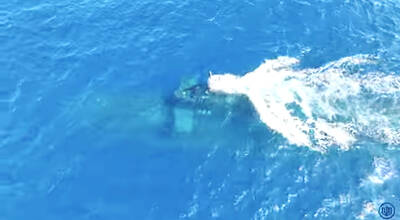
CSBC Corp, Taiwan (台灣國際造船) yesterday released the first video documenting the submerged sea trials of Taiwan’s indigenous defense submarine prototype, the Hai Kun (海鯤), or Narwhal, showing underwater navigation and the launch of countermeasures. The footage shows the vessel’s first dive, steering and control system tests, and the raising and lowering of the periscope and antenna masts. It offered a rare look at the progress in the submarine’s sea acceptance tests. The Hai Kun carried out its first shallow-water diving trial late last month and has since completed four submerged tests, CSBC said. The newly released video compiles images recorded from Jan. 29 to
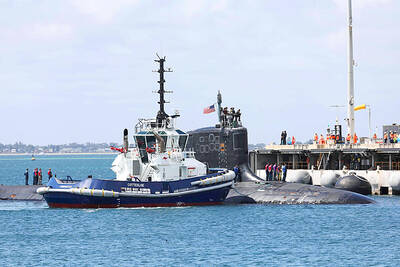
DETERRENCE EFFORTS: Washington and partners hope demonstrations of force would convince Beijing that military action against Taiwan would carry high costs The US is considering using HMAS Stirling in Western Australia as a forward base to strengthen its naval posture in a potential conflict with China, particularly over Taiwan, the Wall Street Journal reported on Saturday. As part of its Indo-Pacific strategy, Washington plans to deploy up to four nuclear-powered submarines at Stirling starting in 2027, providing a base near potential hot spots such as Taiwan and the South China Sea. The move also aims to enhance military integration with Pacific allies under the Australia-UK-US trilateral security partnership, the report said. Currently, US submarines operate from Guam, but the island could
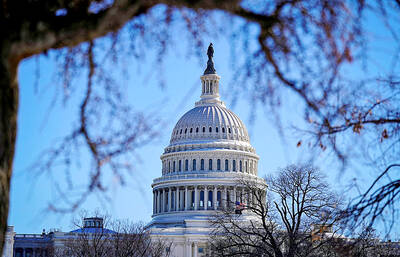
RESTRAINTS: Should China’s actions pose any threat to Taiwan’s security, economic or social systems, China would be excluded from major financial institutions, the bill says The US House of Representatives on Monday passed the PROTECT Taiwan Act, which states that Washington would exclude China from participating in major global financial organizations if its actions directly threaten Taiwan’s security. The bill, proposed by Republican Representative Frank Lucas, passed with 395 votes in favor and two against. It stipulates that if China’s actions pose any threat to Taiwan’s security, economic or social systems, the US would, “to the maximum extent practicable,” exclude Beijing from international financial institutions, including the G20, the Bank for International Settlements and the Financial Stability Board. The bill makes it clear that China must be prepared

Taiwanese trade negotiators told Washington that Taipei would not relocate 40 percent of its semiconductor production to the US, and that its most advanced technologies would remain in the nation, Vice Premier Cheng Li-chiun (鄭麗君) said on Sunday. “I told the US side very clearly — that’s impossible,” Cheng, who led the negotiation team, said in an interview that aired on Sunday night on Chinese Television System. Cheng was referring to remarks last month by US Secretary of Commerce Howard Lutnick, in which he said his goal was to bring 40 percent of Taiwan’s chip supply chain to the US Taiwan’s almost


 RSS
RSS