


A Chinese dissident seeking refuge in Taiwan accused President Ma Ying-jeou (馬英九) of failing to speak up for human rights in China and said he feared he could face a lengthy prison sentence, or worse, if deported back home.
Cai Lujun (蔡陸軍), a 53 year-old former businessman who escaped China disguised as a fisherman almost three years ago, spent more than three years behind bars in a Chinese prison after he posted a series of online articles criticizing Beijing’s leadership and blasting the Chinese Communist Party for what he called “holding fake elections.”
“After being released, I was constantly harassed and placed under surveillance by the authorities. I was hassled wherever I moved, but I could not leave the country,” he said.
In 2007, as a result of what he calls a spur of the moment decision, Cai left Hubei Province and decided that he would try and move to Taiwan, a country he felt respected human rights and the rule of law.
He arrived in Yilan County in July that year on a Chinese fishing boat, using a borrowed fisherman’s license with his own photo.
A week later, he applied for political asylum after Taiwanese human rights activists agreed to review his case. He said he was then moved to a holding center and issued papers allowing him entry into Taiwan.
“The government had two choices; they could either accept my request for political asylum and allow me to stay in Taiwan or send me back to China,” Cai said.
They did neither.
An official familiar with the case who wished to remain anonymous told the Taipei Times that Cai’s case was in administrative limbo.
Cai has been unable to work, file taxes or do anything that requires Republic of China (ROC) citizenship because the government has refused to issue him any sort of identification. He receives a monthly stipend of NT$20,000 from the immigration authorities for basic expenses.
However, the National Immigration Agency (NIA) has also ruled out sending him back to China.
“We want to help him … but there is no proper procedure for dealing with a case like his,” an NIA official said.
The agency said Cai’s case for political asylum was rejected after a tribunal found that his arrival did not meet Article 17 of the Act Governing Relations Between The People Of The Taiwan Area And The Mainland Area (臺灣地區與大陸地區人民關係條例). That article deals with Chinese that come to Taiwan without authorization.
While the government is unwilling to deport Cai, it is also unable to provide him with the papers he needs to work, the official said, adding that the agency was now waiting for lawmakers to revise the law to standardize procedures.
Another NIA official who also spoke on condition of anonymity said a major factor in the ruling was Cai’s use of a fake fisherman’s license, a charge that makes Cai shake his head in disbelief.
“If I had the proper documents to come into Taiwan, I wouldn’t be applying for political asylum,” he said.
Cai adds that his experience in dealing with the immigration agency has dampened his initial enthusiasm for Taiwan.
“I know how they think: They all discriminate against people from China. I think they are all real bastards and I want nothing to do with them anymore,” he said.
NIA officials deny the charges.
The agency released a statement yesterday saying that it was working with the Mainland Affairs Council to get legislators to revise Article 17 to loosen the entry requirements for unauthorized Chinese citizens such as Cai.
Cai would be allowed to stay in Taiwan but would continue to see restrictions placed on his rights, the statement said.
Cai said that based on his reading of the relevant laws, he is an ROC citizen, albeit from the mainland area and that he believes in the protections of the ROC Constitution.
His case has been looked into with interest by Democratic Progressive Party (DPP) legislators.
Speaking at the legislature yesterday, DPP Legislator Tien Chiu-chin (田秋堇) said Cai’s case was an important indicator of Taiwan’s human rights situation.
Last week, aided by a number of other political refugees from China, Cai launched an appeal, challenging the decision to deny him political asylum. The case is expected to be heard by the Taipei High Administration Court in the coming months.
While Cai said he believed he had a strong case, there are concerns that any decision could ultimately be affected by political factors beyond his control.
“I can understand that … the Chinese Nationalist Party [KMT] doesn’t want to provoke [China],” Cai said. “But Taiwan cannot keep looking to see China’s attitude before it makes its decisions and throw human rights and democracy out of the window.”
Cai criticized President Ma Ying-jeou (馬英九) for not being firmer in support of human rights and democracy in China. He said it was regrettable that the government had toned down its criticism of the Tiananmen Square Massacre during the recent anniversary.
Nevertheless, he refuses to make any plans to return to China, saying that despite its rapid economic transformation, the situation in terms of freedom of speech and democracy had yet to improve.
“Every day, dissidents are rounded up and detained. Although there are more high-rise buildings, I don’t think that we can call this progress,” Cai said.
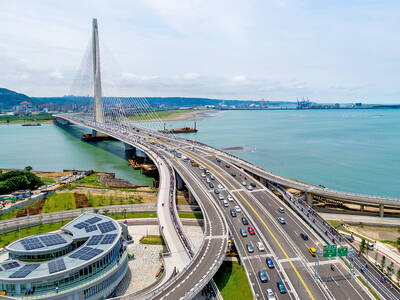
The Ministry of Transportation and Communications yesterday inaugurated the Danjiang Bridge across the Tamsui River in New Taipei City, saying that the structure would be an architectural icon and traffic artery for Taiwan. Feted as a major engineering achievement, the Danjiang Bridge is 920m long, 211m tall at the top of its pylon, and is the longest single-pylon asymmetric cable-stayed bridge in the world, the government’s Web site for the structure said. It was designed by late Iraqi-British architect Zaha Hadid. The structure, with a maximum deck of 70m, accommodates road and light rail traffic, and affords a 200m navigation channel for boats,

Taiwan Semiconductor Manufacturing Co (TSMC, 台積電), the world’s largest foundry service provider, yesterday said that global semiconductor revenue is projected to hit US$1.5 trillion in 2030, after the figure exceeds US$1 trillion this year, as artificial intelligence (AI) demand boosts consumption of token and compute power. “We are still at the beginning of the AI revolution, but we already see a significant impact across the whole semiconductor ecosystem,” TSMC deputy cochief operating officer Kevin Zhang (張曉強) said at the company’s annual technology symposium in Hsinchu City. “It is fair to say that in the past decade, smartphones and other mobile devices were
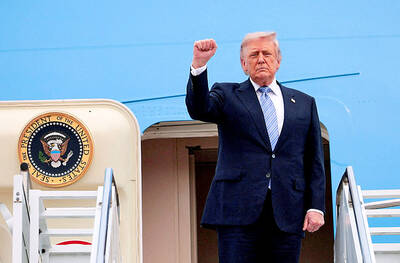
US-CHINA SUMMIT: MOFA welcomed US reassurance of no change in its Taiwan policy; Trump said he did not comment when Xi talked of opposing independence US President Donald Trump yesterday said he has not made a decision on whether to move forward with a major arms package for Taiwan after hearing concerns about it from Chinese President Xi Jinping (習近平). Trump’s comments on Taiwan came as he flew back to Washington after wrapping up critical talks in which both leaders said important progress was made in stabilizing US-China relations even as deep differences persist between the world’s two biggest powers on Iran and Taiwan. “I will make a determination,” Trump said, adding: “I’ll be making decisions. But, you know, I think the last thing we need right

TAIWAN ISSUE: US treasury secretary Scott Bessent said on the first day of meetings that ‘it wouldn’t be a US-China summit without the Taiwan issue coming up’ There were no surprises on the first day of the summit between US President Donald Trump and Chinese President Xi Jinping (習近平), the Mainland Affairs Council (MAC) said yesterday, as the government reiterated that cross-strait stability is crucial to the Asia-Pacific region, as well as the world. As the two presidents met for a highly anticipated summit yesterday, Chinese state media reported that Xi warned Trump that missteps regarding Taiwan could push their two countries into “conflict.” Trump arrived in China with accolades for his host, calling Xi a “great leader” and “friend,” and extending an invitation to visit the White House


 RSS
RSS