


The Presidential Office yesterday dismissed comments by Tibetan spiritual leader the Dalai Lama, who said the Chinese Nationalist (KMT) administration appeared to be “aimless.”
Presidential Office Spokesman Lo Chih-chiang (羅智強) said the direction of the administration was clear.
“Our policy is Taiwan is always the focus and the people’s interest comes first,” he said.
The Dalai Lama told the Liberty Times (the Taipei Times’ sister paper) during an interview with Chinese-language reporters in Japan on Sunday that he did not know where the Taiwanese government was heading.
The spiritual leader made the comment after being asked if he would visit Taiwan again.
The Dalai Lama said his visit to Taiwan last year seemed to create trouble for the administration of President Ma Ying-jeou (馬英九). He said some Taiwanese media had produced negative reports about him at first, but that the coverage turned positive after they learned more about the nature of his trip.
He said that when he met former KMT chairman Lien Chan (連戰) in 1997, he told Lien he was not against the Chinese Communist Party (CCP). Lien, however, told him that his party was.
“What about now?” the Dalai Lama asked, adding that he was confused about the direction the KMT administration was adopting.
Meanwhile, the Presidential Office declined to criticize former president Lee Teng-hui (李登輝), who on Saturday called on the public to reject Ma in the 2012 presidential election. Instead, it said that Ma’s cross-strait policy had taken a Taiwan-centered approach while protecting public interests.
“The public will judge whether former president Lee is bigoted,” Lo said.
Lo said many business groups and economic strategists in Taiwan and abroad recognized that the economic cooperation framework agreement (ECFA) the administration is expected to sign with Beijing today had more advantages than disadvantages.
On Saturday, Lee also said Ma was “not qualified to be the president of Taiwan” because he was bending over backward to cooperate with Beijing’s plans to annex Taiwan. He said Ma’s policies put Taiwan in an unfavorable position and urged the public to strongly oppose what he called the administration’s “erroneous” policies.
Democratic Progressive Party (DPP) lawmakers rallied behind Lee yesterday.
DPP legislators told a press conference that the former president’s comments were an accurate reflection of much of the public’s opposition to the controversial agreement.
“For Lee to say that the DPP should win all five municipalities [due for election in November] and call on the public to boot Ma out the sake of Taiwan shows just how angry and worried he is [about the ECFA],” DPP Legislator Wong Chin-chu (翁金珠) said. “Lee sees that from an overall economic perspective, an ECFA will cause Taiwan irreversible harm and danger. This is why he called on the public to boycott the Ma administration.”
DPP spokesperson Tsai Chi-chang (蔡其昌) said that both Lee and DPP Chairperson Tsai Ing-wen (蔡英文) agreed that the only weapon left for the public to keep the government honest in its push to sign an ECFA with China was through their votes.

PROVOCATIVE: Chinese Deputy Ambassador to the UN Sun Lei accused Japan of sending military vessels to deliberately provoke tensions in the Taiwan Strait China denounced remarks by Japan and the EU about the South China Sea at a UN Security Council meeting on Monday, and accused Tokyo of provocative behavior in the Taiwan Strait and planning military expansion. Ayano Kunimitsu, a Japanese vice foreign minister, told the Council meeting on maritime security that Tokyo was seriously concerned about the situation in the East China and South China seas, and reiterated Japan’s opposition to any attempt to change the “status quo” by force, and obstruction of freedom of navigation and overflight. Stavros Lambrinidis, head of the EU delegation to the UN, also highlighted South China Sea
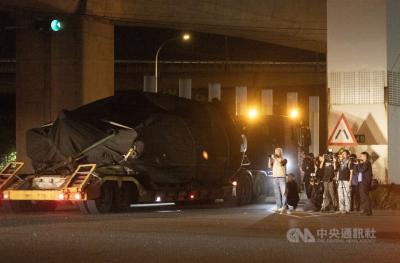
The final batch of 28 M1A2T Abrams tanks purchased from the US arrived at Taipei Port last night and were transported to the Armor Training Command in Hsinchu County’s Hukou Township (湖口), completing the military’s multi-year procurement of 108 of the tanks. Starting at 12:10am today, reporters observed more than a dozen civilian flatbed trailers departing from Taipei Port, each carrying an M1A2T tank covered with black waterproof tarps. Escorted by military vehicles, the convoy traveled via the West Coast Expressway to the Armor Training Command, with police implementing traffic control. The army operates about 1,000 tanks, including CM-11 Brave Tiger
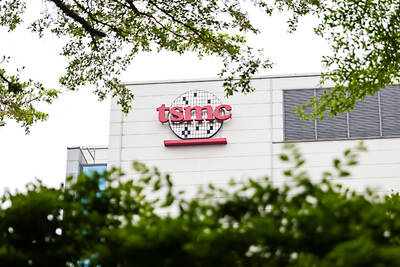
Taiwan Semiconductor Manufacturing Co (TSMC, 台積電), the world’s largest contract chipmaker, said it expects its 2-nanometer (2nm) chip capacity to grow at a compound annual rate of 70 percent from this year to 2028. The projection comes as five fabs begin volume production of 2-nanometer chips this year — two in Hsinchu and three in Kaohsiung — TSMC senior vice president and deputy cochief operating officer Cliff Hou (侯永清) said at the company’s annual technology symposium in Silicon Valley, California, last week. Output in the first year of 2-nanometer production, which began in the fourth quarter of last year, is expected to
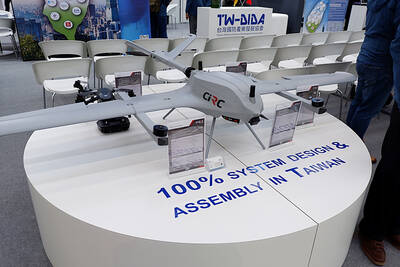
Taiwan’s drone exports surged past US$100 million in the first quarter, exceeding last year’s full-year total, with the Czech Republic emerging as the largest buyer, the Ministry of Economic Affairs said. Exports of complete drones reached US$115.85 million in the period, about 1.2 times the total recorded for all of last year, the ministry said in a report. Exports to the Czech Republic accounted for about US$100 million, far outpacing other markets. Poland, last year’s top destination, recorded about US$11.75 million in the first quarter. Taiwan’s drone exports have expanded rapidly in the past few years, with last year’s total


 RSS
RSS